
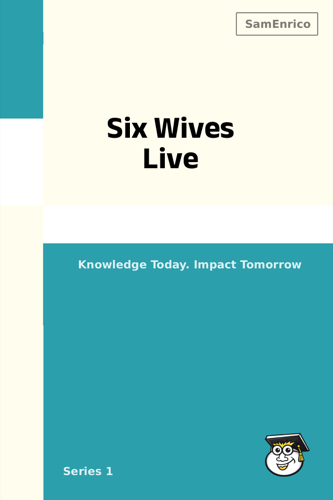
Non-FictionBiographyGirl Group
Six Wives Live eBook
Reveals the pop concert format and the six actress
by Thorne Joya
Reveals the pop concert format and the six actresses playing Henry VIII's queens.
Formats
Free sample
Chapter 1: Beyond the Rhyme...--The rhyme arrives before the history. Every schoolchild learns it, recites it on playgrounds, whispers it in exam hallways: Divorced, beheaded, died. Divorced, beheaded, survived. Six words. Six commas.
Six women reduced to six verbs. It is efficient, memorable, and utterly devastating—not because it is false, but because it is incomplete.Catherine of Aragon was not merely "divorced." She was a Spanish infanta who landed on English shores at sixteen, who rode south in armor to rally troops against the Scots while Henry was in France, who spent seven years of her life fighting an annulment that would redefine the relationship between church and state. Anne Boleyn was not merely "beheaded." She was a radical Evangelical intellectual who smuggled banned texts into England, who transformed the English court into a salon of religious reform, whose daughter would become one of the most powerful monarchs in Western history. Jane Seymour was not merely "died." She was the quiet survivor of a brutal household, the daughter of knights who understood that in the Tudor court, silence was often the only weapon. Anna of Cleves was not merely "divorced." She was a German noblewoman who turned a humiliating rejection into a life of wealth, independence, and genuine friendship with the man who had cast her aside.
Katherine Howard was not merely "beheaded." She was a teenager, possibly fifteen years old, groomed by the men around her from childhood, executed not for adultery but for the crime of being young and vulnerable in a palace full of wolves. Catherine Parr was not merely "survived." She was the first woman to publish a book in English under her own name, a scholar who out-argued the king on theology and lived to tell the tale.The rhyme is not wrong. It is just insufficient. And for nearly five hundred years, insufficiency was the best these women could hope for.Until six women in rhinestone-studded costumes took a stage at the Edinburgh Fringe Festival and rewrote everything.The Problem with the Mnemonic The "divorced, beheaded, died" rhyme appears in English common culture as early as the sixteenth century, though its exact origins remain murky. What is clear is that it served a purpose: it helped a population that was largely illiterate remember the fates of the six women who had briefly sat beside their volatile king.
In an era before Wikipedia, before biographies, before mass literacy, a rhyme was a form of information storage. It was useful. It was functional. It was also a cage.Consider what the rhyme leaves out. It does not tell you that Catherine of Aragon was married to Henry for twenty-four years—longer than the other five combined.
It does not tell you that Anne Boleyn was the mother of Elizabeth I, whose reign defined the English Renaissance. It does not tell you that Jane Seymour gave Henry the son he had destroyed two marriages to obtain, or that she died of puerperal fever twelve days later, her body ravaged by an infection that antibiotics would have cured three centuries on. It does not tell you that Anna of Cleves outlived Henry by ten years, dying peacefully in her English mansion, richer than almost any woman in the realm. It does not tell you that Katherine Howard was likely a child, or that Catherine Parr buried Henry and married again for love.The rhyme does not tell you any of this because the rhyme was never designed to tell you anything except fate. Fate is simple.
Fate is easy. Fate is what happens to women when men write the histories.The feminist historian Gerda Lerner once observed that women's history is not a supplement to conventional history but a fundamental revision of it. The rhyme is conventional history: a man's actions (divorcing, beheading, suffering death, divorcing, beheading, surviving as a widower) described through the passive fates of the women he encountered. The rhyme is about Henry, not about his wives. It is a record of his choices, his appetites, his frustrations.
The women are merely the objects upon which those appetites acted.The musical Six performs a radical inversion. It takes the rhyme—the same six words, the same six commas—and it hands the microphone to the women. The opening number, "Ex-Wives," begins with the rhyme, but it does not end there. "Divorced, beheaded, died," the queens sing, and then they keep singing: "And then there was a little bit of fuss." The rhyme becomes the chorus, not the whole song. The women become the subjects of their own verbs.
They are no longer divorced, beheaded, or died upon; they are divorcing, beheading, and dying as choices they narrate.This is not a rejection of history. It is a remix.The Historians' War: Fraser vs. Weir To understand the remix, one must first understand the source material. The modern study of Henry VIII's wives begins in earnest in the late twentieth century, when two historians published books that would define the field for decades to come. Antonia Fraser's The Six Wives of Henry VIII (1992) and Alison Weir's The Six Wives of Henry VIII (1991) arrived within a year of each other, and despite their identical titles, they could not be more different.Fraser, a literary aristocrat with a taste for narrative drama, approached the wives as tragic figures caught in the gears of a monstrous machine.
Her Henry is a tyrant, her court a snake pit, her wives victims of circumstance and royal caprice. "Each of them came to the marriage with hopes, with fears, with personality," Fraser writes in her introduction, "and each of them was destroyed by it." For Fraser, the tragedy of the six wives is that they had no real power; they could only survive, or fail to survive, the king's whims.Weir, a meticulous archival researcher, had a different thesis. "These were not passive victims," she wrote in the preface to her second edition. "These were political actors who made calculated choices, sometimes wisely, sometimes catastrophically, but always within a system they understood." Weir's Henry is still dangerous, but her wives are not merely his prey. Catherine of Aragon chose to fight the annulment knowing it would cost her everything; Anne Boleyn chose to accept the king's pursuit knowing it would elevate her family; Catherine Parr chose to remarry after Henry's death knowing she was risking her reputation.
Agency and victimhood, for Weir, are not opposites but companions.Toby Marlow and Lucy Moss, the Cambridge students who wrote Six, kept Fraser's book in their writing room. They did not keep it because they agreed with her thesis. They kept it because Fraser is a brilliant storyteller, and Six is, above all, a story. But the musical's actual relationship to historical scholarship is more complicated than simple endorsement or rejection. Six takes Fraser's empathy—her insistence that these women suffered—and Weir's agency—her insistence that these women chose—and synthesizes them into something neither historian quite anticipated: a pop concert where the women sing about their suffering and their choices simultaneously, without resolving the tension between the two.This is the remix.
The historians provided the sample; Marlow and Moss wrote the beat.The Structure of Silence: What the Books Don't Say There…
This is the end of the free sample. Get the eBook to keep going. Buy now
About this book
Details
- Author
- Thorne Joya
- Publisher
- SamEnrico
- Language
- English
- Genre
- Non-Fiction, Biography, Girl Group
- Released
- 2026-06-07
- Pages (approx.)
- 125
- Available as
- eBook, Audiobook

Read better in the ZLOADR app
Your eBooks on your phone or tablet. Sign in with your SamEnrico account and start reading.
More by Thorne Joya
 Thunberg Plastic Pollution CrusadeThorne Joya$11.99
 Mansa Musa Pilgrimage WealthThorne Joya$11.99
 Security Guard LayoffThorne Joya$11.99
 The Parenting Difficult TalkThorne Joya$11.99
 Self Esteem for Social WorkersThorne Joya$11.99
 Gratitude for VeteransThorne Joya$11.99
 Creative Confidence for ArchitectsThorne Joya$11.99
 The Pink Panther Heist: The Unbelievable True Story of the 1993 Tokyo Diamond CaperThorne Joya$11.99
 The Ghosts of Monte Cassino: The Unbreakable Monks and the Mountain of BloodThorne Joya$11.99
 How to Become a Hair WorkerThorne Joya$11.99
 How to Produce Other Packaging MaterialsThorne Joya$11.99
 How to Produce Compost AeratorsThorne Joya$11.99
You may also like
 Hong Kong Handover 1997Dunn Johnnie$11.99
 Zumba For Postnatal Recovery CourseNeal Christian$11.99
 Zumba for BeginnersLadner Nikia$11.99
 YouTube Comment Mining GuideHumes Pandora$12.99
 Worry Box MeditationCarlin Rudy$11.99
 Workplace Stress MeditationNguyen Lynn$11.99
 Workplace Stress and Sleep RepairHawley Ivory$11.99
 Workplace Perfectionism CureDelaney Jeffry$11.99
 Workplace Injustice Anger GuideWallen Isabelle$11.99
 Work Addiction and Burnout LinkGreenwood Ester$11.99
 Women in Yoga and WellnessBeattie Galina$11.99
 Women in Stand Up ComedyChun Evangeline$11.99