
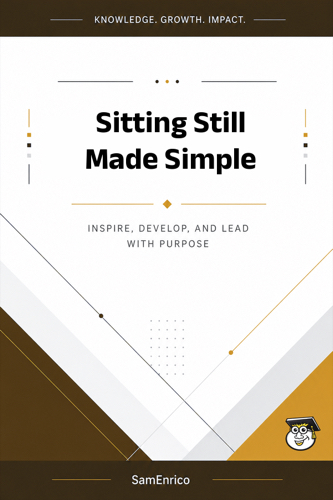
Sitting Still Made Simple eBook
Find a comfortable seated posture and begin observ
by Gough Misha
Find a comfortable seated posture and begin observing your thoughts without judgment.
Formats
Free sample
Chapter 1: The Posture Paradox...--Most people believe that meditation requires a straight spine, crossed legs, and a level of discomfort that proves you are “doing it right.” They have seen the images—serene figures in perfect lotus position, backs as straight as a ruler, faces blank with concentration. And when they try to imitate that posture on their own living room floor, something predictable happens. Their back aches. Their knees complain. Their mind, far from becoming peaceful, starts a running commentary: “This is uncomfortable.
I’m not flexible enough. Maybe meditation isn’t for me.”Here is the truth that no one tells you: that discomfort is not a sign of progress. It is a sign that your posture is working against you.The posture paradox is simple and, once understood, liberating. Comfort leads to focus. Discomfort leads to distraction.
A body that is fighting against gravity, strain, or pain will dominate your attention entirely. You will not be observing your thoughts. You will be observing your screaming lower back. And then you will be observing your judgment about your screaming lower back. And then you will quit.This chapter dismantles the myth of the “perfect” meditation posture and replaces it with something far more practical: a sustainable, comfortable, alert position that works for your body, exactly as it is right now.
Whether you are twenty or seventy, flexible or stiff, sitting on a chair or a cushion, you can find a posture that supports rather than sabotages your practice. The goal is not to look like a meditation expert. The goal is to forget your body entirely so that you can attend to your mind.Let us begin by unlearning everything you thought you knew about how to sit.The Myth of the Perfect Lotus The lotus position—feet placed on opposite thighs, knees on the ground, spine stacked like a tower of coins—has become the visual shorthand for meditation. It appears on book covers, app icons, and yoga studio posters. It suggests that serious meditators sit a certain way, and that anyone who cannot achieve that position is somehow less advanced, less committed, or less capable.This is nonsense.The lotus position originated in ancient yogic traditions that spent years preparing the body through stretching, strengthening, and specific physical disciplines.
It was never intended as a starting point for beginners. It was an advanced posture for people who had already developed extraordinary hip flexibility and spinal awareness. Using it as the default image of meditation is like using a photograph of an Olympic weightlifter as the default image of exercise. Technically accurate for a tiny fraction of practitioners. Completely misleading for everyone else.Worse, attempting lotus without proper preparation can injure your knees.
The knee joint is not designed for the external rotation that lotus demands. Force yourself into it, and you risk ligament strain or meniscus tears—injuries that can take months to heal. No meditation practice is worth that.So let us retire the lotus position from your mental image of “doing it right.” You do not need it. You never did.What Your Body Actually Needs to Sit Still Before we talk about specific postures, let us talk about principles. Your body has three basic requirements for sitting still meditation.
Meet these three requirements, and you can meditate in almost any position. Fail to meet any of them, and your body will constantly interrupt your mind.The first requirement is stability. Your body should not feel like it is working to stay upright. If you are constantly engaging muscles to prevent yourself from tipping over, those muscles will fatigue, and that fatigue will become the center of your awareness. Stability means your skeleton, not your muscles, is doing most of the work of holding you up.
When you find a stable position, you should feel as though you could relax your muscles completely and still remain in place. Test this gently—do not actually collapse—but notice whether your posture requires constant correction.The second requirement is alertness without strain. You need to be awake enough to observe your thoughts, but not so tense that your shoulders are crawling toward your ears. The ideal posture is sometimes called “dignified relaxation.” Imagine a string pulling gently upward from the crown of your head, lengthening your spine, but without any gripping or hardening. Your jaw should be soft.
Your throat should be open. Your shoulders should sit back and down, not hunched forward or pulled back militarily.The third requirement is sustainability. A posture that feels fine for thirty seconds but unbearable after three minutes is not a posture you can use. When you test a new sitting position, stay in it for at least five minutes before deciding. Many people shift immediately upon feeling any sensation, assuming that sensation equals pain.
But your body often needs a minute or two to settle into a new position. What feels strange at first may feel perfectly comfortable by minute three. Conversely, what feels fine at first may reveal hidden strain by minute five. Give each posture a fair trial.These three requirements—stability, alertness without strain, sustainability—are the only rules that matter. How you meet them depends entirely on your unique body.Your Sitting Options: A Practical Guide Most people have four realistic options for a meditation seat.
Each has advantages and disadvantages. Each works better for some bodies than others. The correct choice is the one that allows you to meet the three requirements above with the least amount of effort.Option One: A Chair A chair is the most underrated meditation seat. It is accessible, adjustable, and familiar. It requires no special equipment or flexibility.
And despite what some meditation traditionalists might suggest, sitting on a chair does not make you “less than.”The ideal meditation chair has a firm, flat seat. Avoid soft armchairs or couches that swallow your hips—these tend to tilt your pelvis backward, rounding your spine and encouraging drowsiness. A dining chair, desk chair, or folding chair works perfectly. Sit toward the front edge of the seat rather than leaning back. Your feet should rest flat on the floor.
If they do not reach, place a book, folded blanket, or yoga block under them. Unsupported dangling feet create tension in your hamstrings and lower back.Your knees should be roughly level with your hips or slightly lower. If your knees are higher than your hips, raise your seat with a cushion. If your chair is too tall and your knees drop below hip level, lower the chair or raise your feet. The angle of your hips influences the natural curve of your lower spine.
Experiment with small adjustments.Place your hands on your thighs, palms facing down or up according to preference. There is no “correct” orientation. Palms down can feel more grounding. Palms up can feel more receptive. Try both and see which allows you to forget your hands more completely.Option Two: A Meditation Cushion (Zafu)A meditation cushion, traditionally called a zafu, lifts your hips above your knees when sitting on the floor.
This pelvic tilt creates a natural curve in your lower back, allowing your spine to stack vertically without muscular effort.…
This is the end of the free sample. Get the eBook to keep going. Buy now
About this book
Details
- Author
- Gough Misha
- Publisher
- SamEnrico
- Language
- English
- Genre
- Non-Fiction, Self-Help
- Released
- 2026-06-07
- Pages (approx.)
- 136
- Available as
- eBook, Audiobook

Read better in the ZLOADR app
Your eBooks on your phone or tablet. Sign in with your SamEnrico account and start reading.
More by Gough Misha
 Values And Mission Alignment Remote Teams GuideGough Misha$11.99
 Morning Dream Recall GuideGough Misha$11.99
 Food Addiction and ADHD ConnectionGough Misha$11.99
 Pinterest VA Client Offboarding GuideGough Misha$11.99
 The Last Flight of the Concorde: Supersonic Dreams and the End of an EraGough Misha$11.99
 The Bone Whisperers of the Nile: Unraveling Egypt's Lost IdentitiesGough Misha$11.99
 Understanding Complement Component 2 DeficiencyGough Misha$17.99
 Glauconite MiningGough Misha$11.99
 Pre Seed Data Room SetupGough Misha$12.99
 Medical School Country GuideGough Misha$12.99
 A Beginners Guide to Attack! (Volume 1)Gough Misha$11.99
You may also like
 Hong Kong Handover 1997Dunn Johnnie$11.99
 Zumba For Postnatal Recovery CourseNeal Christian$11.99
 Zumba for BeginnersLadner Nikia$11.99
 YouTube Comment Mining GuideHumes Pandora$12.99
 Worry Box MeditationCarlin Rudy$11.99
 Workplace Stress MeditationNguyen Lynn$11.99
 Workplace Stress and Sleep RepairHawley Ivory$11.99
 Workplace Perfectionism CureDelaney Jeffry$11.99
 Workplace Injustice Anger GuideWallen Isabelle$11.99
 Work Addiction and Burnout LinkGreenwood Ester$11.99
 Women in Yoga and WellnessBeattie Galina$11.99
 Women in Stand Up ComedyChun Evangeline$11.99