
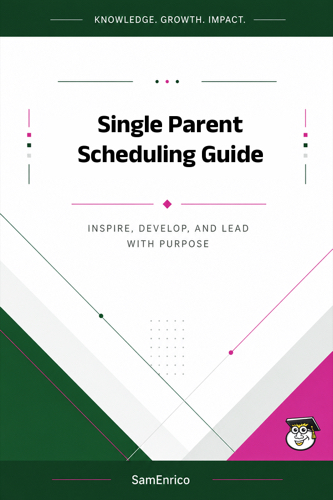
Single Parent Scheduling Guide eBook
Time management for solo caregivers.
Time management for solo caregivers.
Formats
Free sample
Chapter 1: The Hidden Truth...--Most time management books assume you have a partner. Not a romantic partner necessarily—though that’s common—but a functional partner. Someone who can pick up the kids when you’re stuck in traffic. Someone who remembers to sign the permission slip you forgot existed. Someone who notices that the youngest has been coughing for three days and maybe it’s time to call the pediatrician.The authors of those books don’t say this out loud, of course.
They write about “priority matrices” and “deep work blocks” and “optimizing your morning routine” as if these tools exist in a vacuum. But they don’t. They exist in a world where someone else is handling the invisible work while you focus on your color-coded planner.This book exists because that world is not your world.You are a solo caregiver. Whether by divorce, death, choice, deployment, or circumstance, you are the only adult in your household responsible for the physical, emotional, financial, and logistical well-being of your children. There is no one to hand the baton to when you’re exhausted.
There is no one to say, “I’ll handle dinner tonight; you rest.” There is no backup.And yet, you have likely been reading the same productivity advice as everyone else. You have tried the apps. You have tried waking up earlier. You have tried batch cooking on Sundays and time-blocking your calendar and “just saying no” to more commitments. And somehow, despite all of that effort, you still feel like you’re drowning.That is not because you are failing.
It is because the advice was never written for you.This chapter will name what has been invisible: the unique burden of solo parenting that standard time management ignores. It will introduce you to the Atlas Complex—the unconscious belief that you must personally carry every responsibility because there is no one else to share the load. It will define The Invisible Load, the constant mental labor of tracking, anticipating, and managing your family’s needs. It will help you Diagnose the "Crisis Mode" Cycle, the exhausting loop of reacting to emergencies rather than preventing them. And it will introduce the 80/20 Principle for One, a framework for identifying the small handful of tasks that actually create peace and stability in your home.By the end of this chapter, you will understand why traditional time management has failed you—not because you’re bad at it, but because it was built for a different reality.
And you will be ready to build something that actually works.The Myth of Balance Let’s start with a word you have probably heard a thousand times: balance.Work-life balance. Finding balance. Achieving balance. The word suggests a scale, with work on one side and family on the other, and your job is to add and remove weights until they hover perfectly level. It’s a comforting image—a still pond, a calm sea, a life where nothing tips over.It is also a lie.Balance implies that work and family are opposing forces that must be held in equilibrium.
But for a solo parent, work and family are not separate domains competing for your time. They are two hungry animals chained to the same post, and you are the only one with food. You don’t balance them. You negotiate with them constantly, and usually, someone goes hungry.The myth of balance is particularly cruel for solo caregivers because it assumes you have control over both sides of the equation. It assumes you can choose to work less when family needs more.
It assumes you can say no to overtime, decline the late meeting, leave your desk at exactly 5 p.m. But for many solo parents, those are not real choices. You cannot work less because you are the sole breadwinner. You cannot say no to overtime because that overtime pays for the dental bill. You cannot leave at 5 p.m.
because the project is due and your boss does not care that you have a single income and a single set of hands.The myth of balance also assumes there is someone else holding the other end of the scale. In a two-parent household, when one parent is overloaded with work, the other can pick up the slack at home. When one is exhausted from parenting, the other can take over. The scale has two hands. Yours has one.This is not to say that two-parent households don’t struggle with balance.
They do. But their struggle is different. Their struggle is often about coordination—who picks up, who cooks, who attends the school meeting. Your struggle is about sole responsibility. There is no coordination because there is no one to coordinate with.
There is only you.So let us retire the word “balance” for the duration of this book. We are not aiming for balance. We are aiming for sustainability—a life that does not constantly require you to run on empty. We are aiming for intentionality—spending your limited energy on what actually matters, not on what looks good on paper. And we are aiming for permission—permission to let some things fall apart so that the most important things can hold together.The Atlas Complex: Why You Try to Do the Work of Two People In Greek mythology, Atlas was a Titan condemned to hold up the sky for eternity.
He stood with the weight of the heavens on his shoulders, unable to put it down, unable to pass it to anyone else, unable to rest. His punishment was not the weight itself—it was the permanence of the weight. There was no relief coming.If that feeling is familiar to you, you are experiencing what I call the Atlas Complex.The Atlas Complex is the unconscious belief that because there is no one else to do the work, you must do all of the work. Not just your share. Not just what’s reasonable.
Everything. Every bedtime, every permission slip, every meal, every doctors’ appointment, every sick day, every school project, every emotional meltdown, every financial decision, every holiday, every birthday party, every lost tooth, every nightmare, every everything.The complex is reinforced by a thousand small messages. When the school calls because your child is sick, you are the only number on the emergency contact list. When the pediatrician asks about family medical history, you are the only one who remembers it. When the teacher sends home a note about volunteering for the class party, there is no one to say “I’ll go this time; you go next time.” You are next time.
You are every time.The Atlas Complex is not laziness. It is not a lack of boundaries. It is not a failure to delegate. It is a logical adaptation to a world that genuinely expects one person to do the work of two. But logical adaptation comes at a cost.The cost is chronic exhaustion that no amount of sleep can fix.
It is the feeling of waking up already tired. It is the knowledge that if you get sick, there is no one to take your…
This is the end of the free sample. Get the eBook to keep going. Buy now
About this book
Details
- Author
- Quintero Vernetta
- Publisher
- SamEnrico
- Language
- English
- Genre
- Non-Fiction, Self-Help, Single Parent
- Released
- 2026-06-06
- Pages (approx.)
- 126
- Available as
- eBook, Audiobook

Read better in the ZLOADR app
Your eBooks on your phone or tablet. Sign in with your SamEnrico account and start reading.
More by Quintero Vernetta
 OA Explained for OvereatersQuintero Vernetta$11.99
 Senior Holiday Alone CopingQuintero Vernetta$11.99
 Design Thinking for AuditQuintero Vernetta$11.99
 Flight Attendant Sleep GuideQuintero Vernetta$11.99
 Iterative Improvement LoopQuintero Vernetta$11.99
 Metabolic Adaptation CourseQuintero Vernetta$11.99
 Cigar and Pipe Tobacco CessationQuintero Vernetta$11.99
 The Silk Road Conspiracy: How a Forgotten Empress Changed the WorldQuintero Vernetta$11.99
 The Siege of Xerxes: The Gates of Babylon Shatter (539 BC)Quintero Vernetta$11.99
 How to Produce Toy AbacusesQuintero Vernetta$11.99
 Service Providers Guide to Hospice CareQuintero Vernetta$11.99
 How to Become a Grain Elevator ClerkQuintero Vernetta$11.99
You may also like
 Single Parent Loneliness GuideMarkley Hillary$11.99
 Work Addiction And Single ParentingGreco Jaleesa$11.99
 The Single Parent Anger GuideGillen Dimple$11.99
 Single Parent Time HacksRoberts Clyde$11.99
 Single Parent Sleep AidLofton Glady$11.99
 The Single Parent Money StressHager Brianne$11.99
 Self Esteem For Single ParentsRedmond Leonore$11.99
 Loving Kindness for a Single ParentHinkle Irwin$11.99
 Financial Stress for Single ParentsClayton Shelly$11.99
 Time Blocking For Single ParentsNeedham Georgene$11.99
 Success Without Burnout for Single ParentsWiese Aron$11.99
 Single Parent Self Care GuideCorrigan Jaquelyn$11.99