
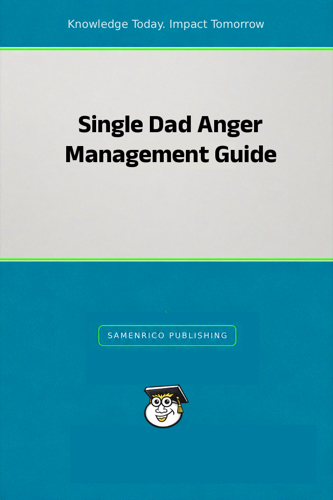
Non-FictionSelf-HelpSingle Fatherhood
Single Dad Anger Management Guide eBook
Handle sole custody pressure and emotional lonelin
by Bunn Lavina
Handle sole custody pressure and emotional loneliness without directing frustration at children.
Formats
Free sample
Chapter 1: The Silent Volcano--–- You are not a bad father. You are an exhausted, lonely, and legally entangled man who has been given an impossible job with no training, no relief shift, and no applause. The fact that you are still in the room—still trying, still showing up, still reading a book about how to do better—is proof that the core of you is good. But somewhere between the third tantrum of the morning and the fourth passive-aggressive text from your ex, something inside you cracks open. Heat rises up your neck.
Your jaw locks. Your voice, which minutes ago was patient, suddenly sounds like a stranger's. You yell. The child cries. You hate yourself.
Then you do it again next week. This chapter is not about fixing your anger yet. First, we have to understand what is actually causing it—because most single dads are pointing their frustration at the wrong target. The juice spilled on the floor is not the enemy. Your child's whining is not the crisis.
The real enemy is a silent, invisible structure of pressure that has been built around you over months and years. This chapter names that structure, dismantles it piece by piece, and gives you the first honest self-assessment you have probably ever taken as a single father.The Pity That Feels Like a Punch Let us start with something no one warns you about when you become a sole custodial father: the way other adults look at you. Society has clear categories for men. There is the heroic weekend dad who takes his kids to the park and returns them to their mother. There is the absent father, judged and dismissed.
There is the married father, the provider. But there is almost no cultural script for the man who does hair, packs lunches, attends teacher conferences, cleans vomit at 2 AM, and sits alone on the couch after the kids are asleep. When people encounter you, they do not know what to do with you. So they default to pity. "Oh, you have them full-time?
That must be so hard." "You're a saint for doing this alone." "Where's their mother?"On the surface, these sound like compliments or concerns. But for a man already stretched thin, pity feels like emasculation. Pity says: You are not supposed to be here. You are doing a woman's job. You are a hero only because you are a disaster.
And because men are rarely taught how to process that specific kind of shame, it does not become sadness or vulnerability. It becomes anger. You do not yell at the neighbor who gave you the pitying look. You hold it in. Then your child asks for a second snack, and suddenly you explode over something tiny.
The pity didn't cause the explosion directly. It added one more pound of pressure to a boiler that was already near its limit.This is the first truth of this book: Your anger is rarely about the thing you think it is about. It is about the accumulation of invisible blows that you have no cultural permission to acknowledge. You cannot tell your boss you feel emasculated by pity. You cannot tell your child that you snapped because the grocery store cashier asked where Mom was.
So the pressure builds, and it leaks out on the only people who cannot leave: your children.Role Captivity: The Cage with No Handle Now we arrive at the single most important concept in this entire book. In academic literature on single fathers, there is a term called role captivity. It refers to the suffocating feeling of being trapped inside a role you did not choose, with no escape hatch, no backup, and no end date. You are not just a father. You are the mother, the breadwinner, the disciplinarian, the cook, the janitor, the nurse, the tutor, the chauffeur, and the emotional anchor.
In a two-parent household, these roles can be shared, traded, or temporarily abandoned when one parent is sick or exhausted. In your house, there is no one to trade with. If you stop, everything stops.Think about the last time you were genuinely sick with the flu. Did you get to lie in bed for two days? Or did you still make breakfast, drive to school, and sit through a work meeting with a fever because there was literally no other adult to hand the baton to?
That is role captivity. It is not just busyness. It is the psychological weight of knowing that you are the single point of failure for an entire family system. Every parent feels tired. But you feel trapped.
And trapped people are angry people.The research on sole custodial fathers is sobering. Studies consistently show that single fathers report higher levels of parenting stress than single mothers or married fathers—not because men are less capable, but because they are more isolated. Single mothers have a social infrastructure: playgroups, mommy-and-me classes, support groups, and cultural permission to ask for help. Single fathers face a different reality. When you show up at a playground with your daughter, mothers pull their children closer.
When you ask for a day off work because your son is sick, colleagues assume you are exaggerating. When you try to join a parenting group, you discover it is called a "Mommy and Me" group. The message is clear: You are an anomaly. You are intruding. Figure it out yourself.Most single dads respond to this isolation by doubling down.
They try to be perfect. They hide their exhaustion. They never say, "I cannot do this alone," because admitting that feels like failure. But perfectionism is not a solution. It is a pressure valve that is welded shut.
Eventually, the boiler explodes—usually at 7:15 on a Tuesday morning when a child cannot find their other shoe.The Ex Factor: Two Very Different Problems No book on single fatherhood can avoid the ex-partner. But most books make a critical error: they treat every ex as the same. They preach forgiveness, co-parenting harmony, and "letting go." For some fathers, that advice is appropriate. For others, it is not just useless—it is dangerous. So let us split this into two distinct paths right now.Path One: The Low-Conflict Ex.
This is the mother who is generally reasonable but unreliable. She might be late for pickups. She forgets to return the winter coat. She cancels visitation at the last minute. She is not malicious; she is disorganized or struggling herself.
In this scenario, your anger is not about betrayal. It is about disappointment and the chronic stress of unpredictability. You cannot rely on her, so you have to over-function to protect the kids. That over-functioning feeds role captivity. The solution here involves boundary-setting, communication protocols, and eventually, a form of forgiveness that is really about lowering your own blood pressure.
We will cover that in Chapter 6.Path Two: The High-Conflict Ex. This is a different animal entirely. This mother uses the children as leverage. She makes false accusations. She withholds visitation to punish you.
She sends hostile texts late at night. She undermines your authority to the kids. She may have a personality disorder…
This is the end of the free sample. Get the eBook to keep going. Buy now
About this book
Details
- Author
- Bunn Lavina
- Publisher
- SamEnrico
- Language
- English
- Genre
- Non-Fiction, Self-Help, Single Fatherhood
- Released
- 2026-06-07
- Pages (approx.)
- 126
- Available as
- eBook, Audiobook

Read better in the ZLOADR app
Your eBooks on your phone or tablet. Sign in with your SamEnrico account and start reading.
More by Bunn Lavina
 The Maharam SchiffBunn Lavina$11.99
 The Parent Microbreak WorkbookBunn Lavina$11.99
 The Emotional Chain Reaction CourseBunn Lavina$11.99
 Self Hypnosis Breathing MethodBunn Lavina$11.99
 The Silk Road in the Sky: The First Aerial Survey of Central AsiaBunn Lavina$11.99
 Love Letters from the Pacific: The Secret Romance of WWII’s ‘Code Girls’Bunn Lavina$11.99
 African Coding Bootcamp GuideBunn Lavina$12.99
 Returns Management Five Year ViewBunn Lavina$12.99
 Understanding Brachydactyly Types B and E CombinedBunn Lavina$17.99
 How to Become a Insulation Cutter And FormerBunn Lavina$11.99
 Forensic EntomologyBunn Lavina$11.99
You may also like
 Hong Kong Handover 1997Dunn Johnnie$11.99
 Zumba For Postnatal Recovery CourseNeal Christian$11.99
 Zumba for BeginnersLadner Nikia$11.99
 YouTube Comment Mining GuideHumes Pandora$12.99
 Worry Box MeditationCarlin Rudy$11.99
 Workplace Stress MeditationNguyen Lynn$11.99
 Workplace Stress and Sleep RepairHawley Ivory$11.99
 Workplace Perfectionism CureDelaney Jeffry$11.99
 Workplace Injustice Anger GuideWallen Isabelle$11.99
 Work Addiction and Burnout LinkGreenwood Ester$11.99
 Women in Yoga and WellnessBeattie Galina$11.99
 Women in Stand Up ComedyChun Evangeline$11.99