
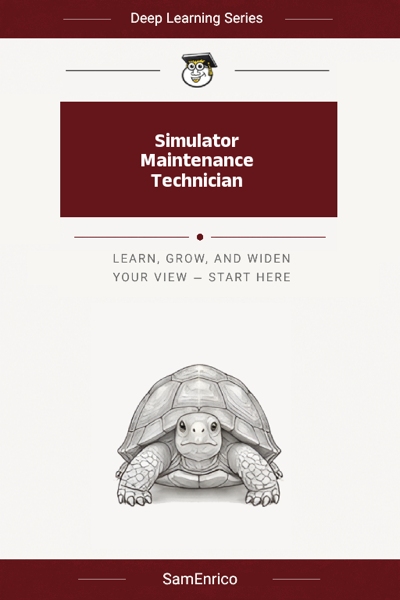
Non-FictionInformativeEducational
Simulator Maintenance Technician eBook
A Coursebook on Simulator Maintenance Technician
by Hoff Lang
A Coursebook on Simulator Maintenance Technician
Formats
Free sample
Chapter 1: The First Hour--It is 7:47 on a Tuesday morning, and a $20 million flight simulator has just announced its own death.You have been a simulator maintenance technician for exactly nine days. Your mentor, a grizzled veteran named Ed who claims he has been fixing simulators since they ran on vacuum tubes, is on his third cup of coffee and his first cigarette of the day—outside, where regulations require. The pager clipped to your belt buzzes with a code you have memorized but never expected to see so soon: MOTION SYSTEM FAULT – PLATFORM LOCK – INTERLOCK VIOLATION.In the training center hallway, you can already hear the instructor shouting. The captain whose recurrent training session has just been aborted is not shouting—he is using the quiet, controlled voice that experienced pilots reserve for emergencies. That is worse.This is the moment that every simulator technician remembers for the rest of their career.
Not the day they graduated from technical school. Not the day they passed their certification exam. The day the machine broke, the clock started ticking, and everyone in the building turned to look at you.Welcome to the first hour.The Weight of the Machine Before you can fix a simulator, you have to understand what you are actually maintaining. This sounds obvious, but in practice, the sheer complexity of modern high-fidelity simulators overwhelms even experienced technicians who come from aviation maintenance, IT, or industrial controls. A Full Flight Simulator—the kind with a full cockpit, six-degree-of-freedom motion platform, and wrap-around collimated visual display—is not a computer that happens to have moving parts.
It is not a hydraulic machine that happens to have software. It is a real-time, fault-tolerant, multi-domain integration problem that happens to look like an airplane.Let us be precise about what we mean. A Level D Full Flight Simulator, the highest qualification available under civil aviation regulations, must replicate the behavior of its real-world aircraft so accurately that pilots can complete their entire type rating—including emergency procedures—without ever leaving the ground. The regulatory standard requires that the simulator's motion system produce cues indistinguishable from actual flight within defined tolerances. The visual system must render runways, taxiways, terrain, weather, and other aircraft with sufficient fidelity that pilots can safely practice low-visibility approaches.
The control loading system must replicate the feel of hydraulic and aerodynamic forces on the yoke, throttles, and rudder pedals to within fractions of a pound of force.And every single component in this system must work together, in real time, with latencies measured in milliseconds, or the training value collapses.A simulator that feels wrong is worse than no simulator at all. It trains pilots to respond incorrectly. It builds muscle memory for the wrong control forces. It teaches them to trust instruments that disagree with motion cues. When a qualified pilot steps out of a simulator and into a real aircraft, they carry every habit—good and bad—that the simulator instilled.
That is why your job matters more than most people will ever understand.The Ecosystem of Simulation Before we go any further, we need a shared vocabulary. The word "simulator" covers a vast range of devices, from the 50,000desktoptrainerusedforproceduraltrainingtothe50,000 desktop trainer used for procedural training to the 50,000desktoptrainerusedforproceduraltrainingtothe20 million Level D FFS that dominates the training centers of major airlines. Understanding the differences between these categories is essential because the maintenance philosophy—and the technician's daily reality—changes dramatically across the spectrum.Full Flight Simulators (FFS) are the top of the pyramid. These devices feature a full-scale replica of an aircraft cockpit mounted on a six-degree-of-freedom motion platform. They use high-fidelity visual systems, often with collimated displays that create the illusion of infinite focus, and they must meet the most stringent regulatory standards.
A Level D FFS requires no credit hours in the actual aircraft for initial type rating—the simulator alone is sufficient. The maintenance burden is immense. You will manage hydraulic systems that operate at 3,000 psi, visual systems with six or more projectors that require weekly calibration, real-time host computers with redundant everything, and a thousand other subsystems that all fail eventually.Flight Training Devices (FTD) occupy the middle ground. These devices replicate the cockpit and instruments but typically lack motion systems. Some have simple vibration systems to simulate engine rumble, but they cannot replicate sustained acceleration cues.
FTDs are often used for systems training, procedural practice, and initial instrument training. From a maintenance perspective, FTDs are simpler than FFS—no hydraulics, no motion control loops—but they still require expertise in avionics simulation, networking, and visual systems. The regulatory requirements are less demanding, but the expectations for availability are just as high. A grounded FTD costs the training center just as much revenue as a grounded FFS.Operator Training Simulators (OTS) are a different world entirely. These devices simulate industrial processes—nuclear power plants, chemical refineries, marine vessels, and oil rigs—rather than aircraft.
The physical cockpit is replaced by a bank of screens showing process diagrams, and the motion system is absent. But don't be fooled into thinking OTS maintenance is simpler. These simulators model complex thermodynamic, fluid dynamic, and chemical processes in real time. A single modeling error can cause a trainee to make a decision that, if repeated in the real world, would lead to a meltdown, explosion, or environmental disaster. The maintenance technician for an OTS must understand process engineering, real-time simulation, and the specific industrial domain in ways that their aviation counterparts do not.Other specialized simulators include military tactical trainers (which add weapons and sensor simulation), driving simulators (with vehicle dynamics and road surface modeling), and medical simulators (with physiological responses and haptic feedback for surgical procedures).
Each domain has its own quirks, but the fundamental maintenance principles remain consistent. You will see those principles throughout this book.The Maintenance Philosophy: Preventive, Predictive, and Emergency When Ed returns from his cigarette, he doesn't rush to the motion bay. He doesn't pull out a multimeter or start swapping boards. He walks to the instructor station, pulls up the fault log, and sits down heavily in the chair."What's the first rule of simulator maintenance?" he asks.You hesitate. "Safety first?""Wrong.
The first rule is: don't make it worse." He taps the screen. "This fault says interlock violation. That means the motion system detected a condition that should not exist—like a position sensor reading outside its expected range, or a valve commanded to open but not responding. The system shut itself down to prevent hardware damage. If I go in there and start poking around without understanding why it shut down, I might bypass a safety check that's protecting me from a 3,000 psi hydraulic rupture.
So I'm going to sit here and think for a minute."This is the maintenance philosophy in action. Every simulator technician operates within a framework that balances three competing priorities: preventing failures before they occur, predicting failures before they cause downtime, and responding to failures when they inevitably happen. The best technicians master all three.Preventive maintenance is what you do on a schedule. Daily inspections of hydraulic fluid levels and filter conditions. Weekly cleaning of projector lenses and air filters.
Monthly checks of emergency stop circuits and motion envelope limits. Quarterly replacement of wear items like servo-valve filters and cooling…
This is the end of the free sample. Get the eBook to keep going. Buy now
About this book
Details
- Author
- Hoff Lang
- Publisher
- SamEnrico
- Language
- English
- Genre
- Non-Fiction, Informative, Educational
- Released
- 2026-05-25
- Pages (approx.)
- 149
- Available as
- eBook, Audiobook

Read better in the ZLOADR app
Your eBooks on your phone or tablet. Sign in with your SamEnrico account and start reading.
More by Hoff Lang
 Social Reconnection After LossHoff Lang$11.99
 Renters Insurance BrokersHoff Lang$11.99
 CrossFit Injury Prevention WorkbookHoff Lang$11.99
 Beginner Fitness for Back PainHoff Lang$11.99
 Home Modification for AgingHoff Lang$11.99
 Echoes of the First Moonwalk: The Hidden Tapes of Apollo 11Hoff Lang$11.99
 Understanding Dermatopathia Pigmentosa ReticularisHoff Lang$17.99
 Ultimate Handbook Guide to Suva : (Fiji) Travel GuideHoff Lang$11.99
 Alibaba Cloud CertificationHoff Lang$12.99
 Updated BOI Information GuideHoff Lang$12.99
You may also like
 Hong Kong Handover 1997Dunn Johnnie$11.99
 Zumba For Postnatal Recovery CourseNeal Christian$11.99
 Zumba for BeginnersLadner Nikia$11.99
 YouTube Comment Mining GuideHumes Pandora$12.99
 Worry Box MeditationCarlin Rudy$11.99
 Workplace Stress MeditationNguyen Lynn$11.99
 Workplace Stress and Sleep RepairHawley Ivory$11.99
 Workplace Perfectionism CureDelaney Jeffry$11.99
 Workplace Injustice Anger GuideWallen Isabelle$11.99
 Work Addiction and Burnout LinkGreenwood Ester$11.99
 Women in Yoga and WellnessBeattie Galina$11.99
 Women in Stand Up ComedyChun Evangeline$11.99