
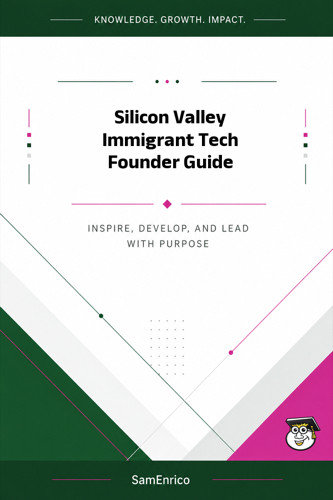
Non-FictionBiographyTech Industry
Silicon Valley Immigrant Tech Founder Guide eBook
Details how foreign born engineers launched billio
Details how foreign born engineers launched billion dollar startups.
Formats
Free sample
Chapter 1: The $10 Trillion Blindspot--–- Most foreign-born engineers working in Silicon Valley believe their visa status is their greatest weakness. They are wrong. The data tells a different story: immigrants have founded or co-founded over 50% of U.S. billion-dollar startups, including Google, Stripe, Instacart, Zoom, and Nvidia. That is a collective market value exceeding $10 trillion.
Yet the typical H1-B holder spends their evenings worrying about visa renewals rather than recognizing that their outsider perspective is actually their sharpest competitive edge. This book exists to reverse that equation. Before we discuss visas, before we discuss pitching to VCs, before we discuss building global teams, we must first rewire how you see yourself. Your immigrant background is not a hurdle to clear. It is a filter that selected for exactly the traits that build billion-dollar companies: hunger, adaptability, and the ability to navigate systems that were not designed for you.The Data That Changes Everything The National Foundation for American Policy released a study in 2022 that should be tattooed onto the forearm of every international student in America.
The researchers found that immigrants make up approximately 55 percent of U.S. billion-dollar startup founders while representing only 15 percent of the population. Let those numbers sit for a moment. You are statistically almost four times more likely to found a unicorn if you were born outside the United States than if you were born here. This is not a coincidence.
It is not a quirk of immigration policy that accidentally benefits the tech industry. It is a causal relationship.The pattern holds across sectors. Indian-born founders lead in Saa S and enterprise infrastructure. Microsoft’s CEO Satya Nadella came from Hyderabad. Google’s Sundar Pichai grew up in Chennai.
Instacart’s Apoorva Mehta arrived from India with an engineering degree and a willingness to sleep on a friend’s couch. Chinese-born founders dominate hardware, logistics, and e-commerce. Zoom’s Eric Yuan struggled for years to get his visa before building a company that became a verb. Nvidia’s Jensen Huang emigrated from Taiwan at nine years old, working as a busboy at Denny’s before co-founding the most valuable chip company in the world. Door Dash’s Tony Xu arrived from China at five, watched his mother run a small restaurant, and built a logistics empire that transformed food delivery.
Israeli founders rule cybersecurity. Wiz, Check Point, and Palo Alto Networks were all founded by Israelis who served in Unit 8200, the military intelligence unit that functions as a finishing school for security entrepreneurs. European founders excel in deep tech and fintech. Spotify’s Daniel Ek came from Sweden. Stripe’s Patrick and John Collison grew up in rural Ireland.What do these founders share beyond their passports?
They all saw something that American-born founders missed. The immigrant founder effect is real: outsiders see market gaps that insiders have been trained to overlook. Eric Yuan noticed that video conferencing software was terrible for international calls because it was built by Americans for Americans. He built Zoom with global latency in mind. Apoorva Mehta noticed that grocery delivery was fragmented because American founders assumed everyone had a car.
He built Instacart for urban dwellers. The Collison brothers noticed that accepting payments online was a nightmare of regulatory complexity that American founders accepted as normal. They built Stripe because they had seen simpler systems in Europe.This is the first principle of this book: your foreignness is not a bug. It is a feature. The very experiences that made you feel like an outsider—the language barriers, the cultural confusion, the bureaucratic nightmares—gave you a radar for problems that Americans have stopped noticing.
The most valuable companies solve problems that have become invisible. And you, by definition, see what they cannot.The Mindset Shift: From Security to Risk Every immigrant carries a survival instinct that was forged in the fire of leaving home. That instinct whispers the same messages regardless of your country of origin: save money, avoid debt, find stable work, do not rock the boat, defer to authority, keep your head down. These messages kept your ancestors alive. They helped your parents build a foundation.
And they will absolutely destroy your chances of building a billion-dollar company.We need to name this voice. Let us call it the immigrant survival script. It is the internal monologue that tells you to take the FAANG job instead of the startup. It is the voice that says you should wait for the green card before you launch. It is the fear that makes you negotiate for salary instead of equity.
This script is not wrong. It is appropriate for the first generation who arrived with nothing and needed to stabilize. But you are not your parents. You are not a refugee fleeing with one suitcase. You are a highly trained engineer standing at the center of the world’s most dynamic economy.
The rules have changed.The founder mindset requires the opposite of the survival script. It demands calculated risk tolerance. It demands betting on yourself when everyone else is betting on safety. It demands embracing uncertainty and treating failure as data rather than disgrace. This transition is not easy.
It feels like betrayal. You will feel guilty for leaving a stable job. You will feel selfish for prioritizing your vision over your family’s security. That guilt is the price of admission. Feel it and act anyway.The self-assessment question for this chapter is brutal but necessary: Is your immigrant background a training ground or a trauma?
If your past taught you that systems are rigged but navigable, that failure is survivable, that you are resourceful enough to start over—then you are ready. If your past left you with a permanent sense of fragility, a belief that one wrong move will send you back to nothing—then you have healing to do before you launch. Both responses are valid. Both come from real experiences. But only one is compatible with founding a company.
The other will make you a world-class employee. That is not a failure. It is a different path.The Lin Wu Case Study Let us make this concrete. Lin Wu arrived in the United States from a country that no longer exists. The geopolitical chaos that erased his homeland also erased his family’s savings, his university credentials, and his sense of safety.
He landed in San Francisco with two hundred dollars in his pocket and no English beyond the word “hello.” He washed dishes at a Chinese restaurant in the Richmond District, slept in a shared room with seven other men, and spent his nights teaching himself to code from library books.The immigrant survival script would have told Lin Wu to focus on becoming a reliable dishwasher. Save money. Send remittances home. Find stability. But Lin Wu had already lost everything.
That was his secret weapon. When you have already lost your country, your language, your savings, and your sense of identity, losing a job or failing at a startup feels small. The refugee experience created in him a low downside, high upside calculus that native-born founders rarely possess. What was the worst that could happen? He would go…
This is the end of the free sample. Get the eBook to keep going. Buy now
About this book
Details
- Author
- Pendergrass Rozanne
- Publisher
- SamEnrico
- Language
- English
- Genre
- Non-Fiction, Biography, Tech Industry
- Released
- 2026-06-09
- Pages (approx.)
- 129
- Available as
- eBook, Audiobook

Read better in the ZLOADR app
Your eBooks on your phone or tablet. Sign in with your SamEnrico account and start reading.
More by Pendergrass Rozanne
 Teacher Emotion GuidePendergrass Rozanne$11.99
 The Assertiveness for Caregivers GuidePendergrass Rozanne$11.99
 Partner Body Acceptance GuidePendergrass Rozanne$11.99
 PTSD Partner Relationship GuidePendergrass Rozanne$11.99
 Siege Artillery DeploymentPendergrass Rozanne$11.99
 The Angry Parent Legacy BreakerPendergrass Rozanne$11.99
 Assertiveness Training WorkbookPendergrass Rozanne$11.99
 The Alchemy of Genius: Florence’s Golden DawnPendergrass Rozanne$11.99
 Love and the Olympics: The Secret Romance of Leni Riefenstahl and Jesse OwensPendergrass Rozanne$11.99
 Echoes of Trinity: The Secret Tapes of Los AlamosPendergrass Rozanne$11.99
 The Mineral Guide to PolaritePendergrass Rozanne$11.99
 Long-Term Community SustainabilityPendergrass Rozanne$11.99
You may also like
 Hong Kong Handover 1997Dunn Johnnie$11.99
 Zumba For Postnatal Recovery CourseNeal Christian$11.99
 Zumba for BeginnersLadner Nikia$11.99
 YouTube Comment Mining GuideHumes Pandora$12.99
 Worry Box MeditationCarlin Rudy$11.99
 Workplace Stress MeditationNguyen Lynn$11.99
 Workplace Stress and Sleep RepairHawley Ivory$11.99
 Workplace Perfectionism CureDelaney Jeffry$11.99
 Workplace Injustice Anger GuideWallen Isabelle$11.99
 Work Addiction and Burnout LinkGreenwood Ester$11.99
 Women in Yoga and WellnessBeattie Galina$11.99
 Women in Stand Up ComedyChun Evangeline$11.99