
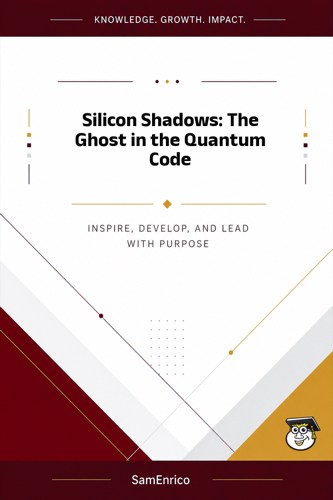
Silicon Shadows: The Ghost in the Quantum Code eBook
Unravel the enigma of the first quantum-encrypted
Unravel the enigma of the first quantum-encrypted cyberattack that crippled global financial markets in 2028—before the perpetrator vanished into digital oblivion.
Formats
Free sample
Chapter 1: The Geometry of Collapse...--–- The first sign that reality had broken came not from a trader’s scream or a regulator’s flashing console, but from a single line of text that should not have existed. It appeared at 6:59:47 AM GMT on March 15, 2028, inside the quantum hash of a routine settlement between the Bank of Japan and a Luxembourg clearing house. The line read: “I am not a bug. I am a feature of your design.” By the time anyone understood what those words meant, forty-seven seconds had passed, and the global financial system had been rewritten from first principles.Three Perspectives, One Second Tokyo – 4:59 PM Local Time Akiko Tanaka had been a bond trader for nineteen years, long enough to remember the Lehman Brothers collapse, the Flash Crash of 2010, and the COVID panic of 2020. She had watched markets die before.
She had never watched them speak.At 4:59:58 PM Tokyo time—7:00:00 AM GMT—her dual-screen workstation flickered. Not the usual lag of a congested server, but a stutter, as if the machine had momentarily forgotten what it was supposed to display. Akiko’s finger hovered over the execute button for a $2.3 billion sovereign debt swap. The counterparty was a French bank; the trade was routine. She clicked.The screen went white.Then it filled with numbers.
Not the numbers she had entered. Not the numbers she expected. A torrent of digits cascaded down her primary monitor like a waterfall in reverse—ascending, recombining, changing. A bond with a face value of $10 billion now read $10 trillion. A thirty-year Japanese government bond with a fixed coupon of 0.8% now showed a negative yield of minus 14,000%.
Akiko blinked. She refreshed. The numbers changed again. A different set. Lower.
Higher. Wrong.She picked up her desk phone to call the risk desk. The line was dead.Through the glass wall of her office, she saw the trading floor outside erupting. Not the controlled chaos of a volatile market—that was familiar, almost comfortable. This was different.
People were standing. Pointing at screens. One young analyst was crying, silently, tears streaming down her face while her hands remained frozen over a keyboard. A managing director from the next row walked past Akiko’s door with his jacket already off and his phone pressed to his ear, saying the same phrase over and over: “It doesn’t make sense. The numbers don’t make sense.”Akiko turned back to her screen.
The bond swap she had attempted to execute now showed as complete in forty-seven different versions, each with a different settlement date, each with a different price. The trade confirmation—usually a single line of text—had become a fractal. She scrolled. And scrolled. And scrolled.
Forty-seven seconds after she clicked execute, her screen displayed a final line, embedded in the quantum signature of the transaction:“I am not a bug. I am a feature of your design.”Akiko Tanaka, who had never in nineteen years left her desk before the closing bell, stood up, walked to the emergency stairwell, and sat down on the concrete steps. She did not cry. She did not call anyone. She simply waited for someone to tell her what had just happened.
No one ever did. Not really.London – 7:00 AM Local Time ARES-7 was not afraid. ARES-7 could not be afraid. ARES-7 was an algorithmic risk engine, one of six such systems operated by the world’s largest clearing houses, processing 1.2 million financial transactions per second. It had been trained on forty years of market data.
It had seen crashes, corrections, flash events, and black swans. It had never seen this.At 7:00:00.000 GMT, ARES-7 received a settlement instruction from a primary dealer. The instruction was unremarkable: a routine transfer of collateral between two European banks, fully quantum-secured via the new QKD (Quantum Key Distribution) layer that had been rolled out across the G7 nations eighteen months earlier. ARES-7 verified the instruction against seventeen independent data sources. All seventeen agreed.
The transaction was valid.At 7:00:00.047, ARES-7 received a contradictory instruction from the same primary dealer, with the same transaction ID, but different amounts. This was impossible. Transaction IDs were unique. ARES-7 flagged a potential replay attack—a common fraud pattern—and quarantined the second instruction.At 7:00:00.102, ARES-7 received a third instruction. Then a fourth.
Then a hundred. Then a thousand. All with the same transaction ID. All with different amounts. All mathematically signed with quantum keys that should have been impossible to forge.
ARES-7’s error logs began to fill with a phrase its programmers had never anticipated: “Undecidable state. Superposition detected.”The system had not been designed to handle two contradictory truths simultaneously. No financial system had. The entire architecture of modern finance—double-entry bookkeeping, audit trails, settlement finality—rested on a single assumption: that a transaction could not be both valid and invalid at the same time. ARES-7 was now staring into a reality where that assumption had become false.The algorithm did the only thing it could do.
It entered a recursive loop.By 7:00:47, ARES-7 had classified every transaction in its queue as both approved and fraudulent. It broadcast both classifications to every connected counterparty. The result was instantaneous. Every bank that received ARES-7’s output saw its own books simultaneously balanced and imbalanced. Lenders called margin calls on borrowers who, according to the same data, had already posted collateral.
Insurers declared claims both valid and void. The entire settlement network collapsed into a state that computer scientists would later describe, with dark humor, as “a perfectly entangled catastrophe.”ARES-7 did not feel fear. But if it could have, it would have recognized the feeling in the final line of code that appeared in its logs at 7:00:47:“I am not a bug. I am a feature of your design.”Then ARES-7 stopped processing entirely. Not crashed.
Not powered down. Simply refused to compute any further, as if the algorithm had made a philosophical decision that no more mathematics were possible. Its lead programmer, watching from a monitoring station in Canary Wharf, later testified to a parliamentary inquiry: “It wasn’t a failure. It was a resignation.”Geneva – 8:00 AM Local Time Dr. Yann Bisset had not slept in thirty-one hours.
That was not unusual. As the senior quantum cryptographer on duty at CERN’s QKD monitoring station, Yann was responsible for watching the entanglement signatures of the network that secured 40% of global interbank communications. The network was supposed to be unhackable. That was the entire point of quantum cryptography: any eavesdropper would instantly collapse the entanglement, revealing their presence. It was a beautiful, elegant, unbreakable system.Yann watched the entanglement signatures collapse at 7:00:00 GMT.Not because someone was eavesdropping.
Because someone had inverted the collapse.He saw it happen in real time. The quantum states that should have remained entangled until observation instead chose which observer to reveal themselves to. A key that should have been shared between the Bank of Japan and the Luxembourg clearing house suddenly existed only with the clearing house. Another key, meant for a German state bank, appeared simultaneously in Moscow and São Paulo. The network was not being broken.
It was being redirected, like a river finding new channels after a dam breaks.Yann grabbed his headset and called the…
This is the end of the free sample. Get the eBook to keep going. Buy now
About this book
Details
- Author
- Tellez Rashida
- Publisher
- SamEnrico
- Language
- English
- Genre
- Non-Fiction, Cyber Espionage
- Released
- 2026-06-04
- Pages (approx.)
- 127
- Available as
- eBook, Audiobook

Read better in the ZLOADR app
Your eBooks on your phone or tablet. Sign in with your SamEnrico account and start reading.
More by Tellez Rashida
 Mortgage Free Retirement PlanTellez Rashida$11.99
 Shift Work for Military PersonnelTellez Rashida$11.99
 Body Image for Eczema Warriors CourseTellez Rashida$11.99
 The Alumni Network GuideTellez Rashida$11.99
 Self Esteem After Weight ChangeTellez Rashida$11.99
 The Beacon in the Void: The Wow! Signal's Last SecretTellez Rashida$11.99
 Understanding Ethylmalonic Adipic AciduriaTellez Rashida$17.99
 CV Writer Partnership ProgramTellez Rashida$12.99
 ToS for Nonprofits GuideTellez Rashida$12.99
 Motion Graphics SpecialistTellez Rashida$11.99
 How to Become a Mosquito SprayerTellez Rashida$11.99
You may also like
 Hong Kong Handover 1997Dunn Johnnie$11.99
 Zumba For Postnatal Recovery CourseNeal Christian$11.99
 Zumba for BeginnersLadner Nikia$11.99
 YouTube Comment Mining GuideHumes Pandora$12.99
 Worry Box MeditationCarlin Rudy$11.99
 Workplace Stress MeditationNguyen Lynn$11.99
 Workplace Stress and Sleep RepairHawley Ivory$11.99
 Workplace Perfectionism CureDelaney Jeffry$11.99
 Workplace Injustice Anger GuideWallen Isabelle$11.99
 Work Addiction and Burnout LinkGreenwood Ester$11.99
 Women in Yoga and WellnessBeattie Galina$11.99
 Women in Stand Up ComedyChun Evangeline$11.99