
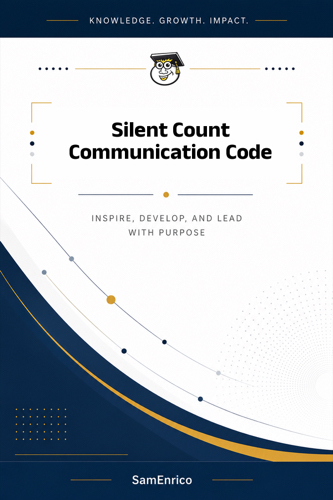
Silent Count Communication Code eBook
Coordinate with teams non-verbally under pressure
Coordinate with teams non-verbally under pressure using silent signals and trust.
Formats
Free sample
Chapter 1: The Silent Language...--You are already fluent in a language you have never been taught. You did not learn it in school. No textbook ever graded your proficiency. And yet, you speak this language every waking moment of your life. Every glance you avoid, every breath you hold, every subtle shift of your shoulders when someone enters the room—these are not random movements.
They are sentences. They are paragraphs. They are entire conversations happening beneath the words you think you are having.The problem is not that you cannot read this language. The problem is that you have forgotten how to listen to it.Most leaders spend their entire careers focused on the wrong channel of communication. They obsess over the perfect phrasing in an email.
They rehearse the precise wording of a difficult conversation. They measure their effectiveness by how clearly they believe they have spoken. And all the while, the room is screaming at them in a language they have trained themselves to ignore. The team member who says "I agree" while crossing their arms and stepping backward is not agreeing. The executive who says "I'm open to feedback" while their gaze darts to the door is not open.
The colleague who says "I'm fine" while their breathing shifts from deep and steady to shallow and rapid is not fine.These are not mysteries. They are signals. And until you learn to read them, you will never be able to send them.This chapter is not about body language as you have heard it described before. It is not a catalog of "what it means when someone touches their nose" or a simplistic decoder ring for human behavior. Those approaches fail because they treat non-verbal communication as a code to be cracked rather than a language to be learned.
A nose touch does not mean "lying" in every context. A crossed arm does not always mean "defensive." Context matters. Baseline matters. Patterns matter.What this chapter offers instead is a framework for reawakening your natural ability to see what others miss. You were born with this ability.
Infants read their parents' micro-expressions before they can crawl. Children navigate the emotional landscape of their homes with astonishing accuracy. But somewhere along the way, you were told that words matter more. You were rewarded for speaking clearly and punished for noticing what was left unsaid. You became fluent in verbal communication and functionally illiterate in the language that carries 93 percent of the meaning.That ends now.The Four Failures of Verbal Communication Before we dive into the mechanics of silent reading, we must understand why this skill has become so rare and so urgently necessary.
Verbal communication—the exchange of meaning through words—fails in predictable ways under pressure. Understanding these failures is the first step toward building a better system.The Speed Failure Words are slow. The average person speaks at approximately 125 to 150 words per minute. But the human brain processes non-verbal cues in as little as 33 milliseconds—roughly sixty times faster than spoken language. In a high-stakes environment, those milliseconds are the difference between success and catastrophe.
A surgical team cannot wait for a spoken warning when a patient's vitals begin to destabilize. A bomb disposal technician cannot pause to ask clarifying questions when their partner's posture shifts. Words create a bottleneck. Silent signals bypass it entirely.The Surveillance Failure Words are public. Even a whispered conversation can be overheard, recorded, or intercepted.
In competitive environments—whether on a football field, in a negotiation room, or across a boardroom table—speaking openly is equivalent to handing your strategy to the opponent. The quarterback uses a silent count not because his own team cannot hear him, but because the defense can. The same principle applies to any situation where surveillance risk exists. Silent signals are invisible to outsiders. They are a private language for a trusted few.The Noise Failure Words are fragile.
A single unexpected sound—an alarm, a crash, a shouted interruption—can render spoken communication useless. In environments with high ambient noise (manufacturing floors, disaster zones, crowded events), verbal commands are either unheard or misunderstood. Silent signals, transmitted through touch, sight, or vibration, cut through noise with perfect clarity. A tap on the shoulder means the same thing whether the room is silent or screaming.The Politics Failure Words are tracked. In any organization with complex power dynamics, speaking openly carries risk.
The employee who points out a safety violation may be labeled a troublemaker. The junior team member who corrects a senior leader's error may face retaliation. Over time, these risks create a culture of deafening silence—people see problems but do not speak about them. Silent signals offer a way around this trap. A subtle gesture, a shift in gaze, a change in breathing pattern—these can communicate warnings and concerns without creating a permanent record or inviting retaliation.These four failures are not arguments against speaking.
They are arguments for expanding your communication toolkit. Words are not the enemy. But they are not always the answer.The Primary Channel Here is the truth that most leadership books dance around but rarely state directly: Non-verbal communication is not a supplement to words. It is the primary channel. Words are the supplement.Consider the evidence.
Before infants can speak, they communicate hunger, fear, comfort, and distress entirely through non-verbal signals. Before humans developed written language, they coordinated hunts, resolved conflicts, and built societies using gesture, gaze, and posture. The oldest parts of your brain—the parts you share with every other mammal—are wired for non-verbal communication. The parts that process grammar and syntax are evolutionary newcomers, still rough around the edges, easily overwhelmed by stress and fatigue.When you are calm and safe, words work reasonably well. But when pressure rises—when the stakes are high, when time is short, when survival is on the line—your brain reverts to its default operating system.
That operating system is silent. It processes faces faster than sentences. It reads posture more accurately than tone of voice. It detects changes in breathing patterns before it registers the words being spoken.This is not a bug. It is a feature.
But most leaders have been trained to override this system. They have been told to "use their words" even when words are the wrong tool. They have been rewarded for articulating clear messages while being punished for trusting their gut. The result is a generation of leaders who are fluent in the secondary channel and illiterate in the primary one.This chapter begins the process of reversing that training.The Six Universal Micro-Expressions In the 1960s, psychologist Paul Ekman traveled to Papua New Guinea to study the Fore people, a remote tribe with no exposure to Western media or culture. He wanted to know whether facial expressions for basic emotions were universal or culturally learned.
His findings were revolutionary. The Fore people recognized and produced the same expressions for anger, fear, disgust, sadness, surprise, and happiness as people in every other culture Ekman studied. These six emotions are hardwired into the human species. They are not chosen or performed. They are involuntary.A micro-expression is the full-face…
This is the end of the free sample. Get the eBook to keep going. Buy now
About this book
Details
- Author
- Hadley Sabine
- Publisher
- SamEnrico
- Language
- English
- Genre
- Non-Fiction, Biography, Nonverbal Communication
- Released
- 2026-06-06
- Pages (approx.)
- 134
- Available as
- eBook, Audiobook

Read better in the ZLOADR app
Your eBooks on your phone or tablet. Sign in with your SamEnrico account and start reading.
More by Hadley Sabine
 Pinterest Idealism Recovery GuideHadley Sabine$11.99
 Reddit Upvote Validation CycleHadley Sabine$11.99
 Healing From Parental FavoritismHadley Sabine$11.99
 Thunberg Books CollectionHadley Sabine$11.99
 Sleep Hygiene for Trauma SurvivorsHadley Sabine$11.99
 High Achiever Doubt CureHadley Sabine$11.99
 Habit for ParentsHadley Sabine$11.99
 Social Media Burnout BreakHadley Sabine$11.99
 Lee vs. Grant: The Clash of Titans at AppomattoxHadley Sabine$11.99
 The Storm Chasers' Last Dance: Love and Lightning on the Great PlainsHadley Sabine$11.99
 The Silk Road Gambit: How a 13th-Century Diplomat Outmaneuvered EmpiresHadley Sabine$11.99
 How to Start a Fancy Dress Hire Business (Beginners Guide)Hadley Sabine$11.99