
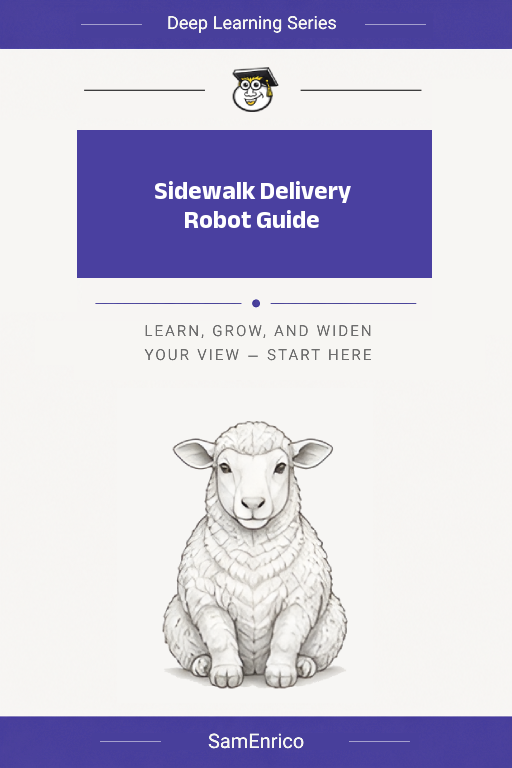
Non-FictionForecast & OutlookDelivery Bots
Sidewalk Delivery Robot Guide eBook
Project pedestrian robot deployment for food and s
Project pedestrian robot deployment for food and small package delivery in dense urban areas.
Formats
Free sample
Chapter 1: The Last Fifty Feet--–- The delivery van double-parked outside your apartment building has its hazard lights flashing, its engine idling, and a driver who has been staring at a call box for ninety seconds. You are on the fourth floor, the elevator is broken, and the package you ordered – a birthday gift that absolutely must arrive today – is somewhere in the back of that van, buried under seventeen other boxes. The driver will not leave the vehicle because the city fines delivery trucks $250 for unattended parking violations. You cannot come down because you are in a video conference that ends in twenty minutes. The package sits, unmoving, fifty feet from your front door.
That distance – that absurd, tiny, maddening sliver of urban space – is about to become one of the most contested territories on the planet.This is the last-meter problem. Not the last mile, which logistics companies have been optimizing since Fed Ex introduced overnight shipping in 1973. The last mile is solved: route algorithms, consolidation centers, delivery vans that talk to traffic lights. No, the problem that keeps supply chain executives awake at night is the final fifty to one hundred feet between where a delivery vehicle legally can stop and where a customer actually lives. That distance accounts for nearly twenty percent of all failed delivery attempts in dense urban areas.
Twenty percent. For every five packages that leave a warehouse, one never makes it into the customer's hands on the first try – not because the address was wrong, not because the driver was incompetent, but because the physical, social, and regulatory friction of the last meter defeated the attempt.And into that gap – that absurd, tiny, maddening gap – a new kind of machine is rolling.The Geography of Frustration Let us conduct a simple experiment. Stand outside any apartment building in any dense urban neighborhood – say, the Upper West Side of Manhattan, or the Marais in Paris, or Shibuya in Tokyo – and watch delivery drivers for one hour. You will see a choreography of desperation. Drivers circle blocks looking for a legal parking spot that does not exist.
They double-park, hazard lights blinking, one eye on the building entrance and one eye on the approaching traffic warden. They call customers who do not answer. They leave packages on sidewalks next to garbage bags. They give up and drive away, marking the delivery as "attempted" in their handheld device, which triggers a second attempt tomorrow at twice the cost.The data behind this theater of frustration is staggering. According to the 2024 Urban Logistics Report from the Last Mile Alliance, the average delivery van in a dense urban area spends forty-two percent of its time parked illegally, twenty-three percent of its time searching for parking, and only thirty-five percent of its time actually moving between stops.
The cost per delivery in Manhattan is 8.40–nearlytriplethesuburbanaverageof8.40 – nearly triple the suburban average of 8.40–nearlytriplethesuburbanaverageof2.90. The primary driver of that difference is not fuel or labor. It is the last meter. The time spent waiting for a customer to come downstairs. The cost of a parking ticket absorbed as a business expense.
The failed delivery that must be reattempted.Now add food delivery to this picture. Restaurant delivery operates on even thinner margins and shorter timelines. A pizza loses its heat tolerance in about fifteen minutes. A sushi roll has about thirty minutes before the rice texture degrades. A bubble tea needs to be consumed within twenty minutes of preparation, or the tapioca pearls become glue.
When a delivery driver on a bicycle – the current gold standard for urban food logistics – spends five minutes looking for a place to lock their bike, then two more minutes waiting at a building call box, that sushi order is already compromised. The customer complains. The restaurant refunds. The platform eats the loss.This is not a technology problem. This is a geometry problem.
The density that makes cities economically vibrant – thousands of people living and working within a square kilometer – also creates a physical constraint that traditional delivery vehicles cannot overcome. A delivery van occupies about twelve square meters of street space. It carries perhaps one hundred packages. It needs to stop within walking distance of each delivery point. But in a dense city, the ratio of delivery points to available curb space is already ten to one during peak hours, and that ratio is worsening as e-commerce grows at twenty-two percent annually.Something has to give.The Robot Arrives – Unannounced and Unloved In 2016, a small Estonian company called Starship Technologies began testing a six-wheeled cooler on sidewalks in Redwood City, California.
The device was unremarkable: white plastic shell, a flag on a mast to make it visible, a top speed of four miles per hour. It looked like a rolling lunchbox. It moved like a determined toddler. The initial public reaction ranged from bemusement to annoyance. People photographed it.
People kicked it. One person reportedly tried to tip it over to see what would happen. (What happened: the robot righted itself and continued on its route.)The robot was not designed to replace the delivery van. It was designed to solve the last meter. The van would still bring packages to a neighborhood hub – a local depot, a convenience store, a dedicated locker bank – and then the robot would handle the final fifty to one hundred feet to the customer's door.
The robot did not need to park. It did not need to double-park. It did not need to call a customer on a broken intercom. It simply rolled up to the building entrance, sent a notification to the customer's phone, and waited for a QR code to be scanned.In theory, this was elegant. In practice, it was chaos.The first wave of sidewalk delivery robots, deployed between 2016 and 2019, failed in ways that no engineer had predicted.
They failed because pedestrians did not understand what the robots were doing. They failed because curb cuts designed for wheelchairs were too narrow. They failed because children threw rocks at them. They failed because one robot in Washington, D.C., encountered a goose that refused to yield, and the robot's collision avoidance algorithm entered an infinite loop, causing the robot to rock back and forth for forty-five minutes until a remote operator manually intervened. (The goose eventually won.
The robot was retrieved by a technician. The goose remains at large.)But they also succeeded in unexpected ways. In Milton Keynes, a new town north of London designed with wide, segregated pedestrian and bicycle paths, Starship deployed a fleet of robots that completed over one hundred thousand deliveries in two years with a customer satisfaction rating of 4.9 out of 5. The robots became a local attraction. Children waved at them.
Elderly residents used them to carry groceries from the nearby supermarket. The town council installed dedicated robot charging docks at the train station. The robots, against all odds, became part of the neighborhood.What made Milton Keynes different? The infrastructure was already robot-ready, though no one had planned it that way. The wide paths, the curb cuts, the relatively low pedestrian density – these features, designed for bicycles and wheelchairs, turned out to be perfect for six-wheeled delivery…
This is the end of the free sample. Get the eBook to keep going. Buy now
About this book
Details
- Author
- Whittle Kendrick
- Publisher
- SamEnrico
- Language
- English
- Genre
- Non-Fiction, Forecast & Outlook, Delivery Bots
- Released
- 2026-06-01
- Pages (approx.)
- 151
- Available as
- eBook, Audiobook

Read better in the ZLOADR app
Your eBooks on your phone or tablet. Sign in with your SamEnrico account and start reading.
More by Whittle Kendrick
 Boundary Setting for Self WorthWhittle Kendrick$11.99
 The Chasing Losses TrapWhittle Kendrick$11.99
 Ski Patrol Career ValueWhittle Kendrick$11.99
 Disappointment in Moving AbroadWhittle Kendrick$11.99
 Work Addiction in Doctors and NursesWhittle Kendrick$11.99
 The Vanishing Frescoes of Herculaneum: A Lost Renaissance in AshWhittle Kendrick$11.99
 How to Start a Cereal Milling and Working Machinery Renting (non Agricultural) Business (Beginners GWhittle Kendrick$11.99
 No Ad KDP Marketing WorkbookWhittle Kendrick$12.99
 Understanding Lecithin Cholesterol Acyltransferase DeficiencyWhittle Kendrick$17.99
 Class B CDL DriverWhittle Kendrick$11.99
You may also like
 Hong Kong Handover 1997Dunn Johnnie$11.99
 Zumba For Postnatal Recovery CourseNeal Christian$11.99
 Zumba for BeginnersLadner Nikia$11.99
 YouTube Comment Mining GuideHumes Pandora$12.99
 Worry Box MeditationCarlin Rudy$11.99
 Workplace Stress MeditationNguyen Lynn$11.99
 Workplace Stress and Sleep RepairHawley Ivory$11.99
 Workplace Perfectionism CureDelaney Jeffry$11.99
 Workplace Injustice Anger GuideWallen Isabelle$11.99
 Work Addiction and Burnout LinkGreenwood Ester$11.99
 Women in Yoga and WellnessBeattie Galina$11.99
 Women in Stand Up ComedyChun Evangeline$11.99