
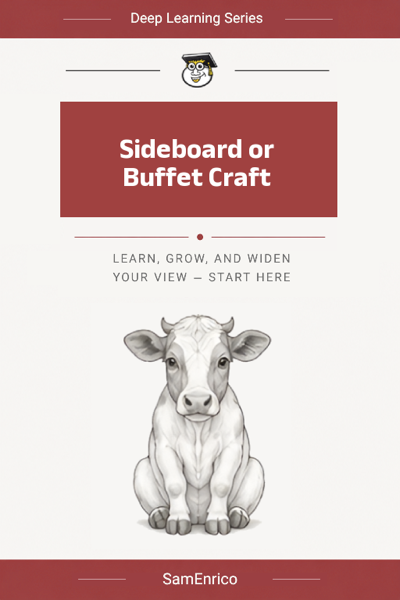
Non-FictionInformativeEducational
Sideboard or Buffet Craft eBook
A Coursebook on Sideboard or Buffet Craft
A Coursebook on Sideboard or Buffet Craft
Formats
Free sample
Chapter 1: Beyond the Buffet...–- The first mistake most woodworkers make when approaching a sideboard is treating it as nothing more than a rectangular box with legs. They measure, cut, assemble, and finish, producing something functional but forgettable. The second mistake is thinking a buffet belongs exclusively in a dining room. The third—and perhaps most damaging—is believing that skill level determines the quality of the outcome rather than intention, planning, and understanding. This book exists to correct all three errors.Before you drive a single nail, spread a single drop of glue, or make a single cut, you need to understand what you are actually building.
A sideboard—whether you call it a buffet, a credenza, a server, or a console—is not merely storage furniture. It is a relational object. It mediates between kitchen and table, between host and guest, between daily clutter and curated display. Its surface holds the Thanksgiving turkey and the Christmas ham. Its drawers store grandmother's silverware and your child's art supplies.
Its doors conceal the mismatched wine glasses and reveal the heirloom china. To build a sideboard well, you must first understand what a sideboard does.This chapter begins not with wood, but with stories. Then it moves to style, helping you identify which of the five major design families aligns with your home, your skills, and your ambitions. Finally, it grounds all of this in a practical worksheet—a tool you will use before drawing a single line on graph paper. By the end of this chapter, you will not know how to cut a dovetail.
You will know something more important: exactly what you are building and why.The Hidden History of the Sideboard The word "sideboard" entered the English language in the late sixteenth century, but the object it describes is far older. In medieval great halls, food was served from a "cupboard" (literally a board for cups) or a "dresser" (a table on which food was dressed or prepared). These early pieces were utilitarian—planks on trestles, sometimes with a lower shelf for storage. They were not furniture in the modern sense; they were tools.The transformation began in the seventeenth century, when the Dutch developed the "kast"—a monumental case piece that combined storage with display. Wealthy merchants showed their pewter, then their porcelain, then their silver behind glass doors.
The English adapted this into the "court cupboard," a tiered side table with open shelves. By the Georgian era (1714–1830), the sideboard had become a status symbol. Thomas Sheraton and George Hepplewhite, the great furniture designers of the age, published patterns for sideboards with serpentine fronts, inlaid satinwood, and brass gallery rails. These pieces no longer just held food; they announced wealth, taste, and lineage.The Victorian era (1837–1901) took this to extremes. Sideboards grew massive, often six feet wide or more, with towering backsplates, mirrored panels, and carved fruit and game birds cascading down their legs.
They were statements of prosperity in an age of industrial excess. But they were also profoundly practical, offering specialized storage for everything from fish forks to finger bowls.The twentieth century brought two revolutions. The first was the Arts and Crafts movement, led by Gustav Stickley and the Greene brothers. They stripped away Victorian ornament, celebrated exposed joinery, and insisted that beauty emerged from honest construction rather than applied decoration. Their sideboards were solid oak, with through-tenons visible on the corners and hammered copper hardware.
The second revolution was modernism. In the 1920s and 1930s, designers like Le Corbusier and Marcel Breuer experimented with tubular steel and plywood. After World War II, Danish designers—most famously Hans Wegner and Finn Juhl—created the "credenza," a low, long sideboard on tapered legs that seemed to float above the floor. This is the ancestor of most sideboards built today: clean-lined, functional, and elegant.Understanding this history is not academic. When you look at a sideboard, you see centuries of decisions about proportion, joinery, and purpose.
A farmhouse sideboard with beadboard panels and turned legs connects to eighteenth-century rural England. A mid-century modern buffet on hairpin legs channels post-war optimism and the rise of open floor plans. A contemporary asymmetrical piece reflects digital-age fluidity. History gives you permission. If you prefer the ornamented curves of Victorian furniture, build them.
If you prefer the severe geometry of the Bauhaus, build that. Your sideboard belongs to a tradition. You get to choose which one.Five Families of Form The history above can be distilled into five distinct stylistic families. Each family has characteristic proportions, materials, joinery, and details. Each also has a different level of difficulty—not because one is "better," but because curves are harder than straight lines, and complex joinery requires more precision than pocket screws.
The table below provides a quick reference, but the descriptions that follow will help you identify which family speaks to you.Style Typical Height Typical Width Typical Depth Characteristic Feet Primary Wood Difficulty Traditional36-40"60-72"20-24"Bun, ball-and-claw, or bracket Mahogany, cherry Advanced Farmhouse34-36"48-72"18-22"Turned, chunky Pine, oak, poplar Beginner-Int.Mid-Century Modern28-32"60-84"16-18"Tapered, angled, or hairpin Teak, walnut, rosewood Intermediate Industrial30-34"48-96"18-20"Metal pipe or angle iron Reclaimed wood, steel Intermediate Contemporary Variable Variable Variable Hidden or integrated Any Advanced Traditional Sideboards Traditional sideboards draw from Georgian, Regency, Victorian, and Edwardian sources. They are characterized by curves—curved fronts, curved aprons, curved legs. They frequently include raised panels (the center of the panel is higher than the frame), inlays or banding, and decorative hardware. The joinery is almost always mortise and tenon, dovetailed drawers, and frame-and-panel construction. The traditional sideboard is not a beginner project.
The curves require bandsaw work and extensive sanding; the raised panels need a router table or a hand plane; the inlays demand precision. But for the experienced woodworker, a traditional sideboard is a chance to demonstrate mastery. Think of it as the classical music of furniture building: complex, rewarding, and timeless.Farmhouse Sideboards The farmhouse style has exploded in popularity over the past decade, and for good reason. It is forgiving, attractive, and deeply rooted in American craft tradition. Farmhouse sideboards are characterized by simple, sturdy construction, painted or lightly stained finishes, and visible hardware.
Beadboard is common for door panels and backs. Legs are turned on a lathe but left chunky and unrefined. The overall impression is one of honest utility—this is a piece meant to hold your everyday dishes and survive children's birthday parties.The farmhouse style is ideal for beginners and intermediates. Construction often uses pocket screws for face frames, butt joints for cases, and simple overlay doors. You can build a farmhouse sideboard with a circular saw, a drill, and a pocket-hole jig.
That accessibility is not a weakness; it is a feature. A well-built farmhouse sideboard has soul, and soul does not require a thousand-dollar tool collection.Mid-Century Modern Sideboards Mid-Century Modern (MCM) sideboards are the most sought-after pieces in vintage furniture markets, and replicating them has become a passion for many woodworkers. The style is defined by clean lines, minimal ornament, and an emphasis on the natural beauty of wood grain. Legs are slender and tapered, often angled outward…
This is the end of the free sample. Get the eBook to keep going. Buy now
About this book
Details
- Author
- Mcreynolds Rhiannon
- Publisher
- SamEnrico
- Language
- English
- Genre
- Non-Fiction, Informative, Educational
- Released
- 2026-06-03
- Pages (approx.)
- 141
- Available as
- eBook, Audiobook

Read better in the ZLOADR app
Your eBooks on your phone or tablet. Sign in with your SamEnrico account and start reading.
More by Mcreynolds Rhiannon
 The I Statement Method GuideMcreynolds Rhiannon$11.99
 HRT For Liver Health CourseMcreynolds Rhiannon$11.99
 Post Hypnotic ChallengeMcreynolds Rhiannon$11.99
 AdTech Investment OutlookMcreynolds Rhiannon$11.99
 The Empathy for Addiction RecoveryMcreynolds Rhiannon$11.99
 The Code of the Jade Masters: Olmec Mathematicians and the Birth of Mesoamerican ScienceMcreynolds Rhiannon$11.99
 London Pop Up Design and BuildMcreynolds Rhiannon$12.99
 Paystack Test Mode GuideMcreynolds Rhiannon$12.99
 Understanding PerimyositisMcreynolds Rhiannon$17.99
 How to Start a Tennis Courts BusinessMcreynolds Rhiannon$11.99
You may also like
 Hong Kong Handover 1997Dunn Johnnie$11.99
 Zumba For Postnatal Recovery CourseNeal Christian$11.99
 Zumba for BeginnersLadner Nikia$11.99
 YouTube Comment Mining GuideHumes Pandora$12.99
 Worry Box MeditationCarlin Rudy$11.99
 Workplace Stress MeditationNguyen Lynn$11.99
 Workplace Stress and Sleep RepairHawley Ivory$11.99
 Workplace Perfectionism CureDelaney Jeffry$11.99
 Workplace Injustice Anger GuideWallen Isabelle$11.99
 Work Addiction and Burnout LinkGreenwood Ester$11.99
 Women in Yoga and WellnessBeattie Galina$11.99
 Women in Stand Up ComedyChun Evangeline$11.99