
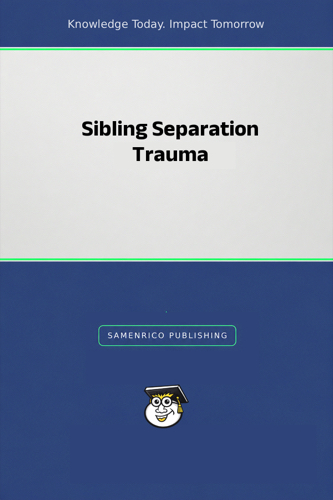
Non-FictionBiographySibling Loss
Sibling Separation Trauma eBook
Tells the story of brothers and sisters split acro
Tells the story of brothers and sisters split across different homes, fighting to stay connected.
Formats
Free sample
Chapter 1: The Unnamed Wound--–- The call came at 2:17 on a Tuesday afternoon. A social worker’s voice, flat and clinical, delivered the news to the foster mother: “We’ve found a placement for Maya. It’s forty-five minutes away. We’ll schedule monthly visits.” The foster mother nodded, wrote down the address, and hung up. Then she turned to the eight-year-old girl sitting on the couch, clutching a stuffed rabbit whose ear had long since been chewed off.
“Maya,” she said, “they found a home for your brother. Leo is going to another family.” Maya did not cry. She did not speak. She simply looked down at the rabbit and began pulling at the loose threads of its remaining ear, one by one, until the white stuffing began to peek through. She would not speak again for three days.This is not a story about bad social workers or broken foster parents.
It is not a story about abuse, though abuse brought Maya and Leo to that couch. It is a story about something most people have never been taught to see: the severing of the longest relationship a human being will ever have. Longer than most marriages. Longer than most friendships. Longer, in many cases, than the relationship with parents.
The sibling bond is the longest relationship in the average person’s life. And when it is broken—deliberately or accidentally, by court order or by logistics—there is no name for what is lost.That is the first problem this book seeks to solve. We have language for parental abandonment. We have therapy protocols for mother loss. We have entire industries built around fatherlessness.
But when a brother and sister are placed in different foster homes, when siblings are separated by divorce, when immigration splits a family across borders, when a parent chooses one child to keep and surrenders another—there is no word for the grief that follows. There is no ritual. There is no cultural script. There is only a child, sitting on a couch, pulling threads from a stuffed animal, unable to speak.This chapter is an invitation to name what has gone unnamed. It is an argument that sibling separation is not merely a sad footnote in a child’s story.
It is a primary trauma, as foundational as the loss of a parent, and in some cases more damaging because it goes unrecognized. To understand why, we must first understand what the sibling bond actually is—not the idealized version from television commercials, but the raw, complicated, life-saving attachment that forms between children who have no one else.The Longest Relationship You Have Never Named Think for a moment about the people in your life. Your parents, if they are still alive, entered your story at your birth. Your spouse or partner entered somewhere in your twenties or thirties or forties. Your children entered when you were already an adult.
But your sibling—if you have one—has been there for nearly your entire conscious life. They knew you before you had a vocabulary for shame. They knew you before you learned to hide your tears. They were there for the first fight, the first secret, the first time you realized that adults could not be trusted to fix everything.The average sibling relationship lasts longer than the average marriage by twenty years. Longer than the average friendship by decades.
And yet, when that relationship is severed, there is no funeral. There is no bereavement leave. There is no support group waiting in a church basement. The child who loses a sibling to the foster care system is told, “You’ll see them next month,” as if monthly visits in a room with a camera in the corner could possibly replace the experience of falling asleep in the same bedroom, of whispering secrets after lights out, of having someone who remembers the same parents, the same house, the same version of yourself that no longer exists.This is what makes sibling loss unique. It is not the loss of an authority figure, like a parent.
It is not the loss of a dependent, like a child. It is the loss of a witness. Your sibling is the only person who knows what your childhood actually looked like, because they were standing right next to you. When that witness disappears, you lose more than a companion. You lose the co-author of your own history.Consider two sisters I will call Jasmine and Tanya.
Removed from their home at ages six and eight, they were placed in separate foster homes because the only available beds were in different counties. For three years, they saw each other once a month for two hours. During those visits, they sat across from each other at a plastic table, a social worker watching from behind one-way glass. They could not hug for more than a few seconds. They could not whisper.
They could not talk about the things that mattered—the night their mother left, the sound of the front door slamming, the way their father’s voice changed when he drank. So they talked about school. About what they had for breakfast. About nothing. After each visit, Jasmine would cry in the car for the entire forty-five-minute drive home.
After the sixth visit, she stopped crying. She stopped talking about Tanya at all. Her foster mother thought she was healing. In fact, she had learned to dissociate—to separate her body from her feelings—because the pain of remembering was worse than the pain of forgetting.The Sibling Paradox: Safety and Danger in the Same Face Here is where the story becomes complicated, and where many well-meaning professionals get it wrong. The sibling bond is not always gentle.
It is not always healing. For children who have experienced abuse, the sibling relationship often contains both safety and danger, sometimes in the same moment.This is the Sibling Paradox. The same brother who protected you from a violent parent may also trigger you because he looks like that parent. The same sister who held your hand during a removal may also remind you of the terror of that day. The same person who was your only source of comfort may also be the only person who remembers the shame you are trying to forget.
This ambiguity does not make the bond less important. It makes it more complicated—and more in need of careful, informed support.The chapter introduces a critical distinction that will recur throughout this book: the difference between losing an authority figure and losing a co-navigator. When a child loses a parent to death, incarceration, or termination of rights, they lose someone who had power over them. That loss is devastating, and it has been well studied. But when a child loses a sibling, they lose someone who was beside them—not above, not below, but equal.
A co-navigator. Someone with whom they could complain about the parents, strategize about survival, and dream about escape.A child can often survive the loss of a parent if they have a sibling to process it with. Two children who lose their mother and are placed together will grieve…
This is the end of the free sample. Get the eBook to keep going. Buy now
About this book
Details
- Author
- Packer Shayla
- Publisher
- SamEnrico
- Language
- English
- Genre
- Non-Fiction, Biography, Sibling Loss
- Released
- 2026-06-06
- Pages (approx.)
- 147
- Available as
- eBook, Audiobook

Read better in the ZLOADR app
Your eBooks on your phone or tablet. Sign in with your SamEnrico account and start reading.
More by Packer Shayla
 Light Therapy For MDDPacker Shayla$11.99
 The Urban vs Rural App PatternsPacker Shayla$11.99
 Acupuncture for EDPacker Shayla$11.99
 Teen Guy Confidence GuidePacker Shayla$11.99
 Excalibur’s Shadow: The Forgotten Enchantress of AvalonPacker Shayla$11.99
 How to Become a Log Loader HelperPacker Shayla$11.99
 Co-Founder CTO vs Hired CTOPacker Shayla$12.99
 Minority Firm Teaming AgreementsPacker Shayla$12.99
 The Breeder's Guide to Rocky Mountain HorsesPacker Shayla$11.99
 Pareto Chart AnalystPacker Shayla$11.99
You may also like
 Hong Kong Handover 1997Dunn Johnnie$11.99
 Zumba For Postnatal Recovery CourseNeal Christian$11.99
 Zumba for BeginnersLadner Nikia$11.99
 YouTube Comment Mining GuideHumes Pandora$12.99
 Worry Box MeditationCarlin Rudy$11.99
 Workplace Stress MeditationNguyen Lynn$11.99
 Workplace Stress and Sleep RepairHawley Ivory$11.99
 Workplace Perfectionism CureDelaney Jeffry$11.99
 Workplace Injustice Anger GuideWallen Isabelle$11.99
 Work Addiction and Burnout LinkGreenwood Ester$11.99
 Women in Yoga and WellnessBeattie Galina$11.99
 Women in Stand Up ComedyChun Evangeline$11.99