
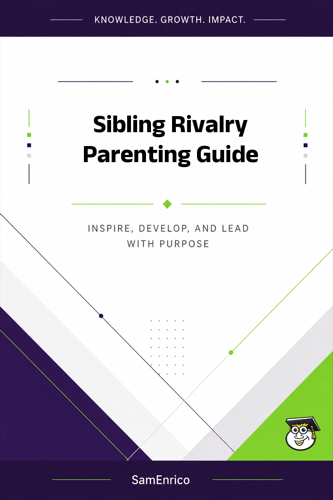
Sibling Rivalry Parenting Guide eBook
Stop your children from fighting and comparing.
Stop your children from fighting and comparing.
Formats
Free sample
Chapter 1: The Peaceful Home Myth--–- The day I stopped believing in peaceful homes was the day my two sons, ages six and eight, reduced a brand-new sofa to a crime scene of grape juice and indignation. The fight started over a stuffed octopus. It escalated into accusations of who breathed on whom. It ended with a flying cup, a screaming match, and me standing in the ruins thinking, What kind of parent raises children who behave like this? That question—the shame buried inside it—is the reason most parents fail at sibling rivalry.
Not because they lack love. Not because they lack effort. Because they are chasing a fantasy that does not exist.Welcome to the first truth of this book: There is no such thing as a peaceful home with multiple children. Not if "peaceful" means the absence of conflict. Not if it means siblings who never raise their voices, never compete for your attention, never shove each other over the last waffle.
That home does not exist. And if you saw a family that appeared to have it, you witnessed either very good acting or very suppressed children.This chapter dismantles the myth that has exhausted more parents than any other: the belief that sibling rivalry is a problem to be eliminated rather than a reality to be managed. You will learn the critical distinction between normal conflict and toxic rivalry. You will understand why the "benign neglect" approach—hoping they work it out—fails so spectacularly. And you will be introduced to Family Systems Theory, the lens through which all subsequent chapters should be viewed.
By the end of this chapter, you will stop asking "How do I make them stop fighting?" and start asking the far more useful question: "What is this fight trying to teach them?"The Grape Juice Sofa Test: Why Your Expectations Are Setting You Up to Fail Let us name the expectation explicitly. Most parents carry an internal image of the "good family." In this image, children share generously, speak kindly, and resolve disagreements with impressive emotional intelligence. When siblings fight—really fight, with volume and tears and accusations—parents feel a specific kind of failure. It is not guilt about the specific incident. It is shame about the pattern.
My children hate each other. I must have done something wrong. Other families don't have this.The research tells a different story. In a landmark longitudinal study of siblings across 200 families, researchers found that children aged two to ten engage in an average of eight conflicts per hour during unstructured play. Eight.
Per hour. That is more than one fight every eight minutes. And here is the detail most parents find relieving: the vast majority of these conflicts last less than two minutes and are forgotten within ten. The parents remember them for hours. The children have moved on to building a pillow fort together.The problem is not the frequency of conflict.
The problem is the meaning you attach to it. When you interpret every squabble as evidence of a broken relationship, you enter a state of chronic parental alarm. From that state, you make terrible decisions: over-intervening, taking sides, dispensing equal punishment, delivering lectures that children have learned to tune out before you finish the first sentence.The Grape Juice Sofa Test is simple. When a fight erupts, ask yourself one question: If I left the room right now, would anyone require medical attention within the next sixty seconds? If the answer is no, you are looking at normal conflict.
If the answer is yes, you are looking at something that requires intervention—and we will cover exactly how to intervene in Chapter 5. But most fights fail the Grape Juice Sofa Test. Most fights are loud, messy, emotionally charged, and fundamentally harmless. They feel like emergencies because they trigger your nervous system. They are not emergencies.
They are practice.Normal Conflict vs. Toxic Rivalry: The Distinction That Changes Everything Not all sibling conflict is created equal. The single most important diagnostic skill you will develop from this book is the ability to distinguish between normal sibling conflict and toxic rivalry. These are not points on a spectrum of severity. They are qualitatively different phenomena requiring entirely different parental responses.
Confusing them is catastrophic. Treating normal conflict as toxic leads to over-parenting, which prevents children from developing negotiation skills. Treating toxic rivalry as normal leads to under-parenting, which allows emotional and physical harm to become entrenched.Normal Sibling Conflict includes the following characteristics:First, it is situational. The fight has a clear trigger—a toy, a turn, a perceived injustice about screen time. Once the trigger is removed or resolved, the conflict dissolves.
Children do not carry grudges from situational fights into unrelated activities.Second, it is symmetrical. Both children participate roughly equally in the escalation. There is not a consistent aggressor and a consistent victim. Power dynamics shift from fight to fight. The child who grabbed the truck in this conflict may be the child who shares their snack in the next.Third, it ends naturally.
Without parental intervention, normal conflicts de-escalate within minutes. Children may cry, shout, or storm off, but they return to play on their own. They do not require a mediated settlement.Fourth, it produces repair. After normal conflict, children spontaneously engage in repair behaviors: tentative offers to play, sharing a snack, sitting closer together on the couch. They may never say the word "sorry," but their actions demonstrate a return to connection.Toxic Rivalry looks fundamentally different:First, it is chronic.
The same patterns repeat daily or weekly with the same roles. One child consistently initiates, and one child consistently ends up hurt—physically or emotionally. There is no rotation of power.Second, it is asymmetrical. There is a clear aggressor and a clear victim. The aggressor shows little to no distress during or after the conflict.
The victim shows signs of genuine fear, not just frustration. If you ask the victim "Are you okay?" and they flinch or withdraw, you are likely looking at toxic dynamics.Third, it does not end naturally. Toxic conflicts escalate without intervention. What begins as a verbal jab becomes name-calling becomes physical aggression becomes exclusion. If left alone, these fights get worse, not better.Fourth, it produces alienation.
After toxic conflict, children do not seek each other out. They may avoid each other for hours or days. The victim may hide in their room. The aggressor may boast or show no awareness of the harm caused.Here is the complicating factor that trips up most parents: toxic rivalry often begins as normal conflict that was mismanaged over time. When parents consistently fail to intervene appropriately—either by ignoring early warning signs or by punishing both children equally—they inadvertently train the aggressor that there are no consequences and train the victim that no one will protect them.
Over months and years, normal sibling squabbling crystallizes into toxic rivalry. This is why early, appropriate intervention matters so much. And it is why this book exists.Why "Benign Neglect" Fails: The Neuroscience of Sibling Conflict There is a well-intentioned school of parenting advice that says: Stay out of it. Let…
This is the end of the free sample. Get the eBook to keep going. Buy now
About this book
Details
- Author
- Crittenden Sage
- Publisher
- SamEnrico
- Language
- English
- Genre
- Non-Fiction, Biography, Parenting
- Released
- 2026-06-07
- Pages (approx.)
- 144
- Available as
- eBook, Audiobook

Read better in the ZLOADR app
Your eBooks on your phone or tablet. Sign in with your SamEnrico account and start reading.
More by Crittenden Sage
 Smartwatch Heart Rate CheckCrittenden Sage$11.99
 Kettlebell HIIT WorkoutsCrittenden Sage$11.99
 Warrant Reset TermsCrittenden Sage$11.99
 The Literary Scout: How One Agent Changed Africa’s StorytellingCrittenden Sage$11.99
 Pharmacist TechnicianCrittenden Sage$11.99
 How to Start a Lodging House (local Authority) Business (Beginners Guide)Crittenden Sage$11.99
 Spot Factoring for SMEs WorkbookCrittenden Sage$12.99Spot Factoring for SMEs WorkbookCrittenden Sage$12.99
 How to Produce a Chaff CutterCrittenden Sage$11.99
You may also like
 Hong Kong Handover 1997Dunn Johnnie$11.99
 Zumba For Postnatal Recovery CourseNeal Christian$11.99
 Zumba for BeginnersLadner Nikia$11.99
 YouTube Comment Mining GuideHumes Pandora$12.99
 Worry Box MeditationCarlin Rudy$11.99
 Workplace Stress MeditationNguyen Lynn$11.99
 Workplace Stress and Sleep RepairHawley Ivory$11.99
 Workplace Perfectionism CureDelaney Jeffry$11.99
 Workplace Injustice Anger GuideWallen Isabelle$11.99
 Work Addiction and Burnout LinkGreenwood Ester$11.99
 Women in Yoga and WellnessBeattie Galina$11.99
 Women in Stand Up ComedyChun Evangeline$11.99