
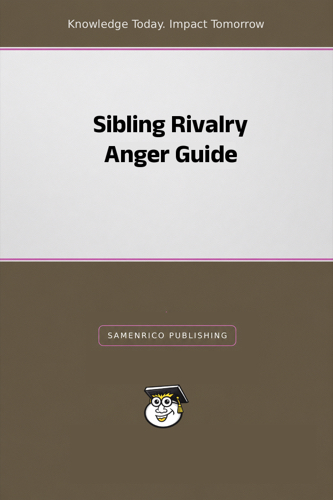
Non-FictionSelf-HelpSibling Conflict
Sibling Rivalry Anger Guide eBook
Stop yelling at fighting children and mediate calm
by Yoo Odette
Stop yelling at fighting children and mediate calmly using this workbook.
Formats
Free sample
Chapter 1: The 90-Second Lie--–- You have been lied to. Not by a person, but by a feeling. The lie sounds like this: When your children start fighting, you must do something immediately. This single, unspoken belief is the reason you yell. It is the reason you feel like a monster afterward.
And it is the reason nothing you have tried so far has worked for more than a week.The truth is more radical, more uncomfortable, and ultimately more freeing than any parenting advice you have ever received. Here it is: In most sibling conflicts, doing nothing for ninety seconds is the most powerful intervention you will ever learn.This chapter is not about your children. It is about your nervous system. Before you can mediate a single fight, before you can teach a single skill, before you can stop yelling, you must understand why your own body betrays you in the heat of the moment. You are not broken.
You are not a bad parent. You are simply operating on bad information about how anger actually works.The Moment Before the Yell Think about the last fight that made you lose your cool. Not the small bickering. The one where your voice rose before you could stop it. The one where you said something you regretted.
The one where, five minutes later, you stood in the kitchen with your head in your hands thinking, Why did I do that again?Let us rewind to the ten seconds before that yell.Your children were probably doing something ordinary. One took a toy. The other screamed. Maybe there was a push. Maybe a door slammed.
And in that instant, something happened inside your body that you did not choose and could not control. Your heart rate increased. Your breathing became shallow. Your jaw tightened. Your field of vision narrowed.
Your brain, in a fraction of a second, made a calculation: This is a threat.Here is the cruel irony. Your children were not actually threatening you. They were threatening each other. But your nervous system does not distinguish between a threat to your physical safety and a threat to your emotional peace. To your amygdala – the ancient, reptilian part of your brain that has not evolved in a hundred thousand years – a screaming child is the same as a charging predator.
Your body prepares to fight, flee, or freeze.And because you cannot flee (you are the parent) and you cannot freeze (something must be done), you fight. You yell. It is not a moral failure. It is a neurological misfire dressed up in a parent's body.The High-Five Rule You Have Never Heard Of Here is where the lie unravels. The physiological surge of anger – the racing heart, the tense muscles, the urge to act – lasts, on average, ninety seconds.
That is it. Ninety seconds from peak activation to natural resolution, provided you do not feed the fire with more thoughts, more actions, or more words.This is called the "High-Five Rule," named for the ninety-second timeout in high-stakes sports. A hockey player sits in the penalty box for two minutes. Your nervous system needs only ninety seconds to cool down on its own. But most parents never experience this natural resolution because they believe they must act immediately.
So they do. They step into the fight. They assign blame. They threaten consequences. They yell.
And each of those actions sends a fresh surge of adrenaline through their system, resetting the ninety-second clock.You are not angry for hours because your children keep fighting. You are angry for hours because you keep intervening while you are angry, and each intervention resets your nervous system back to zero.Think about that. The very thing you are doing to solve the problem – intervening immediately – is the thing that keeps you trapped in the anger loop. You are the one resetting your own timer. Your children are not making you stay angry.
You are making yourself stay angry by refusing to pause.The Three Stages of the Yelling Spiral Understanding the ninety-second wave is not enough. You must also recognize the three distinct physical stages that precede every yell. These stages happen whether you notice them or not. The difference between a parent who yells and a parent who pauses is simply awareness.Stage One: The Tightening (0 to 10 seconds)This is the first sign. Your chest feels tight.
Your shoulders rise toward your ears. Your jaw clenches. You might notice that your hands have formed fists without your permission. Your breathing becomes shallow – chest breaths instead of belly breaths. Your voice, if you speak, sounds higher or tighter than usual.At this stage, you still have a choice.
The physiological surge has begun, but it has not yet taken over. Most parents miss this stage entirely because they are focused on the children. By the time they notice their own body, they are already in Stage Two.Stage Two: The Heat (10 to 30 seconds)Heat rises up the back of your neck. Your face feels flushed. Your heart is pounding audibly in your ears.
Your thoughts narrow to a single track: Make it stop. Make it stop now. Your peripheral vision actually decreases – a physiological response called "tunnel vision" that helps predators focus on prey. Unfortunately, your "prey" is your own child.At this stage, your prefrontal cortex – the logical, empathetic, long-term planning part of your brain – is being overridden by your amygdala. You literally cannot access your best parenting skills right now.
They are offline. Any solution you offer at this stage will be punitive because your brain has categorized the situation as a survival threat, not a teaching moment.Stage Three: The Release (30 to 90 seconds)This is the yell. It feels involuntary because, by this point, it nearly is. Your body has been building toward this release for a full minute. The yell provides a temporary sense of relief – a burst of endorphins, a release of pressure – which is why yelling can feel almost satisfying in the moment.
But that relief lasts seconds. The shame that follows lasts hours.The cruelest part of Stage Three is that the yell does not solve anything. It does not teach your children to stop fighting. It does not make them respect you more. It only teaches them that when conflict escalates, the loudest voice wins.
And it teaches you that you cannot control yourself.But you can. You just need to catch yourself in Stage One.Triggers vs. Kindling: Why Some Days You Explode Faster You have probably noticed that some days you can handle the same fight with patience, and other days you lose your mind over a minor squabble. This is not random. It is the difference between a trigger and kindling.The trigger is the fight itself.
The toy snatch. The scream. The door slam. You cannot control triggers. They will happen.
That is life with siblings.The kindling is everything else that has lowered your threshold before the fight even began. Lack of sleep. Hunger. A stressful day at work. A deadline.
A headache. A fight with your partner. Financial worry. Past trauma. Each of these things is like dry wood stacked…
This is the end of the free sample. Get the eBook to keep going. Buy now
About this book
Details
- Author
- Yoo Odette
- Publisher
- SamEnrico
- Language
- English
- Genre
- Non-Fiction, Self-Help, Sibling Conflict
- Released
- 2026-06-06
- Pages (approx.)
- 112
- Available as
- eBook, Audiobook

Read better in the ZLOADR app
Your eBooks on your phone or tablet. Sign in with your SamEnrico account and start reading.
More by Yoo Odette
 Self Care for Military ParentsYoo Odette$11.99
 Eisenhower Matrix for Financial GoalsYoo Odette$11.99
 Mindfulness for Tinnitus GuideYoo Odette$11.99
 King Leopold's Ghost RevisitedYoo Odette$11.99
 Startup Software DeductionYoo Odette$11.99
 Home Office Deduction Optimization HandbookYoo Odette$11.99
 Depression And ThyroidYoo Odette$11.99
 The Rape of Nanking: Japan's Forgotten AtrocityYoo Odette$11.99
 The Banquet of the Medici: A Feast of Renaissance GeniusYoo Odette$11.99
 Mastering The Art of ScotlandYoo Odette$11.99
 A Collector's Handbook to the Fiat 500 4-seater (1939-40)Yoo Odette$11.99
 Online Exam Backup Power GuideYoo Odette$12.99
You may also like
 Hong Kong Handover 1997Dunn Johnnie$11.99
 Zumba For Postnatal Recovery CourseNeal Christian$11.99
 Zumba for BeginnersLadner Nikia$11.99
 YouTube Comment Mining GuideHumes Pandora$12.99
 Worry Box MeditationCarlin Rudy$11.99
 Workplace Stress MeditationNguyen Lynn$11.99
 Workplace Stress and Sleep RepairHawley Ivory$11.99
 Workplace Perfectionism CureDelaney Jeffry$11.99
 Workplace Injustice Anger GuideWallen Isabelle$11.99
 Work Addiction and Burnout LinkGreenwood Ester$11.99
 Women in Yoga and WellnessBeattie Galina$11.99
 Women in Stand Up ComedyChun Evangeline$11.99