
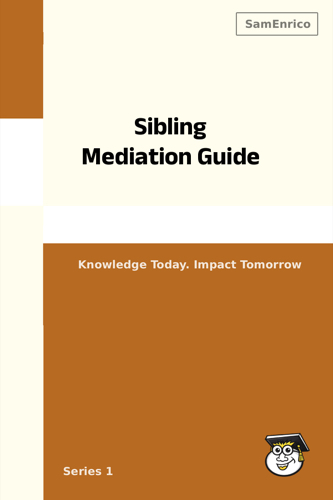
Sibling Mediation Guide eBook
Use neutral third party to resolve disputes.
by Derr Weston
Use neutral third party to resolve disputes.
Formats
Free sample
Chapter 1: The Scream Cycle...–- You hear it from the other room. The shriek. The thud. The wail of “MOM, HE HIT ME!” followed by the indignant “SHE STARTED IT!” Your shoulders tense. Your jaw clenches.
You have a choice: ignore it and hope they work it out (they won’t), or march in and play judge, jury, and executioner (they’ll resent you for it). Either way, you lose. Either way, the screaming returns tomorrow.This is the Scream Cycle. And this book is your way out.The Universal Morning That Breaks Parents It is 7:32 AM. You have not yet had coffee.
Your four-year-old wants the blue bowl. Your seven-year-old is already holding the blue bowl. The four-year-old grabs it. The seven-year-old holds on. Cereal sprays across the counter like a dairy-based crime scene.
The four-year-old screams. The seven-year-old yells, “You’re a baby!” The four-year-old hits. The seven-year-old hits back harder. You walk in, coffee-less, and say the words you have said four thousand times before: “I don’t care who started it. Give her the bowl.
No, wait, you had it first. No—stop crying—fine, nobody gets the bowl. Everyone is in time-out. I am done.”You are not done. You will never be done.
Because you just solved nothing. You taught them that the parent is the referee, that the goal is to win the parent’s favor, that conflict ends when an authority figure descends from on high with a verdict. You also taught them that their feelings don’t matter, that the truth doesn’t matter, and that the only thing that matters is who can cry louder or lie more convincingly before you arrive.This is not a failure of your parenting. This is a failure of the model.Every parent of multiple children inherits a default conflict resolution system without ever choosing it. That system has three settings: ignore, separate, or dictate.
Ignore the fighting and you teach the stronger child that aggression works. Separate the children and you teach them that conflict is so dangerous it requires quarantine, but you teach them nothing about how to re-enter. Dictate a solution and you teach them that authority, not negotiation, resolves disputes—which works beautifully until you are not in the room.The Scream Cycle persists because parents are given a referee’s whistle when what they actually need is a mediator’s script.The Sibling Relationship Trap Here is a fact that will rearrange your understanding of your children’s fighting. The sibling relationship is the longest relationship most human beings will ever have. Longer than the relationship with parents.
Longer than the relationship with spouses. Longer than the relationship with children. Your seven-year-old and four-year-old will know each other for seventy or eighty years. They will attend each other’s weddings. They will sit together at your funeral.
They will be old people together, remembering the blue bowl incident of 2026.Now ask yourself: what do you want that eighty-year relationship to be built on?A 2012 study from Brigham Young University followed 308 adolescents and found that sibling conflict in childhood was a stronger predictor of depression and anxiety in teenage years than parent-child conflict. Not stronger than peer conflict. Stronger than conflict with parents. The researchers were surprised by the magnitude. They had expected parents to matter more.
They were wrong.The reason is simple: siblings are inescapable. You can leave a playground bully. You cannot leave your brother. You can avoid a mean kid at school. You cannot avoid the sister who shares your bathroom, your dinner table, your parents’ attention, and your genetic legacy.
Sibling relationships are forced proximity relationships. And forced proximity plus unresolved conflict equals chronic low-grade trauma.But here is the good news buried inside that alarming fact. The same inescapability that makes sibling conflict so damaging also makes sibling conflict resolution so transformative. Because siblings have thousands of opportunities to practice. A child who learns to resolve disputes with a sibling is not learning a skill for childhood.
They are learning a skill for every roommate, every coworker, every romantic partner, and every future in-law they will ever have.The sibling relationship is the practice field for life. And right now, you are coaching the wrong game.Healthy Friction vs. Harmful Aggression Not all conflict is bad. This is the most important distinction in the entire book, and it is the distinction that most parents miss.Healthy friction is disagreement over resources, attention, ideas, or turn-taking that does not involve physical harm, humiliation, or systematic exclusion. Healthy friction sounds like: “I had it first!” “No, I did!” “You’re not sharing!” “You’re using it wrong!” It is loud, irritating, and developmentally essential.
Healthy friction teaches children that other people have different perspectives, that the world does not revolve around them, and that conflict can be resolved without catastrophe. Children who experience zero sibling friction—only parental dictation—grow into adults who freeze when a coworker disagrees with them. They never learned that disagreement is survivable.Harmful aggression is different. Harmful aggression includes physical harm (hitting, biting, kicking that leaves marks or causes pain), humiliation (public shaming, mocking, deliberate embarrassment), systematic exclusion (“You can’t play with us and no one else can either”), and character assassination (“You’re stupid, you’re ugly, you’re a loser”). Harmful aggression requires immediate adult intervention and, often, the parent stepping out of the mediator role and into the arbitrator role (see Chapter 11).Here is the nuance that confuses parents.
A child can hit out of healthy friction. A four-year-old who lacks language may hit when a toy is taken. That is not necessarily harmful aggression; it is an underdeveloped skill. The distinction is not about the behavior alone. It is about pattern, intent, and power.
A single hit from a four-year-old who is still learning impulse control is different from a ten-year-old who systematically punches a younger sibling whenever the parent leaves the room. One is a skill gap. The other is a safety issue.The parent’s job is to know the difference. Most parents err on the side of treating everything as harmful aggression, which leads to over-intervention and children who never learn to self-regulate. Or they err on the side of treating everything as healthy friction, which leads to under-intervention and children who learn that aggression is acceptable.
This book will teach you to distinguish between the two with a simple decision tree.The Judge, The Referee, and The Mediator Before we go further, we need to name the three roles a parent can play in sibling conflict. You have played all of them. Only one works.The Judge arrives on the scene and asks, “What happened?” Then the Judge listens to both sides, weighs evidence, determines who is at fault, and issues a verdict. “You started it, so you apologize. You hit back, so you also apologize.
The toy goes to her because she had it first.” The Judge’s word is final. There is no appeal.The problem with the Judge is not that the Judge is unfair. The problem is that the Judge teaches children to be lawyers. Children learn to present their…
This is the end of the free sample. Get the eBook to keep going. Buy now
About this book
Details
- Author
- Derr Weston
- Publisher
- SamEnrico
- Language
- English
- Genre
- Non-Fiction, Biography, Mediation
- Released
- 2026-06-08
- Pages (approx.)
- 138
- Available as
- eBook, Audiobook

Read better in the ZLOADR app
Your eBooks on your phone or tablet. Sign in with your SamEnrico account and start reading.
More by Derr Weston
 League of Legends Addiction GuideDerr Weston$11.99
 HIIT and Strength TrainingDerr Weston$11.99
 Gua Sha Scraping GuideDerr Weston$11.99
 The Iron Chancellor: Bismarck’s Political Mastery and the Birth of Modern GovernanceDerr Weston$11.99
 Process Safety Management CoordinatorDerr Weston$11.99
 How to Become a Patch DrillerDerr Weston$11.99
 How to Produce Changing Mat and Tray CoversDerr Weston$11.99
 Distressed Receivable Factoring GuideDerr Weston$12.99
You may also like
 Hong Kong Handover 1997Dunn Johnnie$11.99
 Zumba For Postnatal Recovery CourseNeal Christian$11.99
 Zumba for BeginnersLadner Nikia$11.99
 YouTube Comment Mining GuideHumes Pandora$12.99
 Worry Box MeditationCarlin Rudy$11.99
 Workplace Stress MeditationNguyen Lynn$11.99
 Workplace Stress and Sleep RepairHawley Ivory$11.99
 Workplace Perfectionism CureDelaney Jeffry$11.99
 Workplace Injustice Anger GuideWallen Isabelle$11.99
 Work Addiction and Burnout LinkGreenwood Ester$11.99
 Women in Yoga and WellnessBeattie Galina$11.99
 Women in Stand Up ComedyChun Evangeline$11.99