

Non-FictionBiographyLove Languages
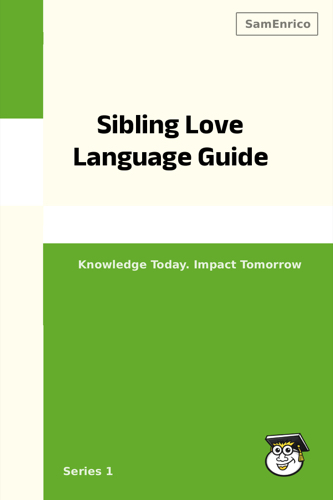
Sibling Love Language Guide eBook
Express care through acts of service or gifts.
by Quezada Cher
Express care through acts of service or gifts.
Formats
Free sample
Chapter 1: The Closet War...--It begins, as most wars do, with something small. A borrowed sweatshirt returned stained. A Lego piece swallowed by the vacuum cleaner during a vengeful cleaning spree. The last slice of pizza claimed not by right of hunger but by right of speed. In thousands of homes every evening, the same scene unfolds: two children who share DNA, a bathroom, and a family history cannot share a few square feet of living room carpet without generating enough static electricity to power a small city.Parents watch from the kitchen, exhausted.
They have tried everything. Equal portions. Timers on the video game controller. The stern voice. The calm voice.
The "we are a family that loves each other" lecture delivered for the seventeenth time. Nothing works. Or rather, nothing works for long. Because the parents are trying to solve the wrong problem.The conventional wisdom about sibling conflict is that it stems from rivalry—competition for parental attention, for status, for the front seat, for the last word. This is not wrong, but it is incomplete.
Rivalry explains why siblings fight. It does not explain what they are fighting about. And if you listen closely to the actual words children hurl at each other, a pattern emerges that has nothing to do with the front seat."You never help me clean up.""You never get me anything.""You broke my thing.""You didn't save me any."These are not complaints about fairness in the abstract. These are complaints about specific kinds of care. And they map almost perfectly onto two of the five love languages identified by Dr.
Gary Chapman in his decades of work on human relationships: Acts of Service and Receiving Gifts. But here is what Chapman himself did not fully explore—and what this book exists to remedy: siblings live in a unique emotional ecosystem where these two languages are not merely preferences. They are survival tools.The Hidden Language of the Playroom Imagine two siblings, ages nine and twelve. The nine-year-old, let us call her Maya, spends an afternoon making a bracelet for her older brother. She picks colors she knows he likes—navy and silver, his team's colors.
Weaves it carefully. Presents it with genuine excitement.Her brother, Leo, glances at it. "Cool," he says, and sets it on his desk. He does not wear it. He does not put it on his backpack.
He does not mention it again.Maya is crushed. Leo is confused. He said "cool." What more does she want?Now imagine a different scenario. Leo notices that Maya's backpack is overflowing, her homework crumpled at the bottom. Without being asked, he takes ten minutes to organize it—folded papers in one pocket, pencils sharpened, water bottle secured.
He does not announce this. He just does it.Maya barely notices. Or worse, she is annoyed that he touched her things. "Don't go through my backpack," she says.Leo is hurt. Maya is confused.
He was helping. What more does she want?These two scenarios are not hypothetical. They play out in millions of homes every day, and they explain why verbal expressions of love—"I love you, bro"—often fail between siblings. Maya and Leo are not speaking different dialects. They are speaking different languages entirely.
Maya's native language is Receiving Gifts. For her, love is spelled T-H-O-U-G-H-T. A bracelet made with her brother's colors in mind is a declaration of care. A saved snack. A found rock.
A meme sent at exactly the right moment. These are her love letters.Leo's native language is Acts of Service. For him, love is spelled T-I-M-E. An organized backpack. A chore covered during exam week.
A door held open. A water bottle refilled without being asked. These are his love letters.They are writing to each other in languages the other does not fluently read. And then they are getting angry at each other for not responding correctly. It would be tragic if it were not so ordinary.The Psychology of Equity: Why Siblings Keep Score There is a reason siblings, more than any other relationship, obsessively track fairness.
Developmental psychologists call this the psychology of equity, and it emerges around age four or five, intensifies through middle childhood, and peaks in early adolescence. Children are hardwired to notice when they give more than they receive. This is not selfishness. It is a cognitive milestone—the dawning awareness that relationships involve exchange, and that imbalances feel wrong.But here is where the love language lens becomes essential. Siblings are not tracking the same currency.
Maya is tracking gifts given and received. Leo is tracking services performed and received. When Maya gives Leo a bracelet (a gift) and receives nothing back (in her currency), she perceives an imbalance. When Leo helps Maya with her backpack (a service) and receives no reciprocal help (in his currency), he perceives an imbalance.They are both right. And they are both wrong.
They are right that the exchange is imbalanced—in their own currency. They are wrong to assume that their sibling is tracking the same currency.This is the core argument of this book, and it bears repeating because it is counterintuitive: most sibling conflict is not caused by malice, selfishness, or even typical rivalry. It is caused by a language barrier. Your sibling is not ignoring you. They are speaking French while you are speaking Japanese.
And neither of you has a phrasebook.The Two Languages We Will Learn This book focuses on two of Chapman's five love languages because they are the most action-oriented, the most observable, and the most conflict-prone in sibling relationships. (The other three—Words of Affirmation, Quality Time, and Physical Touch—matter, but they create less confusion because they are more easily interpreted across siblings. A hug is a hug. A "good job" is recognizable. But a gift?
A service? These require translation.)Acts of Service are actions taken to reduce a sibling's burden or increase their capacity. They can be physical (doing a chore, fixing something), logistical (covering a shift, sharing a resource), or emotional (listening without interrupting, waiting up to unlock the door). The defining feature is effort on behalf of the other.Receiving Gifts are tangible symbols of being remembered. They can be purchased (a small toy, a snack) or created (a drawing, a playlist, a meme).
They can be expensive or free. The defining feature is remembrance expressed through an object.Throughout this book, we will refer to these as the Service language and the Gift language. Some siblings are bilingual—they understand and appreciate both equally. Others are strongly one or the other. A smaller group falls into what we will call the Conflict Zone: they prefer to give love in one language but receive it in the other.
(For example, a sibling who loves doing things for others but feels most loved when given gifts.)The Assessment Journey Before we go any further, a note about the assessment you will encounter in Chapter 2. That assessment is not a verdict. It is a starting point. Love language preferences shift with age, stress, and context. A seven-year-old who craves gifts may become a teenager…
This is the end of the free sample. Get the eBook to keep going. Buy now
About this book
Details
- Author
- Quezada Cher
- Publisher
- SamEnrico
- Language
- English
- Genre
- Non-Fiction, Biography, Love Languages
- Released
- 2026-06-10
- Pages (approx.)
- 122
- Available as
- eBook, Audiobook

Read better in the ZLOADR app
Your eBooks on your phone or tablet. Sign in with your SamEnrico account and start reading.
More by Quezada Cher
 TCM Digestion FixQuezada Cher$11.99
 Hinge Addiction Recovery GuideQuezada Cher$11.99
 HIIT Community ChallengeQuezada Cher$11.99
 The Codebreaker Heir: Alan Turing's Legacy in Silicon ValleyQuezada Cher$11.99
 Public Health NurseQuezada Cher$11.99
 How to Produce Check PresentersQuezada Cher$11.99
 AI Financial Reporting AutomationQuezada Cher$12.99
You may also like
 Hong Kong Handover 1997Dunn Johnnie$11.99
 Zumba For Postnatal Recovery CourseNeal Christian$11.99
 Zumba for BeginnersLadner Nikia$11.99
 YouTube Comment Mining GuideHumes Pandora$12.99
 Worry Box MeditationCarlin Rudy$11.99
 Workplace Stress MeditationNguyen Lynn$11.99
 Workplace Stress and Sleep RepairHawley Ivory$11.99
 Workplace Perfectionism CureDelaney Jeffry$11.99
 Workplace Injustice Anger GuideWallen Isabelle$11.99
 Work Addiction and Burnout LinkGreenwood Ester$11.99
 Women in Yoga and WellnessBeattie Galina$11.99
 Women in Stand Up ComedyChun Evangeline$11.99