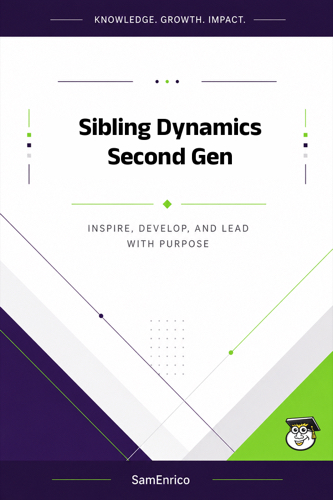
Sibling Dynamics Second Gen eBook
Compare how you and your siblings each navigated i
Compare how you and your siblings each navigated immigrant heritage.
Formats
Free sample
Chapter 1: The Accidental Translator...--–- The first time Soo-jin Kim translated for her mother, she was nine years old, standing in a fluorescent-lit examination room at Queens General Hospital, watching a doctor deliver a cancer diagnosis in English that her mother could not understand. Soo-jin repeated the words in Korean—"유방암. breast cancer. Stage two."—and watched her mother's face collapse. Then she watched her mother smooth her expression back into composure, thank the doctor, and ask, in Korean, whether she could still cook dinner for the family that night.
Soo-jin translated the doctor's confused reply—"She should rest, actually"—and her mother's firm response—"I will rest when I am dead." Soo-jin was nine. She did not cry until she got home, and then she cried in the bathroom where no one could see her, because she had already learned that translators do not get to fall apart. They are the bridge. Bridges do not weep.Twenty years later, Soo-jin is a thirty-year-old corporate lawyer in Manhattan, unmarried, sleep-deprived, and profoundly resentful of her younger sister, Mi-young, who is twenty-seven, lives in a rent-stabilized apartment in Bushwick, works as a graphic designer, and has never translated a single document for their parents. Mi-young does not know how to dispute a utility bill in Korean.
She does not know how to explain an MRI result. She does not know that their mother sometimes cries in the car after oncology appointments, because Soo-jin stopped telling her years ago. "You don't carry anything," Soo-jin said during their last family dinner, after their mother had asked Mi-young, gently, whether she might consider learning more Korean. Mi-young had laughed and said, "Google Translate exists, Mom." Soo-jin had felt something inside her chest crack open. "You don't carry anything," she repeated, quieter this time.
Mi-young looked at her like she was insane. Their mother looked at the table. Their father, who speaks no English and has never spoken more than two sentences about his feelings, ate his rice in silence.This chapter is for Soo-jin. And for Mi-young. And for every second-generation sibling who has ever stood in a bank, a hospital, a courtroom, a school, translating fear into a language that does not belong to them, while their sibling scrolled through Instagram in the waiting room.
This chapter is about the most invisible form of parentification: the language broker. It is about the specific, grinding weight of being the child who learned early that love requires labor, and about the sibling who never had to learn that lesson at all.The Structural Transformation of Childhood The term "language broker" emerged in sociolinguistic research in the 1990s, when scholars began studying the children of immigrants who served as linguistic intermediaries for their families. Unlike professional interpreters, who are trained, compensated, and emotionally detached, language brokers are children. They are unpaid. They are untrained.
And they are translating not contracts or menus but the texture of their parents' vulnerability.What researchers discovered is that language brokering is not merely a task. It is a structural transformation of the parent-child relationship. When a child translates for a parent, the hierarchy inverts. The child gains access to adult information—finances, medical diagnoses, legal troubles, marital conflicts—that most children are protected from. The child becomes the parent's interface with the world.
The child learns, often before puberty, that the adults in their life are not all-powerful. They are frightened, sometimes illiterate in the dominant language, often dependent.This inversion has two faces, and every language broker knows both of them.The Face of Power: The translator child gains premature authority. They become the family's de facto decision-maker, the one who knows where the money is, what the doctor said, whether the landlord is bluffing. This breeds competence, confidence, and a kind of cold efficiency. Soo-jin, by age fourteen, could negotiate a lease renewal in two languages, calm her mother's panic about a mammogram, and explain a notice of eviction to her father without raising her voice.
Her teachers described her as "mature for her age." Her friends' parents called her "responsible." She learned to take pride in this role—to see herself as the capable one, the dependable one, the one who held the family together.The Face of Weight: But the same role that granted Soo-jin power also burdened her with invisible costs. The terror of mistranslating a mortgage document—what if she said the wrong number, and they lost the dry cleaner? The shame of explaining her mother's illiteracy to a bank teller who looked at her with pity. The exhaustion of being the family's sole interface with a system that was often hostile, always indifferent, and never designed for a child. And the deepest cost: Soo-jin lost the ability to be angry at her parents.
She had seen their vulnerabilities too clearly. She knew that her mother's cancer was not her mother's fault, that her father's silence was grief, not neglect. But anger does not disappear. It transfers. And Soo-jin's anger transferred to the only safe target: her younger sister, who never had to carry any of it.The Sibling Split: Parentified Translator vs.
Protected Baby Every immigrant family with multiple children produces a version of this split, though it takes different shapes depending on birth order, gender, and age of arrival. In most cases, the Parentified Translator is the eldest child, or the one who arrived at an age that required rapid language acquisition, or the daughter in a family where sons are exempted from care labor. The Protected Baby is the younger sibling born in the new country, or the one who arrived too young to remember language acquisition as trauma, or the son in a family where translation is considered women's work.The psychological profiles of these two positions are strikingly consistent across families, cultures, and immigration histories.The Parentified Translator develops what psychologists call "precocious maturity." They are often anxious, hyper-responsible, and prone to burnout. They have difficulty relaxing, delegating, or trusting others to handle important tasks. They may struggle with intimacy, having learned that love is labor and that their value lies in what they can do for others, not who they are.
In adulthood, they often choose high-pressure careers—law, medicine, finance—that replicate the stress and competence of their childhood role. They may resent their siblings deeply but also feel responsible for them, trapped in a loop of care and contempt.The Protected Baby experiences childhood as childhood. They may remember the family's immigration story as a narrative, not a lived experience. They did not spend weekends on hold with utility companies or afternoons in hospital waiting rooms. They may see the parentified sibling as bossy, controlling, or dramatic—"She always thinks she's the mother." They may feel judged and criticized, without understanding the weight that makes their sibling so sharp.
And they may carry their own form of pain: the sense that they are less "authentic" than their sibling, less connected to the culture, less loved by parents who seem to rely more on the translator.The tragedy is that neither sibling sees the other's reality clearly. The parentified translator believes the protected baby is selfish, naive, and…
This is the end of the free sample. Get the eBook to keep going. Buy now
About this book
Details
- Author
- Trahan Serafina
- Publisher
- SamEnrico
- Language
- English
- Genre
- Non-Fiction, Biography, Sibling
- Released
- 2026-06-09
- Pages (approx.)
- 153
- Available as
- eBook, Audiobook

Read better in the ZLOADR app
Your eBooks on your phone or tablet. Sign in with your SamEnrico account and start reading.
More by Trahan Serafina
 Attention Block Scheduling CourseTrahan Serafina$11.99
 Imposter Syndrome For Mid Career ProsTrahan Serafina$11.99
 Pre Exam Sleep StrategyTrahan Serafina$11.99
 John Coltrane Love SupremeTrahan Serafina$11.99
 Keto Cholesterol Response GuideTrahan Serafina$11.99
 Family Subscription RetentionTrahan Serafina$11.99
 Annuity Income OptionsTrahan Serafina$11.99
 The Fur Trade Pioneers: Canada's Path to ProsperityTrahan Serafina$11.99
 The Gold Coast Heist: The Unlikely Duo Who Stole Millions in Broad DaylightTrahan Serafina$11.99
 How to Produce Skate HelmetsTrahan Serafina$11.99
 Middle East Sales Exit Barriers GuideTrahan Serafina$12.99
 WIPO Madrid Dependency RuleTrahan Serafina$12.99