
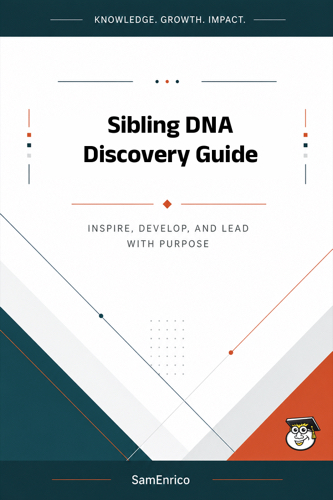
Sibling DNA Discovery Guide eBook
Process unexpected genetic connection results.
Process unexpected genetic connection results.
Formats
Free sample
Chapter 1: The Tuesday Email–- The email arrived at 2:47 on a Tuesday. I remember the time because I took a screenshot before I even understood what I was looking at. The subject line was benign—“DNA Match Update: New Close Relatives”—the kind of notification that usually meant a second cousin in Nebraska had uploaded a family tree. I clicked it while standing in my kitchen, a half-eaten apple in one hand, my phone in the other. The apple was Honeycrisp.
I remember that too. Not because it matters, but because the mind latches onto useless details when the world beneath it is shifting.The match was listed as “Immediate Family.” The shared DNA was 1,782 centimorgans across forty-three segments. The name was a woman I had never heard of, living in a state I had never visited. Ancestry DNA’s algorithm predicted, with absolute confidence, that this person was my half-sibling.I did not have a half-sibling. I had one brother, the one I grew up with, the one who stole my Lego sets and defended me from bullies and now lived three states away and called me on birthdays.
My parents had been married for forty-two years. My father was a quiet accountant who kept meticulous records of everything, including, presumably, his paternity. There was no room in this picture for a half-sibling.And yet there she was.I stared at the screen for what felt like an hour but was probably ninety seconds. Then I did exactly what I am about to tell you not to do: I messaged her. I typed something clumsy and terrified—“Hi, this is weird, but we matched as close family?”—and hit send before I could think better of it.
She replied within minutes. She had known about me for years. Her mother, it turned out, had been a donor. My father had been the donor. The quiet accountant had been, in his twenties, a sperm donor.
And I was one of an unknown number of half-siblings scattered across the country, connected by nothing but a frozen vial and a decision made before I was born.That was my Tuesday. That was the beginning of everything. And if you are reading this book, you have likely had your own Tuesday—or your own Thursday, your own Sunday morning, your own moment when a screen told you something that rearranged your past and your future in the same instant.This chapter is about that moment. It is about what happens in the first hours and days after discovery, when your brain is flooded with chemicals that evolved to help you outrun predators, not process existential shocks. It is about why you should not do what I did.
And it is about the single most important decision you will make in this entire process: the decision to stop.The Loneliest Number Before we go any further, I need to tell you something that you probably do not believe right now: you are not alone.The isolation of this experience is one of its cruelest features. You cannot post about it on social media without starting a family war. You cannot bring it up at work without inviting questions you are not ready to answer. You cannot call your mother and ask for advice because your mother may be the one who kept the secret. You are suspended in a private, silent crisis while the world around you continues its ordinary business.
The mail still comes. The dishwasher still needs unloading. Your colleagues still want to talk about the quarterly report.This isolation creates the illusion that you are the only person this has ever happened to. You are not. The data is inexact—genetic genealogy is still a young field, and not everyone who discovers a surprise sibling reports it to a researcher—but the best estimates suggest that between one and two percent of commercial DNA test takers discover a previously unknown close relative.
With more than forty million people tested across the major databases, that translates to roughly half a million people who have received the same kind of email you did. Half a million Tuesdays. Half a million kitchens. Half a million apples abandoned on countertops.These half-million people have gathered in places you may not have found yet. There are private Facebook groups with tens of thousands of members.
There are Reddit communities where people share their discovery stories and their first-contact scripts. There are conferences—the annual Genetic Genealogy Conference, the International Society of Genetic Genealogy workshops—where the language of NPEs and NSRs is spoken fluently. There is a quiet, powerful community of people who have walked this path before you.You will find them when you are ready. For now, it is enough to know that they exist. You are not broken.
You are not cursed. You are not the sole inhabitant of a nightmare no one else can see. You are one of half a million. That number will not solve your particular situation—your sibling is still a stranger, your parents may still be silent, your identity may still feel like a house of cards—but it offers an antidote to the most corrosive aspect of this experience: the belief that you are alone.The Banality of Shock Psychologists have studied how people react to unexpected, life-altering information. The research consistently finds that the context of the disclosure matters almost as much as the content.
Information delivered in a recognizable crisis setting—a doctor’s office, a police station, a hospital waiting room—triggers a predictable cascade of physiological responses. The body knows it is in a crisis because the environment signals crisis.But the commercial DNA test is the opposite of a crisis environment. It is marketed as entertainment. The commercials show smiling people hugging long-lost cousins and discovering they are four percent Viking. The packaging is cheerful.
The process is as mundane as spitting into a tube and sealing it in a prepaid envelope. There is no waiver that says “Warning: this test may reveal that your father is not your biological parent.” There is no counselor on standby. There is just a website that looks like every other genealogy website, offering you colorful pie charts of your ethnic ancestry.This disconnect between the delivery mechanism and the content creates a specific kind of psychological injury. You receive life-altering news in the same way you might receive a coupon for twenty percent off your next test. Your brain, trained to assess threat by context, receives no threat signal from the environment.
And so the shock bypasses your normal threat-detection systems and lands directly in your limbic system—the ancient, pre-verbal part of your brain that handles raw emotion. You feel something enormous. You have no framework for it. And you are standing in your kitchen, holding an apple, with no one to tell.This is what I call the banality of shock. It is why the discovery of a sibling via DNA feels different from other kinds of bad news.
It is not preceded by dread. It is not accompanied by a professional who can guide you through it. It arrives in the…
This is the end of the free sample. Get the eBook to keep going. Buy now
About this book
Details
- Author
- Liles Shaunda
- Publisher
- SamEnrico
- Language
- English
- Genre
- Non-Fiction, Biography, DNA
- Released
- 2026-06-06
- Pages (approx.)
- 140
- Available as
- eBook, Audiobook

Read better in the ZLOADR app
Your eBooks on your phone or tablet. Sign in with your SamEnrico account and start reading.
More by Liles Shaunda
 Call of Duty Mobile BalanceLiles Shaunda$11.99
 Low Carb Pastas GuideLiles Shaunda$11.99
 Ankle Sprain RehabLiles Shaunda$11.99
 The 1972 Munich Olympics: Africa’s Shadow in the SpotlightLiles Shaunda$11.99
 How to Produce CherimoyasLiles Shaunda$11.99
 Requirements EngineerLiles Shaunda$11.99
 How to Start a Pipeline and Ancillary Equipment Testing Business (Beginners Guide)Liles Shaunda$11.99
 AI Vendor Payment OptimizationLiles Shaunda$12.99
You may also like
 Hong Kong Handover 1997Dunn Johnnie$11.99
 Zumba For Postnatal Recovery CourseNeal Christian$11.99
 Zumba for BeginnersLadner Nikia$11.99
 YouTube Comment Mining GuideHumes Pandora$12.99
 Worry Box MeditationCarlin Rudy$11.99
 Workplace Stress MeditationNguyen Lynn$11.99
 Workplace Stress and Sleep RepairHawley Ivory$11.99
 Workplace Perfectionism CureDelaney Jeffry$11.99
 Workplace Injustice Anger GuideWallen Isabelle$11.99
 Work Addiction and Burnout LinkGreenwood Ester$11.99
 Women in Yoga and WellnessBeattie Galina$11.99
 Women in Stand Up ComedyChun Evangeline$11.99