
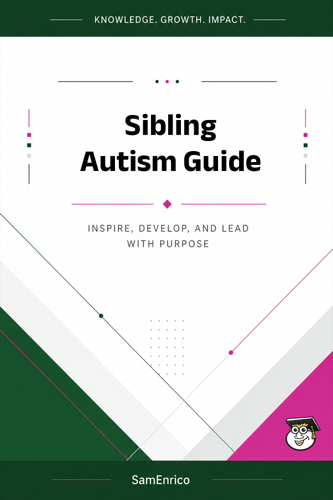
Sibling Autism Guide eBook
Support neurodivergent brother or sister.
by Deal Nydia
Support neurodivergent brother or sister.
Formats
Free sample
Chapter 1: The Before and After...--The day Maya heard the word “autism,” she was sitting on the stairs with a peanut butter sandwich, her legs pulled up against her chest so no one would see her. She was twelve years old, old enough to know that her parents had been whispering for weeks. Old enough to know that her younger brother Leo had been missing more school, that he had stopped saying her name, that his meltdowns had shifted from once a week to twice a day. But she was also young enough to believe, in the quietest part of her heart, that maybe—just maybe—she had caused all of it.Her mother’s voice floated through the crack in the office door. “The developmental pediatrician said it’s clear.
Leo is on the autism spectrum. Moderate support needs.”Her father’s voice was lower, harder to hear. “What does that mean for his future?”“We don’t know yet.”Maya took a bite of her sandwich, but she couldn’t swallow. The bread felt like wet cardboard in her mouth. She had heard the word “autism” before—on TV, in a whispered conversation between two moms at her school’s pickup line, in a meme she had scrolled past on Tik Tok.
She had never paid attention. Now the word had landed inside her house like a stone dropped into still water, and the ripples were already spreading.That night, she lay in bed and made a list in her head. Things I know: Leo doesn’t answer when I call his name. Leo screams when the vacuum turns on. Leo lines up his toy cars in perfect rows and will not let me touch them.
Things I don’t know: Is he going to get better? Is this my fault because I was jealous of him when he was born? Will he ever say my name again? Will my parents ever look at me like they used to—like I was enough?She pulled her blanket over her head and cried. Not the loud, messy crying of a toddler.
The silent, shaking kind where you learn, for the first time, that some grief has no words.The Diagnosis Is Not About You, But It Will Change You If you are reading this book, you have probably had a moment like Maya’s. Maybe you were in the room when the doctor said the words. Maybe you overheard a whispered conversation. Maybe you figured it out yourself, piecing together the long silences, the canceled plans, the way your parents started using words like “therapy” and “assessment” and “sensory” as if those had always been part of your family’s vocabulary.The first thing you need to know is this: the diagnosis moment is a before-and-after event. There is life before you understood what was happening, and there is life after.
Both versions of you are real. Both matter. And you are allowed to grieve the before while still living in the after.This chapter is not about your sibling. It is about you. The top books written for parents focus almost exclusively on how the diagnosis affects the autistic child—what therapies they need, what accommodations to request, how to track milestones.
But siblings are the forgotten ones in this story. Research consistently shows that neurotypical siblings face unique emotional and social challenges, yet they are rarely the focus of any conversation. One study published in the Journal of Autism and Developmental Disorders found that siblings of autistic children are at higher risk for anxiety, depression, and social isolation—not because of anything their sibling does, but because no one gives them permission to talk about what they are feeling.This chapter gives you that permission.The Swirl: Understanding the Confusion, Grief, Fear, and Relief When a sibling first learns about an autism diagnosis, the emotional response is rarely simple. It is a swirl. Let’s name the ingredients.Confusion.
What is autism? You might have heard contradictory things. Someone told you it’s a superpower. Someone else told you it’s a tragedy. Your parents might be using clinical language that doesn’t match the messy reality you see every day.
Your sibling doesn’t look different. They don’t have a wheelchair or a visible scar. So why is everything suddenly different? This confusion is normal. Autism is a spectrum, which means it looks different in every person.
Some autistic people are non-speaking and require full-time care. Others live independently, hold jobs, and have families. Most fall somewhere in the middle. The confusion you feel is not a sign that you’re not “getting it.” It’s a sign that autism is genuinely complex.Grief. This is the hardest feeling to admit, because it sounds like you are mourning a living person.
But grief is not only for death. Grief is also for the loss of a future you imagined. You might have imagined teaching your sibling to ride a bike, sharing a room and whispering secrets after lights out, growing up to be each other’s best man or maid of honor. Those imagined futures might look different now. Grieving them does not mean you love your sibling less.
It means you are human.Fear. What happens to your sibling when your parents get old? What happens to you? Will you be expected to take care of them? Will you be able to go to college far away, or will guilt keep you close to home?
Will your sibling ever be happy? Will you ever feel normal again? Fear about the future is one of the most persistent emotions siblings report, yet it is rarely addressed in the first months after diagnosis. Naming it now—right here, in this chapter—takes away some of its power.Relief. Some siblings feel relief, and then feel guilty about that relief.
Finally, there is a name for the chaos. Finally, your parents aren’t fighting about whether something is “wrong.” Finally, you have a word to explain to friends why your sibling acts the way they do. Relief is not betrayal. It is the natural response to confusion being replaced by clarity.All of these feelings can exist at the same time. You do not have to pick one.The Mac vs.
Windows Analogy: Autism as Difference, Not Defect One of the most helpful ways to understand autism is to stop thinking of it as a broken version of normal. Instead, think of it as a different operating system.Imagine that most people run on Windows. Windows is great. It works well for the majority of tasks. But your sibling runs on Mac.
Mac isn’t worse—it’s just different. It processes information differently. It has different strengths (graphics, design, pattern recognition) and different challenges (compatibility with certain software, a different file structure). If you tried to run Mac software on a Windows computer, it would crash. That’s not because the software is bad.
It’s because the system is different.Your sibling’s brain is not broken. It is wired differently. That difference comes with real challenges—sensory overload, difficulty with social cues, a need for routine. But it…
This is the end of the free sample. Get the eBook to keep going. Buy now
About this book
Details
- Author
- Deal Nydia
- Publisher
- SamEnrico
- Language
- English
- Genre
- Non-Fiction, Biography, Autism
- Released
- 2026-06-08
- Pages (approx.)
- 131
- Available as
- eBook, Audiobook

Read better in the ZLOADR app
Your eBooks on your phone or tablet. Sign in with your SamEnrico account and start reading.
More by Deal Nydia
 Vitamin D and Calcium GuideDeal Nydia$11.99
 Water Contaminant PreventionDeal Nydia$11.99
 Calf Strain RecoveryDeal Nydia$11.99
 The Siege of Shigatse: The Last Stand of the Tibetan LamasDeal Nydia$11.99
 Revenue Technology ServicesDeal Nydia$11.99
 AI Restaurant Accounting GuideDeal Nydia$12.99
 How to Produce China Cabinets and HutchesDeal Nydia$11.99
 A Beginners Guide to Abseiling (Volume 1)Deal Nydia$11.99
You may also like
 Hong Kong Handover 1997Dunn Johnnie$11.99
 Zumba For Postnatal Recovery CourseNeal Christian$11.99
 Zumba for BeginnersLadner Nikia$11.99
 YouTube Comment Mining GuideHumes Pandora$12.99
 Worry Box MeditationCarlin Rudy$11.99
 Workplace Stress MeditationNguyen Lynn$11.99
 Workplace Stress and Sleep RepairHawley Ivory$11.99
 Workplace Perfectionism CureDelaney Jeffry$11.99
 Workplace Injustice Anger GuideWallen Isabelle$11.99
 Work Addiction and Burnout LinkGreenwood Ester$11.99
 Women in Yoga and WellnessBeattie Galina$11.99
 Women in Stand Up ComedyChun Evangeline$11.99