
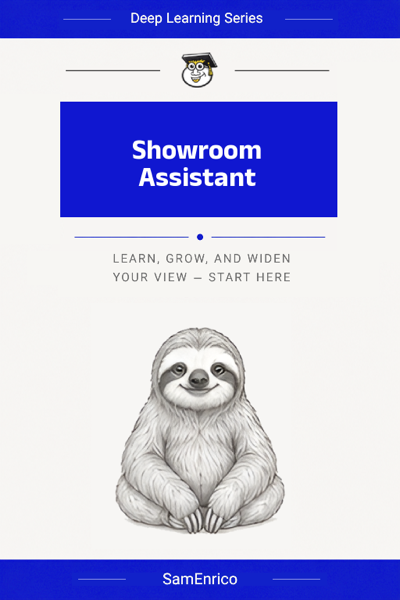
Non-FictionInformativeEducational
Showroom Assistant eBook
A Coursebook on Showroom Assistant
A Coursebook on Showroom Assistant
Formats
Free sample
Chapter 1: The First Impression Machine--–- The first thing a customer sees when they walk through your showroom door should not be a messy desk, a distracted colleague, or a stack of unsorted paperwork. It should be you. And you should be ready.This is not an exaggeration. Research consistently shows that first impressions are formed within seconds of an initial encounter. In a retail environment, those seconds determine whether a customer feels welcomed or ignored, valued or dismissed.
The showroom assistant is not merely an employee—they are the customer's first point of human contact with your brand. You are the first impression machine. And like any machine, you need to be calibrated, maintained, and operated correctly.I learned this lesson on my first day in a showroom, many years ago. I was nineteen years old, freshly hired at a luxury furniture showroom in a city I could barely afford to live in. I had been given a crisp uniform, a name badge, and exactly thirty minutes of training before being stationed at the front door.
My instructions were simple: smile, say hello, and direct customers to the appropriate department.I thought I understood. I did not.My first customer was a woman in her sixties, dressed in clothes that probably cost more than my monthly rent. She walked through the door at 10:07 AM, seven minutes after opening. I smiled. I said hello.
I asked if she needed help finding anything. She looked at me for a long moment, then said, "I'm just looking," and walked past me toward the sofa section.I thought I had done well. I had followed my instructions. I had been polite. But something about the interaction felt wrong.
She had seemed wary, almost defensive. Her shoulders were tight. Her eyes darted around the showroom as if she were looking for an escape route.Later that day, my manager pulled me aside. "You scared that customer," she said."I was nice to her," I protested."You were standing too close. You spoke too loudly.
And when she said she was just looking, you looked disappointed. She felt like she was bothering you just by being here."That conversation changed everything I thought I knew about customer service. I had assumed that being polite was enough. I had assumed that customers would appreciate my enthusiasm. I had not understood that my presence—my posture, my proximity, my tone—was communicating whether I was a helper or a threat.This chapter is about becoming the kind of presence that customers trust.
It is about understanding the psychology of first impressions, mastering the art of professional appearance and body language, and learning to calibrate your welcome to each individual customer. By the end, you will understand not just what to do, but why it works.The Evolution of the Showroom Assistant Not long ago, the person greeting customers at a showroom was called a "receptionist" or simply a "salesperson." Their job was straightforward: answer questions, write up orders, and direct people to the right department. Today, the role has expanded dramatically.Modern showroom assistants are expected to be brand ambassadors—knowledgeable representatives who embody the values and personality of the organization. They are customer experience specialists who understand the entire journey from first contact to post-purchase follow-up. They are problem-solvers who can handle everything from product questions to complaint resolution to coordinating with multiple colleagues.This evolution reflects broader changes in retail.
Customers have more choices than ever before. If they feel ignored or undervalued in your showroom, they can find another showroom, order online, or simply leave. The showroom assistant is often the difference between a customer who buys and a customer who walks out.Consider the numbers. Studies show that customers who have a positive first interaction with a showroom assistant are significantly more likely to make a purchase during that visit. They are also more likely to return, to recommend the showroom to others, and to be forgiving if something goes wrong later.
Conversely, customers who feel ignored or rushed are unlikely to return, regardless of product quality or price.The assistant at the door is not a low-level functionary. They are the gateway. They are the filter through which every customer passes. And they are often the only employee a customer will remember by name.Why First Impressions Matter The psychology of first impressions is well-documented. When a customer enters a showroom, their brain makes rapid assessments: Is this place safe?
Is this person friendly? Am I going to be helped or ignored? These assessments happen in milliseconds, often below conscious awareness.A showroom assistant who offers a warm, professional greeting accomplishes several things simultaneously. First, they signal that the customer has been noticed and is valued. Second, they reduce the customer's anxiety about entering an unfamiliar environment.
Third, they establish the assistant as a helpful resource rather than an obstacle.The alternative—being ignored, receiving a grunt instead of a greeting, or encountering a distracted assistant—triggers the opposite response. The customer's brain shifts into threat detection mode. Stress hormones increase. Their focus narrows to finding an exit. Even if they stay and make a purchase, the interaction is shadowed by that initial sense of not being welcome.I have seen this play out hundreds of times.
A customer enters. The assistant at the door is on their phone, scrolling. The customer hovers awkwardly, waiting to be acknowledged. Nothing happens. They wander into the showroom, increasingly irritated.
By the time another assistant approaches them, the damage is already done. They are not in a buying mood. They are in a leaving mood.The opposite is also true. A customer enters. The assistant looks up immediately, makes eye contact, and smiles.
"Welcome. Let me know if I can help with anything." The customer's shoulders relax. They smile back. They browse longer. They ask questions.
They buy.This is not magic. It is neuroscience. And it is available to anyone willing to practice.Professional Appearance and Personal Presentation Your appearance communicates before you speak. The showroom assistant must project cleanliness, competence, and approachability through their personal presentation. This is not about being conventionally attractive.
It is about signaling that you take yourself and your role seriously.Hygiene is non-negotiable. Shower daily. Brush your teeth. Use deodorant. These seem obvious, but the number of showroom assistants who fail at the basics is staggering.
Customers notice. They notice if your breath smells like coffee and cigarettes. They notice if your uniform is wrinkled or stained. They notice if your hair looks unwashed.Your uniform or professional attire should be clean and pressed. If your showroom provides uniforms, wear them as intended—tucked in, buttoned up, free of rips or stains.
If you are expected to provide your own professional attire, invest in a few pieces that fit well and are appropriate for your showroom's brand. A luxury showroom may require suits or dresses. A casual showroom may allow polos and khakis. Know the standard and meet it.Footwear matters more than you might think. You will be standing for most of your shift.
Your shoes should be closed-toe for safety (see Chapter 3), comfortable for standing, and clean. Customers notice worn or scuffed…
This is the end of the free sample. Get the eBook to keep going. Buy now
About this book
Details
- Author
- Quezada Kaleigh
- Publisher
- SamEnrico
- Language
- English
- Genre
- Non-Fiction, Informative, Educational
- Released
- 2026-06-03
- Pages (approx.)
- 113
- Available as
- eBook, Audiobook

Read better in the ZLOADR app
Your eBooks on your phone or tablet. Sign in with your SamEnrico account and start reading.
More by Quezada Kaleigh
 The Toxin Bucket Theory ExplainedQuezada Kaleigh$11.99
 Cali Drug Lord Ranch LifeQuezada Kaleigh$11.99
 Antwerp Heist Night Security GuardQuezada Kaleigh$11.99
 Study Group Conflict Resolution WorkbookQuezada Kaleigh$11.99
 Stress and Irritable Bowel GuideQuezada Kaleigh$11.99
 The Whale Song Conspiracy: How Humpbacks Changed the WorldQuezada Kaleigh$11.99
 The Vanishing of the Phantom Ship: The Mary Celeste's Last VoyageQuezada Kaleigh$11.99
 Understanding Fetal and Neonatal Alloimmune ThrombocytopeniaQuezada Kaleigh$17.99
 Remote Conflict DocumentationQuezada Kaleigh$12.99
 YC Application Field GuideQuezada Kaleigh$12.99
 How to Become a Music SupervisorQuezada Kaleigh$11.99
You may also like
 Hong Kong Handover 1997Dunn Johnnie$11.99
 Zumba For Postnatal Recovery CourseNeal Christian$11.99
 Zumba for BeginnersLadner Nikia$11.99
 YouTube Comment Mining GuideHumes Pandora$12.99
 Worry Box MeditationCarlin Rudy$11.99
 Workplace Stress MeditationNguyen Lynn$11.99
 Workplace Stress and Sleep RepairHawley Ivory$11.99
 Workplace Perfectionism CureDelaney Jeffry$11.99
 Workplace Injustice Anger GuideWallen Isabelle$11.99
 Work Addiction and Burnout LinkGreenwood Ester$11.99
 Women in Yoga and WellnessBeattie Galina$11.99
 Women in Stand Up ComedyChun Evangeline$11.99