
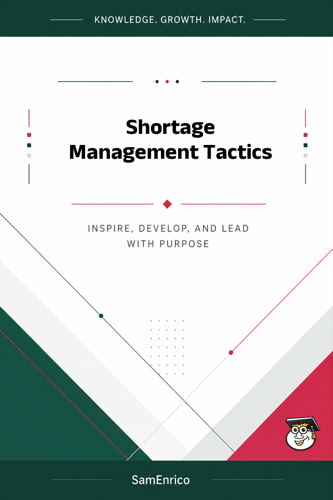
Non-FictionBusiness BriefRationing
Shortage Management Tactics
Allocate scarce products efficiently when demand e
Allocate scarce products efficiently when demand exceeds supply temporarily.
Formats
About this book
Free sample
Chapter 1: The Phantom Menace--–- On a Tuesday morning in March 2021, a supply chain director named Sarah walked into her distribution center and discovered that the previous day’s order volume had exceeded 47,000 units. Her product, a specialized industrial filter used in HVAC systems, normally sold 2,000 units per week. She had not changed prices. There was no new marketing campaign. No competitor had gone out of business.
Nothing in her world had changed except one thing: a news report had mentioned that the resin used to manufacture her filters was in short supply due to a petrochemical plant fire in Texas. The plant fire was real. It would reduce resin production by approximately 8 percent for six weeks. But Sarah was looking at an order spike of 2,350 percent.She celebrated. Her bonus depended on revenue.
She told her team to accept every order, promised customers delivery within ten days, and went home feeling like a hero.Three weeks later, the resin shortage ended. The plant reopened. But Sarah’s warehouse was now filled with 40,000 filters that nobody wanted. Her customers, who had panic-ordered 47,000 units, cancelled 38,000 of them. They had only needed 9,000.
The rest was phantom demand—orders placed not because someone needed the product, but because they feared future unavailability. Sarah’s company lost $4.7 million. She lost her job.This is not a story about a bad supply chain manager. This is a story about a systemic failure that repeats itself every time a scarcity event occurs. The problem is not lack of information.
The problem is that most managers cannot distinguish between real demand and phantom demand. And until you learn that distinction, every allocation decision you make will be built on a lie.The Bullwhip Effect: How Small Whips Become Hurricanes The phenomenon that destroyed Sarah’s career has a name: the Bullwhip Effect. First described by MIT’s Systems Dynamics Group in the 1960s and later formalized by researchers at Stanford and Wharton, the Bullwhip Effect describes how small fluctuations in consumer demand at the retail level produce increasingly larger fluctuations in orders as you move upstream through the supply chain.Imagine…
This is the end of the free sample. Get the eBook to keep going. Buy now
Contents
- Chapter 1
- Chapter 2
- Chapter 3
- Chapter 4
- Chapter 5
- Chapter 6
- Chapter 7
- Chapter 8
- Chapter 9
- Chapter 10
- Chapter 11
- Chapter 12
Details
- Author
- Woodruff Enda
- Publisher
- SamEnrico
- Language
- English
- Genre
- Non-Fiction, Business Brief, Rationing
- Released
- 2026-06-07
- Pages (approx.)
- 154
- Available as
- eBook, Audiobook

Read better in the ZLOADR app
Your eBooks on your phone or tablet. Sign in with your SamEnrico account and start reading.
More by Woodruff Enda
 WFH Five Minute RuleWoodruff Enda$11.99
 Micro Flow in Everyday TasksWoodruff Enda$11.99
 Gambling Addiction and ADHDWoodruff Enda$11.99
 Byron’s Storm: The Poet Who Shaped a CenturyWoodruff Enda$11.99
 Natrolite MiningWoodruff Enda$11.99
 Privacy Policy RequirementsWoodruff Enda$12.99
 Learn to Play the RebabWoodruff Enda$11.99
 How to Start a Blackboard Chalk Making Machinery Business (Beginners Guide)Woodruff Enda$11.99
You may also like
 Hong Kong Handover 1997Dunn Johnnie$11.99
 Zumba For Postnatal Recovery CourseNeal Christian$11.99
 Zumba for BeginnersLadner Nikia$11.99
 YouTube Comment Mining GuideHumes Pandora$12.99
 Worry Box MeditationCarlin Rudy$11.99
 Workplace Stress MeditationNguyen Lynn$11.99
 Workplace Stress and Sleep RepairHawley Ivory$11.99
 Workplace Perfectionism CureDelaney Jeffry$11.99
 Workplace Injustice Anger GuideWallen Isabelle$11.99
 Work Addiction and Burnout LinkGreenwood Ester$11.99
 Women in Yoga and WellnessBeattie Galina$11.99
 Women in Stand Up ComedyChun Evangeline$11.99