
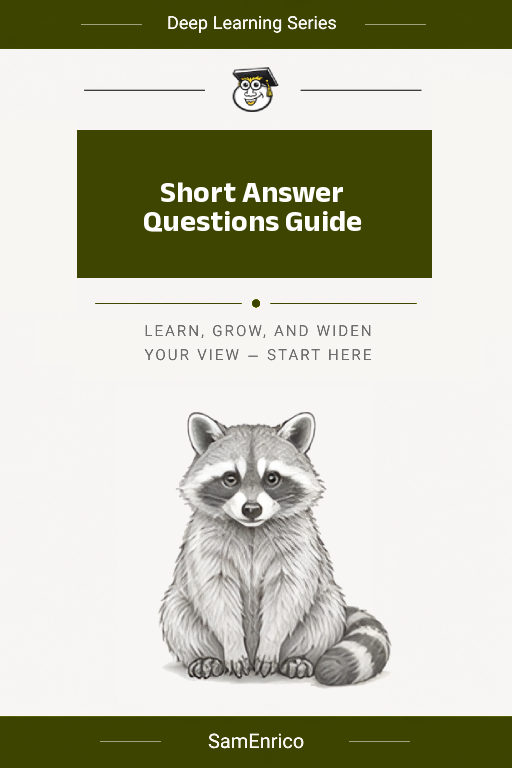
Short Answer Questions Guide eBook
Master 150-word supplements for honors colleges an
Master 150-word supplements for honors colleges and scholarships, being direct and memorable without sacrificing depth.
Formats
Free sample
Chapter 1: The Eight-Second Murder--You have eight seconds. That is not a metaphor. That is not an exaggeration to scare you. That is the measured reality of how long a scholarship reader or honors college admissions officer will spend on your 150-word answer before they decide “maybe” or “no.” Eight seconds is the time it takes to sneeze twice, to tie one shoelace, to scroll past a Tik Tok video you did not ask to see. And in those eight seconds, most students unknowingly murder their own chances.Not because they are bad writers.
Not because they have nothing interesting to say. But because no one ever told them the rules of the game they were playing.This chapter is called The Eight-Second Murder because that is what happens to the vast majority of short answers. They die quickly, quietly, and without the reader even feeling guilty about it. The reader does not close the file thinking, “What a terrible student.” They close it thinking nothing at all. That is the worst outcome—not rejection, but indifference.
Indifference means you never had a chance to begin with.Before you write a single word of your 150-word supplement, you need to understand the psychology of the person who will read it. You need to know what they are thinking, what they are feeling, and most importantly, what they are looking for as a reason to say no. Because once you understand that, you can stop writing for an imaginary audience of sympathetic English professors and start writing for the actual human being who is exhausted, skeptical, and eight seconds away from moving on to the next application.The Reader Is Not Your English Teacher Let us start with a confession that most admissions guides will not tell you. The person reading your 150-word answer is probably not an expert in writing. They are not a professor of creative non-fiction.
They are not a literary critic who will admire your elegant subordinate clauses or your clever use of the em dash.They are an exhausted administrator.In many cases, they are a scholarship coordinator, an honors college staff member, a faculty member pulled from their research to serve on a committee, or a trained graduate student reading on a laptop in a windowless conference room. They have been sitting in that chair for three hours. They have already read two hundred short answers today. They have two hundred more to go before lunch. Their eyes hurt.
Their back hurts. They have stopped hoping to be impressed and started hoping to be finished.Here is what they are not doing: They are not reading your answer like a novel. They are not savoring your prose. They are not underlining beautiful phrases. They are scanning.
They are looking for a reason to say no because saying no is fast and saying yes requires justification.Think about that for a moment. Saying no takes one second. Saying yes means they have to remember your answer, compare it to others, possibly defend it to the rest of the committee. The entire system is designed to filter you out. Your job is not to be “good enough.” Your job is to be so immediately, unmistakably compelling that saying no would require more effort than saying yes.This is a different game than the one you played in English class.
In English class, your teacher was paid to read every word you wrote. They were required to give you feedback. They were rooting for you to improve. Your scholarship reader is not paid to root for you. They are paid to identify the best candidates in the shortest time possible.
Those two goals are not the same.The Boredom Coefficient There is a concept in behavioral economics called the “paradox of choice.” When people are given too many options, they become less satisfied with any single option and more likely to choose based on easily identifiable flaws rather than genuine strengths. This is exactly what happens in scholarship and honors college reading.A typical scholarship committee might receive five hundred applications for twenty awards. That means four hundred and eighty students will receive a no. The reader does not need to find the twenty best. They need to eliminate the four hundred and eighty worst.
And the fastest way to eliminate someone is to spot a single fatal error in the first few seconds.We call this the Boredom Coefficient. The longer a reader has been sitting in that chair, the higher their Boredom Coefficient rises. At hour one, they might read every word of every answer. At hour three, they are scanning for patterns. At hour five, they are looking for the fastest possible no.Here is what a high Boredom Coefficient looks like in practice.
The reader sees your answer. Their eyes go to the first sentence. If the first sentence is boring, vague, or generic, their brain flags it as “likely not worth my time.” They glance at the middle. If the middle has no concrete images, they confirm the flag. They look at the ending.
If the ending says something like “this is why I deserve this opportunity,” they move on.Total time: eight seconds or less.The cruel irony is that your answer might contain a genuinely brilliant insight buried in the second paragraph. But the reader will never reach it because you lost them in the first sentence. They did not murder your answer. You did. You asked them to invest time before you gave them a reason to care.
And in a high-Boredom-Coefficient environment, no one makes that investment.The Five-Second Test Now that you understand the reader’s psychology, let us introduce the first practical tool of this book: The Five-Second Test.The Five-Second Test is simple. Take your first sentence. Cover up the rest of the answer. Read only that first sentence. Does it answer the prompt?
Does it contain at least one concrete noun? Does it make the reader ask a question that only your answer can answer?If the answer to any of those questions is no, you fail the Five-Second Test.Let us look at examples. Suppose the prompt is: “Why do you want to join this honors college?”A failing first sentence: “The pursuit of knowledge has always been a driving force in my life.”Why does this fail? Because it answers no prompt. It could be the first sentence of an essay about anything—philosophy, graduate school, a biography of Socrates.
It contains no concrete nouns. “Pursuit of knowledge” is an abstraction. “Driving force” is a cliché. The reader learns nothing about you, your interests, or the specific honors college. They have no question to ask except “Why am I still reading this?” Eight seconds.
Murder.Another failing first sentence: “Ever since I was young, I have been fascinated by the intersection of science and society.”This is better but still fails. “Science and society” is still abstract. “Ever since I was young” is a generic time stamp that adds nothing. The reader has heard this sentence five hundred times today. They will not read sentence two.A passing first sentence: “I want to double-major in marine biology…
This is the end of the free sample. Get the eBook to keep going. Buy now
About this book
Details
- Author
- Cassidy Delma
- Publisher
- SamEnrico
- Language
- English
- Genre
- Non-Fiction, Student's Shortcut
- Released
- 2026-05-30
- Pages (approx.)
- 149
- Available as
- eBook, Audiobook

Read better in the ZLOADR app
Your eBooks on your phone or tablet. Sign in with your SamEnrico account and start reading.
More by Cassidy Delma
 Meth Addiction Understanding and Action PlanCassidy Delma$11.99
 Dish Soap Antibacterial RisksCassidy Delma$11.99
 Bike Lane Advocate StoryCassidy Delma$11.99
 The Resilience Autoimmune ProtocolCassidy Delma$11.99
 Russian Organized Crime USACassidy Delma$11.99
 Remote Work Accountability SystemsCassidy Delma$11.99
 Middle Passage Nautical TechnologyCassidy Delma$11.99
 Success Without Burnout for DentistsCassidy Delma$11.99
 The Silk Road's Shadow War: How a Lost Empire's Spies Still Control the WorldCassidy Delma$11.99
 Blood and Veldt: The Siege of Ladysmith’s Forgotten HellCassidy Delma$11.99
 A Collector's Handbook to the Mg PbCassidy Delma$11.99
 Service Providers Guide to PET GroomingCassidy Delma$11.99
You may also like
 Hong Kong Handover 1997Dunn Johnnie$11.99
 Zumba For Postnatal Recovery CourseNeal Christian$11.99
 Zumba for BeginnersLadner Nikia$11.99
 YouTube Comment Mining GuideHumes Pandora$12.99
 Worry Box MeditationCarlin Rudy$11.99
 Workplace Stress MeditationNguyen Lynn$11.99
 Workplace Stress and Sleep RepairHawley Ivory$11.99
 Workplace Perfectionism CureDelaney Jeffry$11.99
 Workplace Injustice Anger GuideWallen Isabelle$11.99
 Work Addiction and Burnout LinkGreenwood Ester$11.99
 Women in Yoga and WellnessBeattie Galina$11.99
 Women in Stand Up ComedyChun Evangeline$11.99