
Non-FictionSelf-HelpShort Response
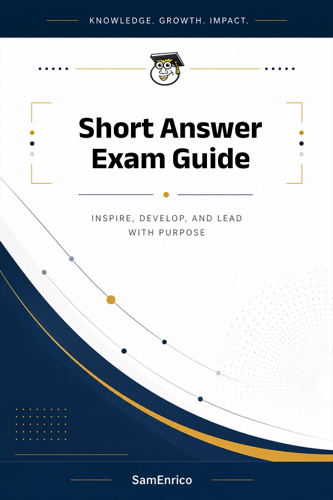
Short Answer Exam Guide Audiobook
Recalls key terms and concise definitions.
by Ligon Bess
Recalls key terms and concise definitions.
Formats
Free sample
Chapter 1: The Blank Page Horror--–- The fluorescent lights hummed overhead. Your pencil is poised. You studied for six hours. You know this material. You can feel the definition somewhere in your skull, like a word on the tip of your tongue when you’re trying to remember an actor’s name.
The proctor says, “Begin.” You flip the page. You read the first short answer question. And then—nothing. The page stares back, white and empty. Your mind, which was full of facts ten seconds ago, is now a white hallway with no doors.
Your heart rate spikes. Your palms sweat. You write one word, cross it out, and glance at the clock. Two minutes have passed. You have eleven more questions to go.
This is not a failure of knowledge. This is a failure of recall under pressure. And this chapter will teach you exactly why it happens—and how to make sure it never happens to you again.The Anatomy of the Freeze Let’s be precise about what just happened. You did not forget the material. If someone had handed you a multiple-choice question with four options, you would have picked the correct answer without hesitation.
If someone had asked you to write an essay on the same topic, you could have produced several paragraphs of coherent analysis. But short answer questions are different. They demand pure retrieval—pulling a specific term, date, name, or definition out of long-term memory with no cues, no context, and no safety net. This is the hardest type of memory task the human brain performs. And when you add a ticking clock and a room full of silent, stressed students, you have created the perfect conditions for what cognitive psychologists call retrieval-induced anxiety.This chapter is not about studying harder.
It is about understanding the biological and psychological machinery of test panic so you can disarm it before it disarms you.The Tip of the Tongue Phenomenon In 1966, Harvard psychologists Roger Brown and David Mc Neill published a landmark study on a universal experience they called the “tip of the tongue” state. They read definitions of obscure words to participants and asked them to recall the word itself. For example, they read “a navigational instrument used to measure angular distance” and waited for “sextant.” What they discovered was remarkable: when participants could not recall the word, they could often still…
This is the end of the free sample. Get the Audiobook to keep going. Buy now
About this book
Details
- Author
- Ligon Bess
- Publisher
- SamEnrico
- Language
- English
- Genre
- Non-Fiction, Self-Help, Short Response
- Released
- 2026-06-06
- Pages (approx.)
- 130
- Available as
- eBook, Audiobook

Listen in the VoxFlicks app
Audiobooks and audio dramas wherever you go. Sign in with your SamEnrico account and press play.
More by Ligon Bess
 Opioid Induced HypogonadismLigon Bess$11.99
 NVC For Imposter SyndromeLigon Bess$11.99
 Franchising Your Local Brand Across Borders Territorial RestrictionsLigon Bess$11.99
 Stimulant and RelationshipsLigon Bess$11.99
 Mindfulness Based Relapse Prevention for AlcoholLigon Bess$11.99
 Home Sharing Platform GuideLigon Bess$11.99
 Anabolic Steroid ReversalLigon Bess$11.99
 The Opium Wars' Poisoned Legacy: The Triads' Deadly Medical ConspiracyLigon Bess$11.99
 The Counterfeit Kings of Berlin: The Great Prohibition ScandalLigon Bess$11.99
 How to Produce Colored Exterior StainLigon Bess$11.99
 How to Produce GrommetsLigon Bess$11.99
 Nigeria VAT Filing Deadlines WorkbookLigon Bess$12.99
You may also like
 Hong Kong Handover 1997Dunn Johnnie$11.99
 Zumba For Postnatal Recovery CourseNeal Christian$11.99
 Zumba for BeginnersLadner Nikia$11.99
 YouTube Comment Mining GuideHumes Pandora$12.99
 Worry Box MeditationCarlin Rudy$11.99
 Workplace Stress MeditationNguyen Lynn$11.99
 Workplace Stress and Sleep RepairHawley Ivory$11.99
 Workplace Perfectionism CureDelaney Jeffry$11.99
 Workplace Injustice Anger GuideWallen Isabelle$11.99
 Work Addiction and Burnout LinkGreenwood Ester$11.99
 Women in Yoga and WellnessBeattie Galina$11.99
 Women in Stand Up ComedyChun Evangeline$11.99