
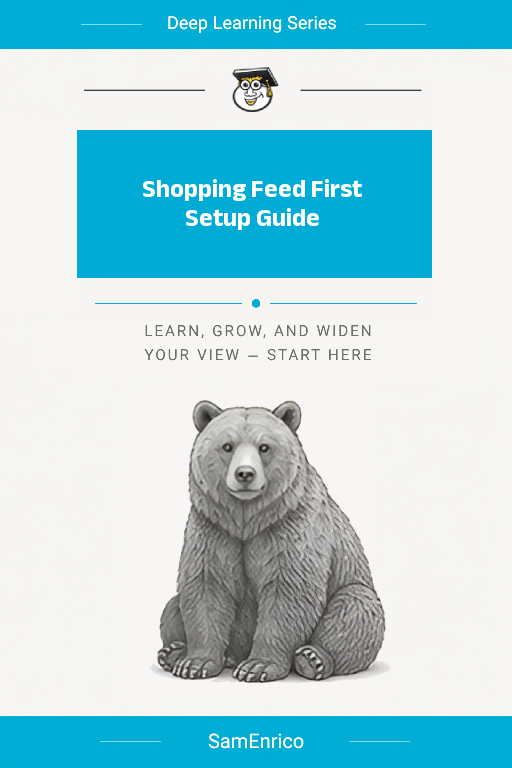
Shopping Feed First Setup Guide eBook
Connect your product catalog to Facebook. Set up c
Connect your product catalog to Facebook. Set up commerce account and create dynamic product ads.
Formats
Free sample
Chapter 1: The Catalog Lie--–- Most Facebook advertisers believe their product catalog is just a spreadsheet of inventory. They are wrong. That misunderstanding costs them thousands of dollars in wasted ad spend every single month, and they never even know it. The belief that a catalog is merely a list of products—names, prices, photos, and links—has been quietly sabotaging dynamic product ads since the day Facebook launched its Commerce platform. But in 2026, with the arrival of Meta’s Andromeda algorithm and the imminent shift toward Generative Ad Models, treating your catalog as a simple inventory file is no longer just inefficient.
It is fatal to your advertising success.This chapter dismantles the single biggest misconception in Facebook commerce: the lie that your product feed is passive. In reality, your catalog is the most powerful targeting tool you will ever own. It is the primary input that the Andromeda algorithm reads to understand who should see your ads, when they should see them, and what price point will trigger a purchase. Get your catalog right, and the algorithm does 80% of your work for you. Get it wrong, and no amount of creative genius or budget will save your campaigns.The Old Way: Spray and Pray Before we can understand why the catalog has become so central, we must first understand what it replaced.
For nearly a decade, Facebook advertising operated on what industry veterans call the "spray and pray" model. An advertiser would create a single static ad—one image, one headline, one description—and then use Facebook’s interest targeting tools to show that ad to a broad audience of people who liked certain pages, engaged with certain content, or fit certain demographic profiles.For example, a hiking boot company might create one ad featuring their best-selling boot and target it to everyone who liked "REI," "The North Face," and "Appalachian Trail." That was it. One message for millions of people. The advertiser would pray that enough of those people happened to be in the market for hiking boots at that exact moment.This model worked reasonably well from 2012 to 2020. But three forces killed it.First, privacy changes.
Apple’s i OS 14.5 update in 2021 gave users the ability to opt out of cross-app tracking. Overnight, Facebook lost visibility into what users did after clicking an ad unless the advertiser had installed server-side tracking like Conversion API (which we cover in Chapter 2). Interest targeting based on third-party data became unreliable.Second, user fatigue. The average Facebook user sees hundreds of ads per week. When every advertiser shows the same static creative to everyone, users develop banner blindness.
They stop noticing ads altogether. Click-through rates plummeted from an average of 1.5% in 2018 to barely 0.7% by 2024.Third, the rise of machine learning. Facebook realized that its own algorithm—trained on billions of user interactions—could predict purchase intent far better than any human-defined interest group. The algorithm could see that someone who searched for "waterproof hiking boots" on Google, visited three outdoor blogs, and liked a post about mountain climbing was far more likely to buy boots than someone who simply liked the REI Facebook page. But for the algorithm to make that prediction, it needed rich, structured data about the products themselves.
It needed a catalog that did more than list inventory.Enter Andromeda: The Algorithm That Reads Products In late 2024, Meta began rolling out a new deep-learning architecture internally codenamed Andromeda. By 2026, Andromeda became the default delivery system for all dynamic product ads across Facebook, Instagram, and the Meta Audience Network. Unlike previous algorithms that relied primarily on user signals (likes, shares, comments, clicks), Andromeda is product-first.What does that mean in practice? Andromeda reads your product catalog as its primary source of truth. It examines each product’s title, description, category, price, availability, and even the visual content of its images (a concept we explore in depth in Chapter 9).
Based on that information, Andromeda builds a semantic understanding of what each product is, who might want it, and how much they might be willing to pay.Consider two products in the same catalog:Product A: Title = "Men’s Hiking Boot – Waterproof, Leather, Size 10" | Price = 149∣Category=Footwear>Boots Product B:Title="Men’s Casual Shoe–Canvas,Lightweight,Size10"∣Price=149 | Category = Footwear > Boots Product B: Title = "Men’s Casual Shoe – Canvas, Lightweight, Size 10" | Price = 149∣Category=Footwear>Boots Product B:Title="Men’s Casual Shoe–Canvas,Lightweight,Size10"∣Price=59 | Category = Footwear > Sneakers To a human, these are clearly different products for different use cases. But to a traditional algorithm, they might look similar—both are men’s footwear, both size 10, both under $200. The algorithm might show Product A to someone who has only ever bought sneakers, wasting the impression.Andromeda, however, reads the semantic difference. It understands that "hiking" implies outdoors, rugged terrain, waterproofing. It understands that "leather" implies durability and a higher price point.
It understands that "boots" are a different subcategory than "sneakers." So Andromeda will show Product A to users who have searched for "waterproof boots," visited camping websites, or engaged with outdoor content. It will show Product B to users who have searched for "casual shoes," visited fashion blogs, or bought sneakers in the past. The algorithm is not guessing. It is reading your catalog.The Trinity of Success: Data, AI, Creative The most successful Facebook advertisers in 2026 operate according to a framework we call the Trinity of Success. This framework has three pillars, each dependent on the others:Clean Data (Your Product Catalog)Smart AI (The Andromeda Algorithm)Authentic Creative (Your Ads)Here is how they work together.Clean Data is the foundation.
If your catalog has missing titles, generic descriptions, incorrect prices, or broken image links, Andromeda has nothing to read. You cannot expect the algorithm to understand that your "blue shoe" is actually a high-end Italian leather loafer if you never wrote that in the description. The quality of your catalog directly limits the quality of your ad delivery.Smart AI is the engine. Andromeda takes your catalog data and matches it to user intent signals in real time. When a user opens Instagram, Andromeda has milliseconds to decide which ad to show.
It scans your catalog, finds the product most relevant to that user based on their recent behavior, and serves the ad. This happens thousands of times per second across Meta’s entire ad ecosystem.Authentic Creative is the messenger. Even with a perfect catalog and a brilliant algorithm, your ads will fail if the creative looks fake or generic. In Chapter 9, we will explore why low-production, user-generated content often outperforms high-gloss studio photography. For now, understand that creative is how the algorithm’s match becomes a click, and how that click becomes a purchase.
The algorithm can bring the right product to the right person, but only compelling creative can close the sale.These three pillars are not optional. If any pillar is weak, the entire system collapses. An advertiser with a perfect catalog and amazing creative but no understanding of Andromeda will waste budget on poorly configured campaigns. An advertiser with deep algorithmic knowledge and great creative but a messy catalog will serve ads for products that are out of stock or…
This is the end of the free sample. Get the eBook to keep going. Buy now
About this book
Details
- Author
- Vail Kristian
- Publisher
- SamEnrico
- Language
- English
- Genre
- Non-Fiction, First 30 Days, Ecommerce
- Released
- 2026-06-01
- Pages (approx.)
- 130
- Available as
- eBook, Audiobook

Read better in the ZLOADR app
Your eBooks on your phone or tablet. Sign in with your SamEnrico account and start reading.
More by Vail Kristian
 Affirmations For Self Worth WorkbookVail Kristian$11.99
 Vietnam Consumer BoomVail Kristian$11.99
 Stress Headache Prevention GuideVail Kristian$11.99
 Combat Trauma Trigger GuideVail Kristian$11.99
 Influence for Political CampaignsVail Kristian$11.99
 Beneath the Black Mountain: The Forgotten Gold Rush of the CarpathiansVail Kristian$11.99
 Understanding Pachyonychia Congenita Jackson–lawler TypeVail Kristian$17.99
 Banquet BartenderVail Kristian$11.99
 Mary Barra PrioritiesVail Kristian$12.99
 10 Ways to Use Curry Paste (Recipe Book)Vail Kristian$11.99
You may also like
 Ecommerce Business Plan One PageLipscomb Colton$12.99
 US Bank Account for Ecommerce SellersRivera Karl$12.99
 Mailchimp Abandoned Cart GuideChamberlain Barrie$12.99
 Gumroad Seller Setup GuideBallard Ronald$12.99
 Ecommerce Terms of Service Action PlanGrogan Cheryle$12.99
 Ecommerce Sales ScriptSanderson Kaci$12.99
 Ecommerce Pricing ConfidenceSanford Thanh$12.99
 US Bank Account for EcommerceNielsen Kyle$12.99
 Mailchimp Integration with ShopifyChisholm Laraine$12.99
 GST Registration for Ecommerce GuideDamron Audie$12.99
 Ecommerce HARO Press GuideHolman Ja$12.99
 Virtual Office for Ecommerce StoresSkelton Etta$12.99