
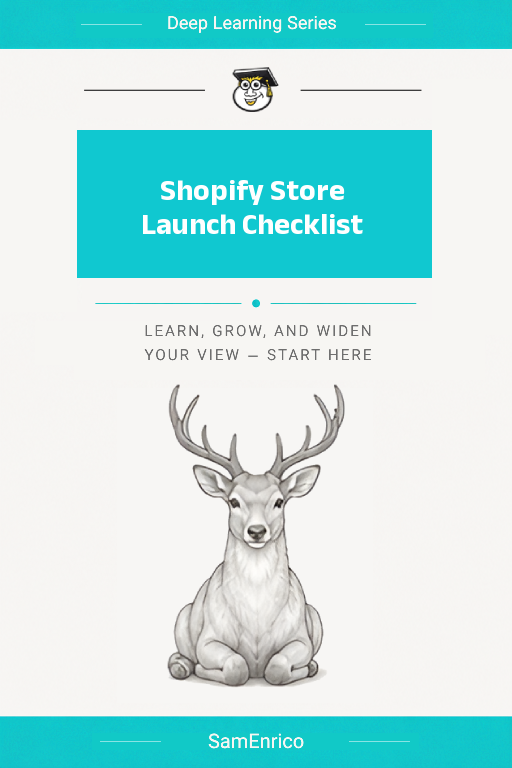
Shopify Store Launch Checklist eBook
Complete 30 tasks before launching your 100 Shopif
by Sewell Deon
Complete 30 tasks before launching your 100 Shopify store.
Formats
Free sample
Chapter 1: The $100 Paradox–- When I launched my first Shopify store, I had exactly 94.37inmybankaccount.Ispent94.37 in my bank account. I spent 94.37inmybankaccount.Ispent14 on a domain, 29on Shopify’s Basicplan,29 on Shopify’s Basic plan, 29on Shopify’s Basicplan,36 on product samples from a supplier I found on Alibaba, and the remaining $15.37 on poly mailers and a roll of packing tape. I had no ad budget, no email list, no social media following, and no cousin who “knew code.” What I had was a laptop, a dream, and a quiet desperation to prove that you didn’t need thousands of dollars to start an ecommerce business.Three weeks later, I made my first sale: 19.99forawaterproofphonepouchdesignedforkayakers.Thecustomerfoundmethrougha Redditcomment Ihadleftonathreadabout“gearthatdoesn’tsuck.”Ipackedthepouchinapolymailer,walkedittothepostoffice,andcriedalittlebitinmycarafterward.Notbecause Iwasemotionalaboutthesale—Iwasemotionalbecause Ihadjustproventhatthesystemworked.Youdidnotneed19.99 for a waterproof phone pouch designed for kayakers. The customer found me through a Reddit comment I had left on a thread about “gear that doesn’t suck.” I packed the pouch in a poly mailer, walked it to the post office, and cried a little bit in my car afterward. Not because I was emotional about the sale—I was emotional because I had just proven that the system worked.
You did not need 19.99forawaterproofphonepouchdesignedforkayakers.Thecustomerfoundmethrougha Redditcomment Ihadleftonathreadabout“gearthatdoesn’tsuck.”Ipackedthepouchinapolymailer,walkedittothepostoffice,andcriedalittlebitinmycarafterward.Notbecause Iwasemotionalaboutthesale—Iwasemotionalbecause Ihadjustproventhatthesystemworked.Youdidnotneed5,000 for a course, $1,000 for Facebook ads, or an agency to run your Google Shopping feed. You needed thirty tasks, one hundred dollars, and the discipline to ignore everything that did not matter.That first store eventually grew to 3,000inmonthlyrevenuebefore Isolditonamarketplaceforsmallecommercebrands.Butthelessons Ilearnedfromthat3,000 in monthly revenue before I sold it on a marketplace for small ecommerce brands. But the lessons I learned from that 3,000inmonthlyrevenuebefore Isolditonamarketplaceforsmallecommercebrands.Butthelessons Ilearnedfromthat94.37 launch became the foundation for every store I built afterward. And the most important lesson was this: constraints are not limitations. Constraints are features.
When you have only $100, you cannot waste money on expensive apps, paid themes, or untested ad campaigns. You are forced to do the things that actually work: validate demand before you buy inventory, write copy that speaks directly to a customer’s pain, and build trust through clarity rather than expensive trust seals.This book is the system I wish I had on day one. It is not theoretical. It is not “raise venture capital” or “hire a growth agency.” It is thirty tasks, thirty days, and one hundred dollars. If you complete task number thirty and have not made a single sale, I will personally audit your store for free.
That is the $100 Promise.But before we get to the tasks, we need to talk about why most entrepreneurs fail with $100—and why you will not.The Copycat Trap Most new entrepreneurs make the same fatal mistake. They find a successful store—maybe a brand they admire on Instagram, or a competitor ranking on the first page of Google for a profitable keyword—and they try to copy it. They buy the same theme, install the same apps, write similar product descriptions, and run similar ads. And then they wonder why they are not getting the same results.Here is what they do not understand: the successful store they are copying did not start where it is now. It started with zero customers, zero trust, and zero search engine authority.
It spent thousands of dollars on ads before it found a profitable audience. It tested dozens of product images before it found one that converted. It lost money on shipping for months before it optimized its logistics. When you copy a successful store, you are not copying its starting point. You are copying its endpoint.
And you cannot reverse-engineer an endpoint without understanding the journey that got it there.This is what I call the Copycat Trap. It feels safe because copying a proven model seems less risky than inventing something new. But it is actually the riskiest thing you can do with $100. You are competing against a store that has already won the trust of your target audience, already secured favorable shipping rates, already built a retargeting audience, and already optimized its conversion funnel. You are bringing a butter knife to a gunfight.The only way to win with $100 is to do something the big stores cannot or will not do.
You must find a niche so specific, a problem so painful, or an audience so underserved that the successful stores ignore it because it is too small for their business model. This is the core insight from Peter Thiel’s Zero to One: monopolies are built on uniqueness, not competition. When you compete, you lose. When you create something unique for a specific group of people, you win.The Constraint as a Feature Most people see a $100 budget as a disadvantage. I want you to see it as the most powerful tool you have.When you have no money for ads, you are forced to find organic ways to reach customers.
This means you actually have to understand your customer—where they hang out online, what problems they complain about, what language they use to describe those problems. This understanding is worth more than any ad campaign. Ads can buy traffic, but they cannot buy empathy. And empathy is what converts strangers into customers.When you have no money for expensive apps, you are forced to understand what each app actually does and whether you need it at all. Most store owners install twenty apps at launch, then wonder why their site takes five seconds to load.
Every app adds 50 to 100 milliseconds of load time. A site that loads in two seconds converts at nearly twice the rate of a site that loads in five seconds. When you have no money for apps, you learn to do more with less. That discipline stays with you even after you start making money.When you have no money for a professional designer, you are forced to learn the principles of usability and conversion optimization. You discover that a free theme configured well outperforms a $300 theme configured poorly.
You learn that customers do not read your homepage—they scan it in three to five seconds—so your headline must communicate value instantly. You learn that clarity beats creativity every time.Constraint is not a limitation. Constraint is a filter. It forces you to focus only on what matters and ignore everything else. And when you have only $100, the only things that matter are these: a product that solves a real problem for a specific group of people, a store that communicates value clearly and quickly, and a launch plan that drives traffic without spending money on ads.The Thirty Tasks Framework This book is organized around thirty specific tasks.
Each task takes between fifteen minutes and two hours to complete. Some tasks are technical, like setting up your domain and configuring your payment gateway. Some tasks are creative, like writing product descriptions and taking product photos. Some tasks are strategic, like validating product demand and building a launch week calendar.The thirty tasks are divided into four phases, which correspond to the four parts of this book.Phase One: Strategy (Days 1-3) – Before you spend a single dollar, you will validate your…
This is the end of the free sample. Get the eBook to keep going. Buy now
About this book
Details
- Author
- Sewell Deon
- Publisher
- SamEnrico
- Language
- English
- Genre
- Non-Fiction, First 30 Days
- Released
- 2026-06-01
- Pages (approx.)
- 146
- Available as
- eBook, Audiobook

Read better in the ZLOADR app
Your eBooks on your phone or tablet. Sign in with your SamEnrico account and start reading.
More by Sewell Deon
 Geo Arbitrage for RetireesSewell Deon$11.99
 Prenatal Postpartum Anger GuideSewell Deon$11.99
 Pelvic Floor SuccessSewell Deon$11.99
 Cocaine Recovery Goal Setting HandbookSewell Deon$11.99
 Chunking for Real Estate ExamSewell Deon$11.99
 The Understimulated Home BlueprintSewell Deon$11.99
 Postpartum Depression Medication SafetySewell Deon$11.99
 Body Image For VitiligoSewell Deon$11.99
 The Silent Spy: The Double Life of Juan Pujol GarcíaSewell Deon$11.99
 The Jade Serpent’s Lament: How a Dragon’s Tears Shaped China’s RiversSewell Deon$11.99
 Tangaroa’s Oath: The Last Voyage of the Celestial NavigatorSewell Deon$11.99
 How to Become a Soft-tile SetterSewell Deon$11.99
You may also like
 Website Launch For New LLCStrunk Tracee$12.99
 Shopify Market Expansion GuideGaffney Jude$12.99
 Power Backup Solutions for Philippine VAsPearce Eldon$12.99
 Feedback License Clause TemplateCrum Ashli$12.99Feedback License Clause TemplateCrum Ashli$12.99Feedback License Clause TemplateCrum Ashli$12.99Feedback License Clause TemplateCrum Ashli$12.99Feedback License Clause TemplateCrum Ashli$12.99Feedback License Clause TemplateCrum Ashli$12.99Feedback License Clause TemplateCrum Ashli$12.99Feedback License Clause TemplateCrum Ashli$12.99
 Channel Distribution On One PagePetersen Narcisa$12.99