
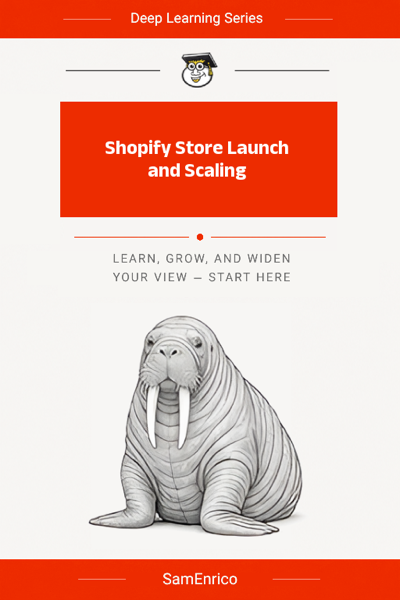
Non-FictionInformativeEducational
Shopify Store Launch and Scaling eBook
A Coursebook on Shopify Store Launch and Scaling
by Trejo Tonia
A Coursebook on Shopify Store Launch and Scaling
Formats
Free sample
Chapter 1: The Validation Lie--– Most aspiring e-commerce founders believe they need a perfect product, a beautiful website, and a big marketing budget before they can make their first sale. That belief is not only wrong—it is actively dangerous. It has bankrupted more Shopify store owners than any failed ad campaign, any supplier scam, or any platform algorithm change. The truth is far simpler and far more uncomfortable: you do not need a better product. You need better evidence that someone will pay for it.This chapter will dismantle the most common, most destructive myth in e-commerce: the idea that validation means building something and then seeing if people buy it.
That is not validation. That is gambling. Real validation happens before you spend a single dollar on inventory, before you install a single Shopify app, and certainly before you agonize over your logo. Real validation is about finding the gap between what customers are currently tolerating and what they actually want—and then placing your store directly inside that gap.By the end of this chapter, you will have a systematic, repeatable method for identifying a profitable niche without guesswork. You will understand why interviewing ten well-chosen customers is worth more than surveying one thousand random people.
You will learn the difference between a market you can enter and a market you can own. And most importantly, you will complete a Growth Sprint that forces you to step away from your computer and talk to real humans—because the data that matters most does not live inside a spreadsheet. It lives inside the frustrated, half-articulated thoughts of people who have already tried to solve their problem and been let down.The 90-Day Mindset Shift Before we talk about markets, customers, or niches, we need to talk about time. Most founders think of a launch as a single event—a specific Tuesday when the store goes live, the social media announcement posts, and the sales theoretically begin. This is a catastrophic framing.
Launches are not events. Launches are windows.The 90-Day Sprint Mindset treats your first three months as a single, continuous, iterative experiment. You are not trying to be profitable on Day 1. You are not trying to go viral on Tik Tok by Week 2. You are trying to learn one thing per week: Does this headline work better?
Does this audience respond to pain or to gain? Does this price point feel like a steal or an insult?This book divides those ninety days into three thirty-day sprints. Sprint One (Launch) covers Chapters 1 through 4—validation, store setup, product psychology, and backend infrastructure. By Day 30, you will have a functional, ugly, provably functional store that has processed at least one real transaction from a stranger. Sprint Two (Traffic) covers Chapters 5 through 7—acquisition, email, and copywriting.
By Day 60, you will have a repeatable method for getting your first hundred customers without burning cash. Sprint Three (Optimization) covers Chapters 8 through 12—analytics, conversion, average order value, fulfillment, and leadership. By Day 90, you will have a store that is not just alive but growing predictably.Here is what changes when you adopt the 90-Day Sprint Mindset: you stop fearing mistakes. A single event launch demands perfection because you only get one first impression. A ninety-day iterative launch expects imperfection because you get ninety first impressions—one for each day you improve something.
The founder who launches and then optimizes is playing a different game than the founder who optimizes and then launches. The first founder learns faster, spends less, and wins.Your only goal in this chapter is to complete the first iteration of the validation loop. You are not choosing a niche forever. You are choosing a niche to test for the next thirty days. If it fails, you will have lost nothing but time—and you will have gained data that makes your next attempt dramatically more likely to succeed.The Iron Law of Market Selection Peter Thiel, the venture capitalist who co-founded Pay Pal and Palantir, wrote a book called Zero to One.
In it, he makes a distinction that should be tattooed on the forearm of every e-commerce founder. Going from zero to one means creating something new—a monopoly niche where you have no direct competition. Going from one to n means copying something that already exists—selling the same products as everyone else and competing almost entirely on price.Most Shopify stores are built on the one-to-n model. They find a supplier on Ali Express or CJ Dropshipping, list the same products a hundred other stores are listing, and then wonder why their Facebook ads have a negative return on ad spend. The problem is not their execution.
The problem is their premise. When you sell what everyone else sells, the only variable left to compete on is price. And price competition is a race to the bottom—a race you will lose to someone with a richer parent, a cheaper supplier, or a higher tolerance for losing money.The zero-to-one model sounds intimidating, but it does not require inventing a new category of product. It requires finding a new angle on an existing product. Consider the difference between selling "cutting boards" and selling "end-grain walnut cutting boards for home chefs who want restaurant-quality knife preservation." The first is one-to-n.
The second is zero-to-one. You are still selling a cutting board. But you have narrowed your audience, specified your material, and attached a benefit that no generic cutting board listing mentions. In a sea of one-to-n stores, the zero-to-one store stands out not because it is louder but because it is clearer.The Iron Law of Market Selection is this: a crowded market is not a sign of opportunity. It is a sign of a fight you are unlikely to win.
Your goal is not to find a market with high demand. Your goal is to find a market with high demand and low quality of supply. Where are customers unhappy with what exists? Where are they tolerating products that break, ship slowly, or ignore a specific use case? Those tolerances are your entry points.
Every frustrated customer is an invitation.The Two-Pass Validation Method Most validation advice falls into one of two traps. The first trap is big data worship—the belief that you need surveys of thousands of people, complex spreadsheets, and statistical significance before you can trust a finding. This approach is slow, expensive, and often misleading because what people say in surveys and what they do with their wallets are two different things. The second trap is intuition worship—the belief that you just know what will sell because you personally like it or because your friends said it was a good idea. This approach is fast, free, and almost always wrong.The Two-Pass Validation Method splits the difference, giving you speed without sacrificing signal quality.
Pass One is secondary research—reading what customers have already written about existing products without talking to anyone directly. Pass Two is primary research—talking to a small number of well-chosen customers to test your hypotheses from Pass One.Pass One takes two to four hours. You will visit three types of websites: Amazon, Reddit, and niche-specific forums or review sites.…
This is the end of the free sample. Get the eBook to keep going. Buy now
About this book
Details
- Author
- Trejo Tonia
- Publisher
- SamEnrico
- Language
- English
- Genre
- Non-Fiction, Informative, Educational
- Released
- 2026-05-04
- Pages (approx.)
- 149
- Available as
- eBook, Audiobook

Read better in the ZLOADR app
Your eBooks on your phone or tablet. Sign in with your SamEnrico account and start reading.
More by Trejo Tonia
 TM For Imposter SyndromeTrejo Tonia$11.99
 The Public MisconceptionsTrejo Tonia$11.99
 Fat Craving Food AddictionTrejo Tonia$11.99
 Bids For Connection Under StressTrejo Tonia$11.99
 The Torso Murders of the Nile: A Victorian-Era Hostage RescueTrejo Tonia$11.99
 The Pomodoro Study Method GuideTrejo Tonia$11.99
 Understanding Warm-reacting-antibody Hemolytic AnemiaTrejo Tonia$17.99
 EU via Madrid SystemTrejo Tonia$12.99
 Angel Investor Process GuideTrejo Tonia$12.99
 How to Start a Bath Salts Business (Beginners Guide)Trejo Tonia$11.99
You may also like
 Hong Kong Handover 1997Dunn Johnnie$11.99
 Zumba For Postnatal Recovery CourseNeal Christian$11.99
 Zumba for BeginnersLadner Nikia$11.99
 YouTube Comment Mining GuideHumes Pandora$12.99
 Worry Box MeditationCarlin Rudy$11.99
 Workplace Stress MeditationNguyen Lynn$11.99
 Workplace Stress and Sleep RepairHawley Ivory$11.99
 Workplace Perfectionism CureDelaney Jeffry$11.99
 Workplace Injustice Anger GuideWallen Isabelle$11.99
 Work Addiction and Burnout LinkGreenwood Ester$11.99
 Women in Yoga and WellnessBeattie Galina$11.99
 Women in Stand Up ComedyChun Evangeline$11.99