
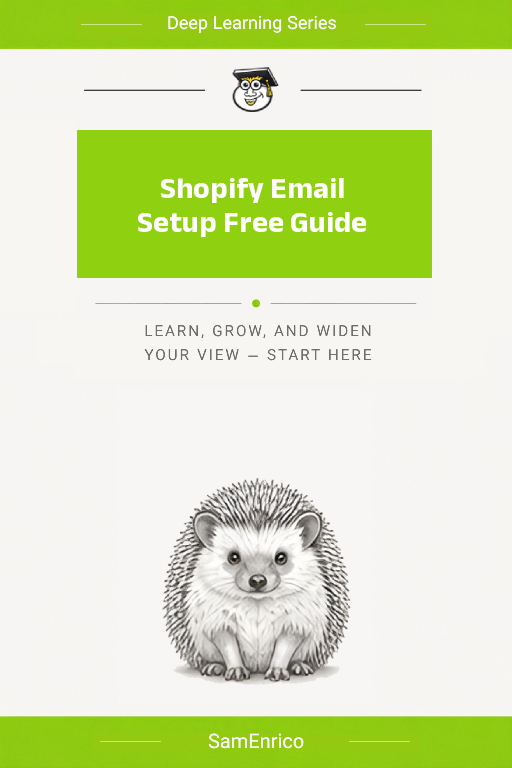
Shopify Email Setup Free Guide eBook
Use Shopify Email free tier to send 10,000 emails
by Wendt Leena
Use Shopify Email free tier to send 10,000 emails monthly.
Formats
Free sample
Chapter 1: The 10,000 Lie--–- Let me tell you the lie that Shopify wants you to believe. It’s the same lie that every freemium software company whispers in your ear the moment you sign up. The lie sounds like this: “Free is free. No strings attached. Send 10,000 emails every month and grow your business without spending another dollar.”It’s not entirely false.
But it’s not entirely true either. And in the world of e-commerce, the difference between a half-truth and a full truth is often the difference between a profitable store and a store that quietly closes its virtual doors after eighteen months of frustration.I’ve seen it happen more times than I can count. A passionate entrepreneur launches a beautiful Shopify store. They spend weeks perfecting the product photography, agonizing over the color scheme, and crafting the perfect about page. Then they discover the Shopify Email app.
“Free,” it says. “10,000 emails per month,” it promises. And they think, “Great. Marketing is solved.”Three months later, they’ve sent exactly 847 emails. Their open rates are below 10%.
Their click-through rates are below 1%. And they’ve generated perhaps three sales from email—none of which they can confidently attribute to the channel because they never set up proper tracking.The problem wasn’t the tool. The problem was the assumption. They assumed that “free” meant “easy.” They assumed that 10,000 emails was a budget to spend carelessly. They assumed that sending emails was the same as marketing.This chapter is going to shatter those assumptions.
Not to discourage you, but to prepare you. Because once you understand what the 10,000 email allowance actually represents—its limitations, its strategic implications, and its proper use—you will stop treating it like a free coupon and start treating it like the powerful business asset it was designed to be.The Economics of “Free”Let’s start with the math, because math doesn’t lie. But first, a necessary clarification that many guides conveniently omit: Shopify Email is not standalone free software. It is a free inclusion within a paid Shopify subscription. As of this writing, you need at minimum a Basic Shopify plan, which costs 29permonth(or29 per month (or 29permonth(or25 per month if paid annually).
If you are reading this book, I am assuming you already have an active Shopify store. If you do not, pause here, go set that up, and then come back. The 29monthlysubscriptionisyourfixedcost.Everythingfromthispointforwardassumesyouhavealreadypaidthatfixedcost,whichmeansthefirst10,000emailsyousendeachmonthtrulycostyou29 monthly subscription is your fixed cost. Everything from this point forward assumes you have already paid that fixed cost, which means the first 10,000 emails you send each month truly cost you 29monthlysubscriptionisyourfixedcost.Everythingfromthispointforwardassumesyouhavealreadypaidthatfixedcost,whichmeansthefirst10,000emailsyousendeachmonthtrulycostyou0 in marginal expense.That marginal cost of zero is revolutionary. In the traditional direct mail era, sending 10,000 physical letters would cost you thousands of dollars in paper, printing, postage, and labor.
In the early days of email marketing, you paid per send or per subscriber, often hundreds of dollars monthly. Today, the dominant platforms like Klaviyo charge based on the number of active profiles you have. At 5,000 subscribers, Klaviyo’s cheapest plan starts around 50permonthandrisesquickly.At10,000subscribers,youmightpay50 per month and rises quickly. At 10,000 subscribers, you might pay 50permonthandrisesquickly.At10,000subscribers,youmightpay100 or more.Shopify Email gives you the first 10,000 sends at no additional cost. That is genuinely valuable.
But you need to understand exactly how the allowance works.The Reset Clock Your 10,000 email allowance resets on the first day of every calendar month. This is not a rolling 30-day window. It is a hard reset. On January 31st at 11:59 PM, your counter reads whatever you have used. On February 1st at 12:00 AM, it resets back to zero.
Any unused emails from the previous month do not roll over. If you sent only 6,000 emails in January, you do not get 14,000 in February. You get 10,000, no more, no less.This calendar-based reset has strategic implications. If you launch a major campaign on the 30th of the month and send 5,000 emails, you will have only 5,000 remaining for the next day. Plan your monthly email calendar around this reset.
I recommend scheduling your highest-volume sends—such as abandoned cart flows, which run continuously—to begin early in the month, giving you the full allowance for the weeks ahead.What Counts Toward the 10,000?Every email sent through Shopify Email counts toward your allowance. This includes:Broadcast campaigns (newsletters, promotional emails, announcements)Automated flows (welcome series, abandoned cart emails, post-purchase follow-ups)Test emails (though these are minimal)Re-sends to non-openers (a feature within Shopify Email)What does not count? Transactional emails—order confirmations, shipping updates, password resets, and customer account emails—are handled by Shopify’s core platform, not the Shopify Email app. You could send 100,000 order confirmation emails and they would not touch your 10,000 allowance. This is crucial to understand because it means you can reserve your allowance entirely for marketing communications while transactional emails operate on a separate, unlimited track.Overages: The $1 Per 1,000 Safety Valve What happens when you exceed 10,000 emails in a single month?
Shopify charges overages at a rate of 1peradditional1,000emails.Theseoveragesarebilledinincrementsof1,000.Ifyousend10,001emails,youpay1 per additional 1,000 emails. These overages are billed in increments of 1,000. If you send 10,001 emails, you pay 1peradditional1,000emails.Theseoveragesarebilledinincrementsof1,000.Ifyousend10,001emails,youpay1. If you send 11,500 emails, you pay 2(forthefirst2,000overages).Ifyousend19,999emails,youpay2 (for the first 2,000 overages). If you send 19,999 emails, you pay 2(forthefirst2,000overages).Ifyousend19,999emails,youpay10.This overage structure is surprisingly affordable.
Compare it to the base subscription of a dedicated email platform, which often starts at 50–50–50–100 per month. Paying 10foranextra10,000emails(bringingyourtotalto20,000)isoftencheaperthanswitchingtoaseparatetool.However,theoveragemodelisdesignedforoccasionalspikes,notsustainedhighvolume.Ifyouconsistentlysend20,000emailseverymonth,the10 for an extra 10,000 emails (bringing your total to 20,000) is often cheaper than switching to a separate tool. However, the overage model is designed for occasional spikes, not sustained high volume. If you consistently send 20,000 emails every month, the 10foranextra10,000emails(bringingyourtotalto20,000)isoftencheaperthanswitchingtoaseparatetool.However,theoveragemodelisdesignedforoccasionalspikes,notsustainedhighvolume.Ifyouconsistentlysend20,000emailseverymonth,the10 monthly overage adds up to $120 per year. That might still be cheaper than a dedicated platform, but you lose the advanced features those platforms offer.
We will explore this trade-off in detail in Chapter 12.The Real Constraint Is Not the Allowance Here is where most store owners get trapped. They look at 10,000 emails and think, “That’s plenty. I only have 500 subscribers. If I send two emails per week, that’s only 4,000 emails per month. I will never hit the limit.”This thinking is dangerously naive because it assumes that your email volume comes only from broadcasts—emails you deliberately write and send to your entire list.
In reality, automated flows will consume your allowance much faster than you expect.Let me show you the math that changed how I think about email allowances.The Abandoned Cart Math Assume you have 1,000 subscribers. In a typical month, 30% of those subscribers might add items to their cart and then abandon before purchasing. That is 300 abandoned carts. For each abandoned cart, you configure Shopify Email to send two recovery emails: one at 1 hour and one at 24 hours. That is 600 emails from this single flow.The Welcome Series Math Every new subscriber should enter a welcome series.
Let us say you gain 150 new subscribers per month (a 15% monthly growth rate, which is healthy but not…
This is the end of the free sample. Get the eBook to keep going. Buy now
About this book
Details
- Author
- Wendt Leena
- Publisher
- SamEnrico
- Language
- English
- Genre
- Non-Fiction, First 30 Days
- Released
- 2026-05-30
- Pages (approx.)
- 157
- Available as
- eBook, Audiobook

Read better in the ZLOADR app
Your eBooks on your phone or tablet. Sign in with your SamEnrico account and start reading.
More by Wendt Leena
 Letting Go of Resentment JournalWendt Leena$11.99
 Chunking for High SchoolWendt Leena$11.99
 Geo Arbitrage Vietnam HandbookWendt Leena$11.99
 Visual Interruption BlockersWendt Leena$11.99
 Windmill Turning CalmWendt Leena$11.99
 Resume Kuwait Specific GuideWendt Leena$11.99
 Commercial Real Estate DemographicsWendt Leena$11.99
 Self Esteem After Weight GainWendt Leena$11.99
 Navigating Parental Narcissism GuideWendt Leena$11.99
 The Relativity Detective: How a Young Scientist Proved Einstein Right in the JungleWendt Leena$11.99
 The Fires of Axum: How an African Kingdom Tamed the EarthWendt Leena$11.99
 Fury from the Deep: The Night the Sea Stole ChristmasWendt Leena$11.99
You may also like
 Hong Kong Handover 1997Dunn Johnnie$11.99
 Zumba For Postnatal Recovery CourseNeal Christian$11.99
 Zumba for BeginnersLadner Nikia$11.99
 YouTube Comment Mining GuideHumes Pandora$12.99
 Worry Box MeditationCarlin Rudy$11.99
 Workplace Stress MeditationNguyen Lynn$11.99
 Workplace Stress and Sleep RepairHawley Ivory$11.99
 Workplace Perfectionism CureDelaney Jeffry$11.99
 Workplace Injustice Anger GuideWallen Isabelle$11.99
 Work Addiction and Burnout LinkGreenwood Ester$11.99
 Women in Yoga and WellnessBeattie Galina$11.99
 Women in Stand Up ComedyChun Evangeline$11.99