
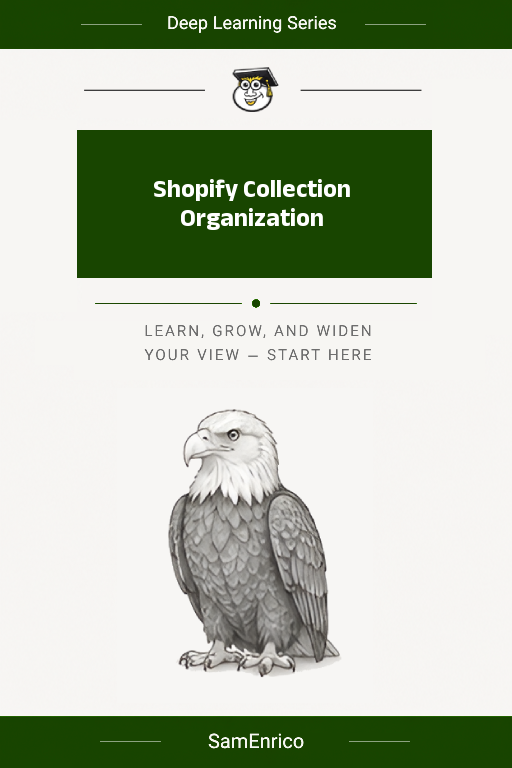
Shopify Collection Organization eBook
Create product collections using free manual and a
by Foley Hilde
Create product collections using free manual and automated rules.
Formats
Free sample
Chapter 1: The Hoarder’s Basement--You have a beautiful website. Your logo is polished. Your product photography belongs in a magazine. Your checkout process is smoother than a fresh jar of Skippy.And yet, your sales are stagnant.You’ve tried Facebook ads. You’ve tried Google Shopping.
You’ve tried influencer shoutouts and email popups and that one Tik Tok trend involving a dancing pickle. Nothing moves the needle. Or maybe sales bump briefly, then fall back to the same frustrating plateau.Here’s what nobody tells you: your store isn’t failing because of your marketing. Your store is failing because your customers can’t find what they’re looking for.Welcome to the hoarder’s basement.Imagine walking into a physical store. The lights are on.
The music is playing. But instead of neat aisles and logical sections, every product is piled in random stacks. Winter coats sit next to bikinis. Dog food shares a shelf with diamond earrings. A sign that says “Sale” points to an empty corner.
When you ask the owner where to find a medium-sized blue sweater, they shrug and say, “It’s in here somewhere. Keep looking.”You would leave. You would never come back. And you would tell your friends to stay away.That is exactly what your Shopify store looks like to customers right now.I’m not saying this to hurt your feelings. I’m saying it because I’ve seen the inside of over 500 Shopify stores, from one-product startups to eight-figure enterprises, and I can tell you with absolute certainty: most of them are organized like a hoarder’s basement.
The only difference is the basement is digital, so the mess is invisible to the owner.But it’s not invisible to customers. They feel it in every extra click, every confusing filter, every dead-end collection page that shows them nothing relevant. And they vote with their wallets by leaving.The $600,000 Mistake Let me tell you about Sarah. (Name changed to protect the embarrassed.)Sarah ran a mid-sized apparel brand doing about $2 million per year in revenue. She had a loyal email list, solid margins, and a product that people genuinely loved.
But in early 2023, her sales plateaued. Then they dipped. Then they dipped again.She hired a marketing consultant. Then another. She increased her ad spend by 40%.
Nothing worked.During a routine audit of her Shopify store, I asked to see her collections. She opened the Collections page in her admin panel. There were 147 of them. I asked how many of those collections were visible in her navigation. She didn’t know.
I asked how many products were assigned to no collection at all. She didn’t know that either.We ran a simple export. The results were devastating.– 412 products—nearly 18% of her entire inventory—were orphans. They belonged to no collection. They were invisible to any customer who browsed her store.
The only way to find them was to type the exact product name into search, assuming a customer knew it existed in the first place.– 63 collections had not been updated in over six months. Many contained products that were out of stock, discontinued, or completely out of season.– Her “Winter Clearance” collection, which she had manually built in January, still featured the same products in July. Customers clicking on it found nothing on sale and left immediately.– Her filter system was so broken that selecting “Size: Medium” returned zero results for three entire categories—even though she had over 200 medium-sized items in stock. The tags read “Med” on some products, “Medium” on others, and “M” on the rest. Shopify treated them as completely different filters.Sarah was losing money every single day, not because her products were bad or her marketing was weak, but because her collection organization was a disaster.We calculated the impact.
Based on her traffic data and average order value, the 412 orphan products alone represented approximately $600,000 in annualized lost revenue. Products that existed. That people wanted. That were literally invisible.Within 30 days of fixing her collections using the system you’re about to learn, Sarah’s conversion rate increased by 22%. Her average order value climbed 15% because customers could finally find the complementary products they wanted.
Her ad spend efficiency doubled because she started sending traffic directly to well-organized collection pages instead of her homepage.She didn’t change her products. She didn’t change her marketing. She changed how her products were organized.That is the power of collection mastery.The 30% Silent Killer You are probably losing somewhere between 10% and 40% of your potential revenue right now due to poor collection organization. I know that sounds extreme. Let me show you the math.Shopify processes billions of dollars in transactions every year.
Their internal data (shared with Plus merchants) shows that conversion rates drop by an average of 12% for every unnecessary click required to find a product. Most stores add 3 to 5 unnecessary clicks through poor collection design. That’s a potential 36–60% reduction in conversions before a customer even sees a product page.But let’s be conservative. Let’s say your collection chaos is only costing you 20% of your revenue. If you’re doing 100,000peryear,that’s100,000 per year, that’s 100,000peryear,that’s20,000 left on the table.
If you’re doing 500,000peryear,that’s500,000 per year, that’s 500,000peryear,that’s100,000. If you’re doing 2millionlike Sarah,that’s2 million like Sarah, that’s 2millionlike Sarah,that’s400,000.And here’s the part that keeps me up at night: you don’t know which 20% you’re losing. It’s not like a broken checkout cart where customers complain loudly. They just leave silently. They don’t email you to say, “I tried to find a medium-sized blue sweater but your filters were broken so I bought from your competitor instead.” They just leave.
And you never know.This is the silent killer of ecommerce stores. Not poor product quality. Not high prices. Not ugly websites. The inability for customers to find what they want, when they want it, in a way that feels effortless.Why Your Brain Hates Bad Organization There’s a reason bad collections hurt so much.
It’s not just inconvenience. It’s cognitive load.Every time a customer interacts with your store, their brain is running a tiny cost-benefit analysis. “How much energy will it take to find what I want? Is it worth it?” The moment the perceived effort exceeds the perceived value, they leave.Psychologists call this the effort heuristic. The easier something is to find, the more valuable it seems.
The harder it is to find, the less valuable it feels—even if it’s the exact same product at the exact same price.When your collections are a mess, you’re not just frustrating customers. You’re devaluing your own products. A beautiful handmade leather bag that takes five clicks to find feels cheap and frustrating. The same bag found in one click feels premium and effortless.Navigation vs. Search: Two Customers, Two Needs Every customer who lands on your store falls into one of two categories: browsers or searchers.
Your collection strategy needs to serve both, and most stores fail at one or the other.Browsers want to explore. They…
This is the end of the free sample. Get the eBook to keep going. Buy now
About this book
Details
- Author
- Foley Hilde
- Publisher
- SamEnrico
- Language
- English
- Genre
- Non-Fiction, First 30 Days
- Released
- 2026-06-01
- Pages (approx.)
- 129
- Available as
- eBook, Audiobook

Read better in the ZLOADR app
Your eBooks on your phone or tablet. Sign in with your SamEnrico account and start reading.
More by Foley Hilde
 The Interruption Decision MatrixFoley Hilde$11.99
 Emotionally Unavailable Parent GuideFoley Hilde$11.99
 Confronting Harassment At Work GuideFoley Hilde$11.99
 Chunking for Daily RoutineFoley Hilde$11.99
 Storming Bastille Revolution GuideFoley Hilde$11.99
 Anger and Intimacy GuideFoley Hilde$11.99
 Pelvic Floor for WomenFoley Hilde$11.99
 CRE Mezzanine Debt GuideFoley Hilde$11.99
 Self Esteem For MenFoley Hilde$11.99
 The Silent Codebreaker: Alan Turing’s Secret War Beyond EnigmaFoley Hilde$11.99
 Summits and Shadows: The Indomitable Women Who Conquered the Southern SkiesFoley Hilde$11.99
 Code of the Pharaohs: The DNA Secrets of Ancient EgyptFoley Hilde$11.99
You may also like
 Hong Kong Handover 1997Dunn Johnnie$11.99
 Zumba For Postnatal Recovery CourseNeal Christian$11.99
 Zumba for BeginnersLadner Nikia$11.99
 YouTube Comment Mining GuideHumes Pandora$12.99
 Worry Box MeditationCarlin Rudy$11.99
 Workplace Stress MeditationNguyen Lynn$11.99
 Workplace Stress and Sleep RepairHawley Ivory$11.99
 Workplace Perfectionism CureDelaney Jeffry$11.99
 Workplace Injustice Anger GuideWallen Isabelle$11.99
 Work Addiction and Burnout LinkGreenwood Ester$11.99
 Women in Yoga and WellnessBeattie Galina$11.99
 Women in Stand Up ComedyChun Evangeline$11.99