
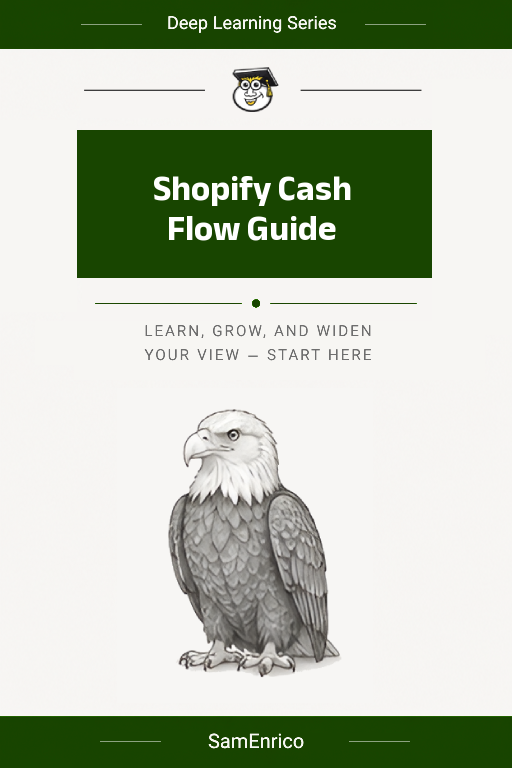
Non-FictionFirst 30 DaysCash Management
Shopify Cash Flow Guide eBook
Manage store cash flow with $100 budget using prep
Manage store cash flow with $100 budget using prepaid cards and revenue reinvestment.
Formats
Free sample
Chapter 1: The $100 Lie--Every guru on You Tube, every course on Click Bank, and every “mentor” in your DMs will tell you the same thing: you need at least five thousand dollars to start a real Shopify store. Some will say ten thousand. The more generous ones will offer to sell you a “done-for-you” store for only twenty-nine ninety-five—plus a monthly retainer, plus ad spend, plus their “premium” plugin package. They are lying to you.Not maliciously, necessarily. Most of them genuinely believe what they are saying because they have never done it any other way.
They raised money, or borrowed from family, or maxed out credit cards. They burned through cash until something stuck, and now they teach that same cash-burning method as gospel. But here is the truth they don’t want you to know: a strict budget of one hundred dollars is not a disadvantage. It is a strategic weapon.This entire book exists to prove that single statement. You do not need thousands.
You do not need a loan. You do not need to go into debt. You need one hundred dollars, a prepaid card, and a completely different mindset about how money moves through a business. The entrepreneurs who succeed with tiny budgets are not luckier or smarter than everyone else. They simply understand something that venture-backed founders often forget: discipline scales.
Waste scales too. If you cannot make money with one hundred dollars, you will not make money with ten thousand. You will just lose it ten thousand times faster.I learned this lesson the hard way, in a way that almost destroyed my first business before it started. I had saved fifteen hundred dollars—a fortune to me at the time. I spent three hundred on a “premium” Shopify theme, two hundred on apps I was told were essential, and put one thousand into Facebook ads.
Within ten days, I had made exactly eighty-seven dollars in sales. My customer acquisition cost was thirty-seven dollars. My average order value was twenty-nine dollars. Do the math. I was losing eight dollars on every customer, and I had no idea why until I sat down with a spreadsheet and realized I had never actually calculated my margins before spending a single dollar.That failure taught me the most important lesson of my entrepreneurial life: cash flow is not about how much money you have.
It is about how clearly you can see where it goes. When I started my next store with exactly one hundred dollars on a prepaid card from a gas station, I had no choice but to see every dollar. And that forced clarity turned into my first profitable month.Let me show you exactly how.The Paradox of Plenty There is a well-documented phenomenon in venture capital called “the curse of the large round.” Startups that raise too much money too early almost always fail at higher rates than startups that scrape by on minimal funding. The reason is counterintuitive but obvious once you see it: when you have plenty of money, you stop asking hard questions.If you have five thousand dollars to spend on Facebook ads, you will launch five thousand dollars worth of ads. You will not ask, “Is this the absolute best use of five dollars?” because five dollars feels meaningless.
But five dollars is not meaningless. Five dollars is five percent of your entire budget if you only have one hundred. And five percent of your budget demands a hard question: “Will this five dollars definitely bring back more than five dollars?”That question is the entire engine of profitable cash flow. And a hundred-dollar budget forces you to ask it on every single purchase.The Small Plate Accounting Method In his book Profit First, Mike Michalowicz introduces a concept he calls “small plate accounting.” The idea is simple: if you put food on a large plate, it looks small, and you take more. If you put the same amount of food on a small plate, it looks full, and you stop.
Money works exactly the same way. When you have a large bank account, expenses look small. A twenty-nine-dollar app subscription barely registers. A fifteen-dollar transaction fee feels like nothing. But when you have a small plate—when your total budget is one hundred dollars—every expense looks enormous.
Twenty-nine dollars is nearly a third of your entire operating cash. Fifteen dollars is fifteen percent. You cannot ignore those numbers.This book will treat your one hundred dollars as a small plate. Every expense will be questioned. Every dollar will have a purpose.
And that discipline will save you from the silent killers that destroy most bootstrapped stores: subscription creep, invisible fees, and the slow bleed of unprofitable ad spend.Value Versus Waste The second foundational concept comes from Eric Ries’s The Lean Startup: the distinction between value and waste. Value is any activity that brings you closer to a paying customer. Waste is everything else. Designing a logo is waste until you have a customer. Tweaking your font colors is waste.
Watching You Tube tutorials about Shopify SEO is waste. Running a five-dollar Facebook ad that brings in a ten-dollar profit? That is value.With a hundred dollars, you cannot afford waste. You cannot spend three days perfecting your “about us” page. You cannot watch forty hours of “Shopify mastery” courses.
You can only do one thing: find a product, put it in front of people who might buy it, and collect money faster than you spend it. Everything else is a distraction. This book will ruthlessly cut waste from your process.The Launch Week Runway Now let us get specific. You have one hundred dollars. You have a Shopify Basic account, which costs twenty-nine dollars per month.
That breaks down to approximately ninety-seven cents per day. You might also have a domain name—fifteen dollars per year, or about four cents per day. Let us say your total fixed daily costs are one dollar and five cents, including a small buffer for unexpected fees.Your Launch Week Runway is your total cash divided by your daily fixed costs. One hundred dollars divided by one dollar and five cents gives you approximately ninety-five days of runway. That sounds comfortable, right?
Ninety-five days to find a customer. Plenty of time.Wrong.That calculation assumes you spend nothing on marketing, nothing on testing, nothing on the actual activities that bring customers to your store. In reality, you will spend the majority of your one hundred dollars on variable costs: ads, samples, shipping for influencer gifts, and small tests. Your true runway is much shorter.Here is the honest calculation that most gurus will not give you. You need to reserve at least sixty dollars for marketing and testing.
That leaves forty dollars for fixed costs. Forty dollars divided by one dollar and five cents per day gives you approximately thirty-eight days. Still comfortable? Maybe. But you are not done yet.You also need to reserve a buffer for unexpected expenses: a chargeback fee, a refund shipping cost, an app subscription you forgot to cancel.
Set aside ten dollars for that buffer. Now you have thirty dollars for fixed costs. Thirty dollars divided by one…
This is the end of the free sample. Get the eBook to keep going. Buy now
About this book
Details
- Author
- Weems Shenika
- Publisher
- SamEnrico
- Language
- English
- Genre
- Non-Fiction, First 30 Days, Cash Management
- Released
- 2026-05-29
- Pages (approx.)
- 145
- Available as
- eBook, Audiobook

Read better in the ZLOADR app
Your eBooks on your phone or tablet. Sign in with your SamEnrico account and start reading.
More by Weems Shenika
 Take Home Naloxone ProgramsWeems Shenika$11.99
 Async SDK Release Notes CourseWeems Shenika$11.99
 TM Parenting PatienceWeems Shenika$11.99
 Emotional Intelligence in PresentationsWeems Shenika$11.99
 Childhood Origins of Imposter SyndromeWeems Shenika$11.99
 Locked in the Cloud: The Ransomware Heist That Froze a CityWeems Shenika$11.99
 The Cartographer’s Heart: Love and Loss on the Indian OceanWeems Shenika$11.99
 Lease Buyout Negotiation GuideWeems Shenika$12.99
 How to Start a Preserved Fruit and Vegetables (retail) Business (Beginners Guide)Weems Shenika$11.99
 Understanding Craniofacial and Skeletal DefectsWeems Shenika$17.99
 Financial Project ManagerWeems Shenika$11.99
You may also like
 Hong Kong Handover 1997Dunn Johnnie$11.99
 Zumba For Postnatal Recovery CourseNeal Christian$11.99
 Zumba for BeginnersLadner Nikia$11.99
 YouTube Comment Mining GuideHumes Pandora$12.99
 Worry Box MeditationCarlin Rudy$11.99
 Workplace Stress MeditationNguyen Lynn$11.99
 Workplace Stress and Sleep RepairHawley Ivory$11.99
 Workplace Perfectionism CureDelaney Jeffry$11.99
 Workplace Injustice Anger GuideWallen Isabelle$11.99
 Work Addiction and Burnout LinkGreenwood Ester$11.99
 Women in Yoga and WellnessBeattie Galina$11.99
 Women in Stand Up ComedyChun Evangeline$11.99