
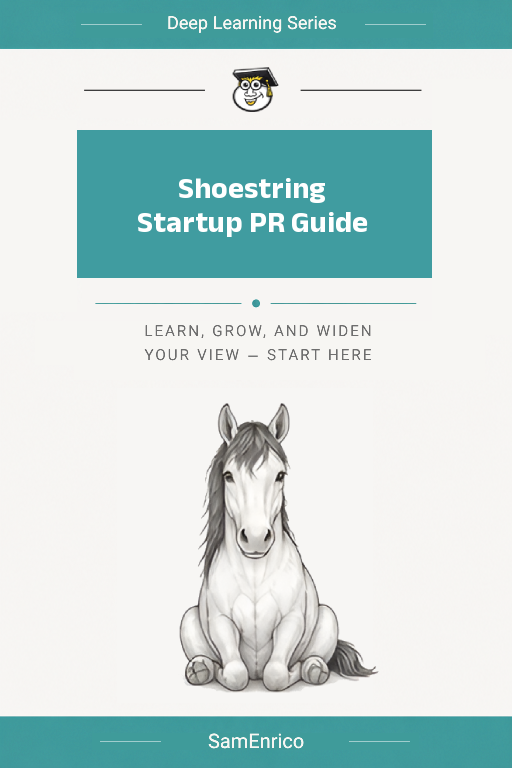
Non-FictionStartup GuideMedia Outreach
Shoestring Startup PR Guide eBook
Get media coverage for your startup without a PR b
by Leblanc Zena
Get media coverage for your startup without a PR budget. DIY tactics that actually work for bootstrapped founders.
Formats
Free sample
Chapter 1: The $30k Lie--–- The email arrived on a Tuesday morning, and it nearly made me throw my laptop across the room.Six months earlier, I had signed my first agency retainer. Five thousand dollars a month. The agency had promised "Tier 1 media placements, strategic narrative development, and ongoing media training." What they delivered was a monthly PDF called a "coverage report" filled with links to no-name blogs, a junior account executive who couldn't remember my startup's name, and exactly zero mentions in any publication I had actually heard of.Thirty thousand dollars. Zero results.The email that broke me was their proposal for "Month Seven." They wanted another $5k to "refine the strategy."I canceled the retainer that afternoon. And then, because I had no choice and no budget left, I did something desperate: I wrote my own email to a journalist.
Not a press release. Not a "media advisory." Just a short, weirdly specific note to a reporter whose article I had actually read and enjoyed.She replied in eleven minutes.Three days later, my startup was mentioned in Fast Company.That was the moment I realized the truth that PR agencies have spent decades hiding: you do not need a budget to get media coverage. You need a pair of eyes, a working email address, and the courage to be useful.This book is the proof. And Chapter 1 is the unlearning.The Myth That Cost Me $30,000Before we talk about what works, we need to talk about what doesn't. And what doesn't work, for bootstrapped founders, is almost every traditional PR agency on the planet.Here is how the PR industry operates.
An agency charges a monthly retainer—typically between 5,000and5,000 and 5,000and30,000 for a "starter package." They assign you a team: an account supervisor, a junior associate, maybe an intern. That team spends the first month "auditing" your brand, which means they ask you to fill out a thirty-page questionnaire about your mission, your values, your "unique positioning." You spend hours on this. You feel productive.Month two: they send you a "media list." This is a spreadsheet of journalists they claim will care about your story. The list is almost always recycled from another client. It contains hundreds of names, most of whom have never written about your industry.
Many of the email addresses are wrong.Month three: they send a blast email to that list. The email is a press release written in the agency's proprietary template, which looks exactly like every other press release every other agency has ever written. It is long. It is boring. It is full of phrases like "revolutionary platform" and "game-changing solution."Journalists delete it in under three seconds.Month four: the agency sends you their monthly "coverage report." It contains a few links.
Maybe a mention on a content farm. Maybe a "sponsored post" they paid for without telling you. Maybe a quote from your CEO in a roundup article that fifty other companies also made it into.You ask about Tech Crunch. They say "we're building relationships."Month five: more of the same.Month six: they propose renewing the contract.This is not malice. This is the business model.
PR agencies are built for enterprises with massive budgets who need to maintain visibility, not create it from zero. An agency cannot get you your first placement because their entire machinery relies on volume, not specificity. They blast thousands of emails and hope for a 0.5% reply rate. That works for a Fortune 500 company with a recognizable name. It does not work for you.Here is the hard truth that agencies will never tell you: if you have less than $500,000 in annual revenue, a PR agency is not just useless.
It is actively harmful. Why? Because it teaches you helplessness. It outsources the very skill you most need to learn yourself. Media relations is not magic.
It is a learnable, repeatable process. And the only person who will ever care enough to get it right is you.Meet The Villain: The PR Industrial Complex I want to give a name to the thing that took my $30,000.I call it The PR Industrial Complex.The PR Industrial Complex is the interconnected web of agencies, software vendors, consultants, and "media training" experts who profit from founder fear. They sell you the belief that PR is mysterious, difficult, and requires specialized expertise. They sell you the belief that you cannot do it yourself. They sell you the belief that without them, you will be invisible.None of that is true.The PR Industrial Complex includes companies like Cision and Meltwater, which sell media database subscriptions for 10,000–10,000–10,000–50,000 per year.
It includes the agencies that mark up those databases and resell them to you. It includes the "PR coaches" who charge 500anhourtotellyouwhatyoucouldlearnfroma500 an hour to tell you what you could learn from a 500anhourtotellyouwhatyoucouldlearnfroma20 book. It includes the media training firms that convince founders they need to practice answering questions before talking to a journalist.Here is what the PR Industrial Complex does not want you to know: journalists are desperate for sources. Right now, as you read this sentence, there are hundreds of reporters on Twitter, Linked In, and HARO actively begging for experts to quote. They have deadlines.
They have editors screaming at them. They have empty columns to fill.And they do not care if you have a PR agency. They do not care if you have a "media kit." They do not care about your "talking points."They care about one thing: can you help them finish their story faster?That is the entire game. And you can play it for exactly zero dollars.The Renegade Vow Before we go any further, I need you to make a decision.This book is not for everyone. It is for a specific type of founder.
The kind who is willing to be wrong, to try things that feel uncomfortable, to send emails that might be ignored, to fail publicly and learn quickly. The kind who would rather spend thirty minutes a day building a skill than five thousand dollars a month renting someone else's.I call this person a Shoestring Renegade.A Shoestring Renegade is not defined by budget. They are defined by mindset. They understand that speed and specificity beat spending every single time. They understand that journalists are not gatekeepers to be begged—they are partners to be helped.
They understand that the only sustainable PR strategy is one they own themselves.If that is you, I want you to take the Renegade Vow. You can say it out loud. You can write it on a sticky note and put it on your monitor. You can tweet it. But take it.The Renegade Vow:I will not spend money on PR until I have proven I cannot do it myself.I will spend thirty minutes a day for ninety days on DIY PR.I will not hire an agency until I have gotten my first three placements alone.I will treat journalists as collaborators, not targets.I will be specific.
I will be fast. I will be helpful.I am a Shoestring Renegade.This is not a gimmick. This is an accountability…
This is the end of the free sample. Get the eBook to keep going. Buy now
About this book
Details
- Author
- Leblanc Zena
- Publisher
- SamEnrico
- Language
- English
- Genre
- Non-Fiction, Startup Guide, Media Outreach
- Released
- 2026-06-01
- Pages (approx.)
- 141
- Available as
- eBook, Audiobook

Read better in the ZLOADR app
Your eBooks on your phone or tablet. Sign in with your SamEnrico account and start reading.
More by Leblanc Zena
 HIIT Immune System BoostLeblanc Zena$11.99
 The Post Scream Repair GuideLeblanc Zena$11.99
 Empathy For Suicidal ThoughtsLeblanc Zena$11.99
 Step Eleven Prayer Meditation GuideLeblanc Zena$11.99
 The Norman Feudalism GuideLeblanc Zena$11.99
 The Last Kingpin: The Rise and Fall of Frank MatthewsLeblanc Zena$11.99
 Customer Event Retention GuideLeblanc Zena$12.99
 The Breeder's Guide to Lavender TurkeysLeblanc Zena$11.99
 Interior Design AssistantLeblanc Zena$11.99
 How to Start a Battery for Flash Lamp Business (Beginners Guide)Leblanc Zena$11.99
You may also like
 Hong Kong Handover 1997Dunn Johnnie$11.99
 Zumba For Postnatal Recovery CourseNeal Christian$11.99
 Zumba for BeginnersLadner Nikia$11.99
 YouTube Comment Mining GuideHumes Pandora$12.99
 Worry Box MeditationCarlin Rudy$11.99
 Workplace Stress MeditationNguyen Lynn$11.99
 Workplace Stress and Sleep RepairHawley Ivory$11.99
 Workplace Perfectionism CureDelaney Jeffry$11.99
 Workplace Injustice Anger GuideWallen Isabelle$11.99
 Work Addiction and Burnout LinkGreenwood Ester$11.99
 Women in Yoga and WellnessBeattie Galina$11.99
 Women in Stand Up ComedyChun Evangeline$11.99