
Non-FictionHealth & WellnessSleep Hygiene
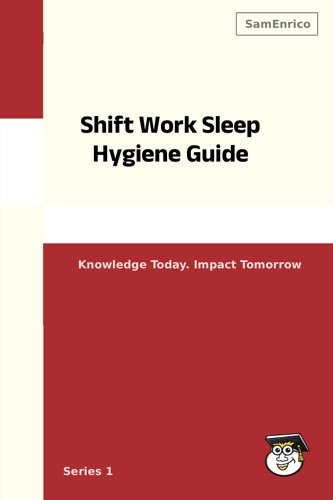
Shift Work Sleep Hygiene Guide eBook
Creates optimal bedroom conditions for daytime sle
by Lockhart Dot
Creates optimal bedroom conditions for daytime sleeping.
Formats
Free sample
Chapter 1: The 3:00 AM Lie--–- You have been told a lie. It is whispered by well-meaning coworkers, reinforced by tired memes, and repeated by family members who “just want you to be normal.” The lie sounds like this: If you just tried harder to sleep during the day, you would figure it out. Or its evil twin: Some people just aren’t built for night work. Neither statement is true. The truth is far simpler and far more liberating: Your body is not broken.
Your environment is. And unlike your circadian rhythm, your environment is something you can change completely, often for less than the cost of a single shift’s worth of takeout coffee.This chapter exists to tear down the shame, the guilt, and the quiet desperation of lying awake at 11:00 AM while the world outside mows lawns and lives life. You are not lazy. You are not weak. You are not “bad at sleeping.” You are a human being trying to force a billion years of evolutionary programming to reverse itself with nothing but willpower and a pair of cheap curtains.
That was never going to work. But the solution—the actual, science-backed, engineer-your-bedroom-into-a-weapon-of-sleep solution—is simpler than you think. Let us begin by understanding exactly what you are fighting, why you are losing, and how to stop fighting altogether.The Circadian Ambush: Why 9:00 AM Feels Like Noon Deep inside your brain, buried just above the spot where your optic nerves cross, sits a cluster of about 20,000 neurons called the suprachiasmatic nucleus (SCN). This is your master clock. It does not care about your work schedule, your bills, or your child’s school play.
It cares about one thing only: light. Specifically, the presence or absence of blue-wavelength light (the kind the sun produces in abundance from sunrise to mid-morning).When blue light hits your retina, the SCN receives a signal that says, “Day has begun.” In response, it does three things simultaneously. First, it orders your pineal gland to stop producing melatonin, the hormone that creates sleep pressure. Second, it releases cortisol into your bloodstream, a stimulant that raises your heart rate and blood pressure. Third, it raises your core body temperature by about one degree, making you feel alert and physically energized.
All of this happens within minutes. It is a beautifully efficient system—for someone who works from 9:00 AM to 5:00 PM.Now imagine you finish a night shift at 7:00 AM. You drive home in morning sunlight (blue light everywhere). You walk into your bedroom at 8:00 AM. Your SCN has just been bombarded with three hours of “wake up” signals.
It is now pumping cortisol at maximum capacity. Your melatonin is near zero. Your body temperature is rising. And you are trying to fall asleep. This is not difficult.
It is physiologically impossible to do without intervention. You are asking your brain to slam on the brakes while your foot is on the accelerator.This is the Circadian Ambush—the moment when your internal biology and your external schedule collide head-on. And you have been losing this battle not because you lack discipline, but because you have been using discipline to fight biology. That never works. You cannot willpower your way past a billion years of evolution.
But you can trick the SCN. You can build a sensory environment that looks like midnight, sounds like midnight, and feels like midnight. When you do that, the SCN has no choice but to act like it is midnight. It does not have eyes. It only has light sensors.
Give it darkness, and it will give you sleep.The REM Theft: Why Daytime Sleep (Without Help) Cheats You Even if you manage to fall asleep during the day without environmental changes—perhaps because you are exhausted to the point of collapse—you are still being cheated. Sleep is not one uniform state. It cycles through four stages, and the most important for your mental health, memory, and emotional regulation is REM (Rapid Eye Movement) sleep. REM is when your brain consolidates memories, processes emotions, and clears metabolic waste. Without sufficient REM, you can sleep ten hours and still feel like you have slept four.Here is the problem that most sleep books do not tell you: unmodified daytime sleep is REM-poor.
Multiple sleep laboratory studies have shown that daytime sleepers (those who do not use blackout conditions) spend significantly less time in REM and more time in light NREM stages 1 and 2. This means you are getting the shallow, easily disrupted part of sleep while missing the deep, restorative part. You wake up feeling “hangry,” forgetful, and emotionally raw—not because you are a difficult person, but because your brain has not been allowed to run its nightly (or daily) maintenance cycle.But—and this is the most important clarification in this entire chapter—this REM deficit is not permanent and not inevitable. A properly engineered “False Night” (complete darkness, cool temperature, and silence) can restore REM to near-nighttime levels. The SCN does not care what the clock on your wall says.
It only cares about sensory inputs. Block the blue light, drop the temperature, mask the noise, and your brain will eventually enter REM cycles indistinguishable from those of a nighttime sleeper. The rest of this book is the instruction manual for exactly how to achieve that.The False Night Imperative: Engineering, Not Effort If you take nothing else from this chapter, remember this phrase: The False Night Imperative. It means that your bedroom must become a sensory replica of midnight—every single time you sleep during the day. Not “pretty dark.” Not “mostly quiet.” Not “kind of cool.” Midnight-level dark.
Midnight-level quiet. Midnight-level cool.Let us be specific about what midnight actually is, sensorily speaking:Light: At midnight in a rural area with no moon, light levels are 0.0001 lux (a unit of illuminance). A typical daytime bedroom with thin curtains might be 500–1000 lux. A room with “good” curtains might still be 5–50 lux due to light leaks around the edges. The goal is to get below 0.5 lux—dark enough that you cannot see your hand in front of your face after 30 seconds of adjustment.Sound: At midnight in a quiet suburban home, ambient noise levels are 25–30 decibels (d B)—the sound of a refrigerator hum or distant wind.
Daytime noise with lawnmowers, traffic, and children can reach 60–80 d B. The goal is to reduce perceived noise to below 35 d B using a combination of sound masking (brown noise) and physical barriers (earplugs).Temperature: At midnight in a temperate climate, room temperature typically falls to 65–68°F (18–20°C). Daytime temperatures in a sunlit bedroom can reach 75–80°F. The goal is to actively cool your bedroom to 60–67°F (15–19°C), which is actually cooler than typical nighttime recommendations because daytime ambient heat requires a more aggressive cooling strategy.When you achieve these three conditions simultaneously, you are no longer “trying to sleep during the day.” You are engineering a false night. And your SCN will respond as if it is night.
Melatonin will rise. Cortisol will fall. Your core temperature will drop. And REM will return.The Cost of Doing Nothing: Microsleeps, Crashes, and Chronic Disease Before we move to solutions, let us…
This is the end of the free sample. Get the eBook to keep going. Buy now
About this book
Details
- Author
- Lockhart Dot
- Publisher
- SamEnrico
- Language
- English
- Genre
- Non-Fiction, Health & Wellness, Sleep Hygiene
- Released
- 2026-06-06
- Pages (approx.)
- 144
- Available as
- eBook, Audiobook

Read better in the ZLOADR app
Your eBooks on your phone or tablet. Sign in with your SamEnrico account and start reading.
More by Lockhart Dot
 Senior Memory Decline CopingLockhart Dot$11.99
 Weight Loss Plateau MythsLockhart Dot$11.99
 The Twelve Step Phone List GuideLockhart Dot$11.99
 Design Thinking for Intergenerational TeamsLockhart Dot$11.99
 Nominal Group TechniqueLockhart Dot$11.99
 Olive Oil ScienceLockhart Dot$11.99
 Elizabeth Favorite ManagementLockhart Dot$11.99
 Golden Shadows: The Untold Story of the First Black Olympic SwimmerLockhart Dot$11.99
 The Archimedes Code: How a Greek Genius Forged the Language of MathematicsLockhart Dot$11.99
 A Beginners Guide to Mountain unicycling (Volume 1)Lockhart Dot$11.99
 How to Produce Topping CompoundLockhart Dot$11.99
 A Collector's Handbook to the Hispano-suiza T68 (J12)Lockhart Dot$11.99
You may also like
 Hong Kong Handover 1997Dunn Johnnie$11.99
 Zumba For Postnatal Recovery CourseNeal Christian$11.99
 Zumba for BeginnersLadner Nikia$11.99
 YouTube Comment Mining GuideHumes Pandora$12.99
 Worry Box MeditationCarlin Rudy$11.99
 Workplace Stress MeditationNguyen Lynn$11.99
 Workplace Stress and Sleep RepairHawley Ivory$11.99
 Workplace Perfectionism CureDelaney Jeffry$11.99
 Workplace Injustice Anger GuideWallen Isabelle$11.99
 Work Addiction and Burnout LinkGreenwood Ester$11.99
 Women in Yoga and WellnessBeattie Galina$11.99
 Women in Stand Up ComedyChun Evangeline$11.99