
Non-FictionHealth & WellnessOccupational Health
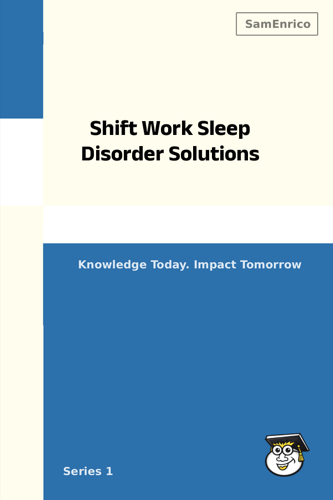
Shift Work Sleep Disorder Solutions eBook
Adapt to night shifts and rotating schedules witho
Adapt to night shifts and rotating schedules without wrecking your health.
Formats
Free sample
Chapter 1: The Hidden Clock--Most people believe that exhaustion is simply the price of working when the world sleeps. They tell themselves that a few extra hours of sleep on the weekend will erase the damage, that their bodies will eventually adapt, or that the persistent brain fog and irritability are normal side effects of a demanding job. None of these beliefs are true. The reality is far more precise, more biological, and in some ways, more hopeful. The exhaustion shift workers feel is not a moral failing or a matter of willpower.
It is the predictable result of a fundamental mismatch between the body’s internal timekeeping system and the external demands of a night shift or rotating schedule. And because this mismatch follows scientific laws as predictable as gravity, it can also be corrected using those same laws.The human body does not run on a 24-hour clock. It runs on approximately 24.2 hours, give or take a few minutes depending on genetics, age, and environmental factors. This slight overrun means that every day, without external cues, your internal clock would drift slightly later. That is why it is easier for most people to stay up an extra hour than to go to bed an hour early.
This built-in tendency toward delay is the first clue that shift work is not inherently impossible—but it requires working with biology, not against it.Before diving into solutions, this chapter establishes the foundational language and concepts that will appear throughout the book. Every protocol, every timing recommendation, and every lifestyle adjustment in later chapters rests on the principles introduced here. Readers who skip this chapter often find themselves confused by terms like “circadian misalignment” or “homeostatic sleep drive” when those concepts are applied in later protocols. More importantly, understanding the why behind each recommendation transforms a list of rules into a flexible system that readers can adapt to their unique schedules, chronotypes, and life circumstances.Shift workers occupy a strange position in modern medicine. They are simultaneously the most underserved sleep population and the one with the most to gain from targeted interventions.
A typical person with insomnia can simply adjust their bedtime, limit screen use, and practice relaxation techniques. A shift worker cannot. Their work hours are fixed by employers, their social obligations often conflict with their sleep windows, and their exposure to sunlight—the most powerful biological time cue—is exactly opposite to what their bodies need. Standard sleep advice fails for shift workers not because it is wrong, but because it assumes a degree of control over the sleep-wake schedule that shift workers simply do not have.This book was built from that gap. The protocols that follow are drawn from ten best-selling books on circadian biology, sleep medicine, metabolic health, and performance psychology, synthesized into a single coherent system.
But before any of those protocols can work, readers must first understand the basic machinery of their own internal clocks. That understanding begins here.The Suprachiasmatic Nucleus: Your Brain’s Master Conductor Deep within the brain, just above the point where the optic nerves cross, lies a tiny cluster of approximately 20,000 neurons called the suprachiasmatic nucleus, or SCN. Despite its small size—roughly the dimensions of a grain of rice—the SCN serves as the body’s master circadian pacemaker. It generates the daily rhythms that dictate when you feel alert, when you feel sleepy, when your body temperature rises and falls, when your digestive system is most active, and even when your cells repair DNA damage.The SCN does not simply respond to the environment. It generates its own intrinsic rhythm, firing electrical impulses in a cycle that repeats approximately every 24.2 hours.
This intrinsic rhythm is why people who are isolated from all external time cues—such as subjects in underground bunker studies or astronauts in space—continue to cycle between sleep and wakefulness, though their cycles gradually drift later each day. The SCN is not a passive clock that needs to be wound; it is an active pacemaker that needs to be synchronized, or “entrained,” to the external world.Entrainment is the process by which external cues, known as zeitgebers (German for “time-givers”), reset the SCN each day to keep it aligned with the 24-hour solar cycle. The most powerful zeitgeber by far is light, specifically blue-wavelength light detected by a special class of photoreceptors in the retina called intrinsically photosensitive retinal ganglion cells (ip RGCs). These cells do not contribute to vision in the traditional sense. They are not responsible for seeing color or detail.
Instead, they contain a photopigment called melanopsin that is exquisitely sensitive to blue light around 480 nanometers. When these cells detect blue light, they send a direct signal to the SCN, effectively resetting the master clock.This is why morning sunlight makes you feel awake and alert. It is also why looking at a smartphone screen at midnight—with its high concentration of blue wavelengths—can trick your SCN into thinking it is still daytime, delaying the release of melatonin and pushing your sleep later. For shift workers, this same mechanism can become either a powerful tool or a relentless enemy, depending entirely on how it is used.Melatonin: The Hormone of Darkness Melatonin is often misunderstood as a sleep-inducing sedative, like a prescription sleeping pill. This is incorrect.
Melatonin is better understood as a hormonal signal of darkness. Its job is not to force sleep but to inform the rest of the body that night has arrived, thereby permitting sleep to occur more easily.The SCN controls melatonin production through a circuitous but elegant pathway. When the SCN detects darkness—specifically, the absence of blue light signals from the ip RGCs—it signals the pineal gland, a small endocrine gland located near the center of the brain, to begin producing melatonin. Melatonin levels rise approximately two to three hours before habitual bedtime, peak in the middle of the night, and fall sharply in the early morning as light exposure suppresses production.For a typical day worker, melatonin begins rising around 9 PM, peaks between 2 AM and 4 AM, and drops to near-zero by 8 AM. This pattern is the opposite of what a night shifter needs.
A person who works from 10 PM to 6 AM should ideally have low melatonin during work hours (to stay alert) and high melatonin during daytime sleep hours (to facilitate rest). Achieving this inversion is not simply a matter of taking melatonin supplements, as many shift workers discover when high-dose melatonin leaves them groggy without improving sleep quality. The timing of melatonin exposure, not just its presence, determines whether it helps or hinders circadian adaptation.Melatonin has a secondary function that is less commonly discussed but equally important for shift workers: it acts as an antioxidant and anti-inflammatory agent in the brain and throughout the body. Chronic suppression of melatonin—exactly what happens when shift workers are exposed to bright light during nighttime hours—has been linked to increased oxidative stress, DNA damage, and higher rates of certain cancers. This is not alarmist speculation.
The World Health Organization’s International Agency for Research on Cancer classified shift work that involves circadian disruption as “probably carcinogenic to humans” (Group 2A) in 2007…
This is the end of the free sample. Get the eBook to keep going. Buy now
About this book
Details
- Author
- Beals Ricarda
- Publisher
- SamEnrico
- Language
- English
- Genre
- Non-Fiction, Health & Wellness, Occupational Health
- Released
- 2026-06-09
- Pages (approx.)
- 157
- Available as
- eBook, Audiobook

Read better in the ZLOADR app
Your eBooks on your phone or tablet. Sign in with your SamEnrico account and start reading.
More by Beals Ricarda
 Color Coding Study SystemBeals Ricarda$11.99
 Casino Environment AddictionBeals Ricarda$11.99
 Childhood Physical Abuse SurvivorBeals Ricarda$11.99
 Psychological Relapse Prevention in Recovery HousingBeals Ricarda$11.99
 Depression Journal WorkbookBeals Ricarda$11.99
 Recovery After The Golden ShotBeals Ricarda$11.99
 Atomic Bomb Test: Crossroads SeriesBeals Ricarda$11.99
 Resentment Toward In LawsBeals Ricarda$11.99
 The Last Pharaoh’s Gambit: Cleopatra’s Lost FleetBeals Ricarda$11.99
 The Iron Chefs of Nubia: Forging the FutureBeals Ricarda$11.99
 Echoes of the Cosmic Frontier: The Untold Story of the Voyager Golden RecordBeals Ricarda$11.99
 AI Model Evaluation and OptimizationBeals Ricarda$11.99
You may also like
 Hong Kong Handover 1997Dunn Johnnie$11.99
 Zumba For Postnatal Recovery CourseNeal Christian$11.99
 Zumba for BeginnersLadner Nikia$11.99
 YouTube Comment Mining GuideHumes Pandora$12.99
 Worry Box MeditationCarlin Rudy$11.99
 Workplace Stress MeditationNguyen Lynn$11.99
 Workplace Stress and Sleep RepairHawley Ivory$11.99
 Workplace Perfectionism CureDelaney Jeffry$11.99
 Workplace Injustice Anger GuideWallen Isabelle$11.99
 Work Addiction and Burnout LinkGreenwood Ester$11.99
 Women in Yoga and WellnessBeattie Galina$11.99
 Women in Stand Up ComedyChun Evangeline$11.99