
Non-FictionHealth & WellnessSleep Tech
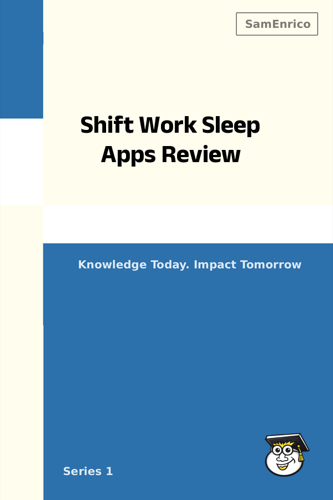
Shift Work Sleep Apps Review eBook
Use digital tools to schedule, track, and optimize
Use digital tools to schedule, track, and optimize your rest.
Formats
Free sample
Chapter 1: The Body’s Betrayal--–- The ceiling of a small, darkened bedroom stared back at Maria for the third hour in a row. Outside, the sun had fully risen. Birds sang. Her neighbor started a lawnmower. And Maria, a 34-year-old emergency room nurse who had finished a twelve-hour night shift at 7:30 AM, was still wide awake at 10:00 AM.
Her body was a traitor. Her legs ached. Her eyelids felt like sandpaper. But her brain—her relentless, sabotaging brain—was running sprints. It replayed the code blue from 3 AM.
It worried about her daughter’s school play at 2 PM. It calculated mercilessly: “If I fall asleep right now, I’ll get four hours. Now three and a half. Now I might as well get up.”Maria is not broken. She is not lazy, weak-willed, or “bad at sleeping.” Maria is a victim of one of the most profound and ignored health crises of the modern economy: circadian rhythm disruption.
And unless you are reading this book from a hammock on a permanent vacation, you already know how she feels.This book is not a collection of gentle suggestions about warm milk and lavender oil. You have tried that. This is a tactical field manual for the 20% of the global workforce—nurses, truck drivers, factory workers, police officers, pilots, call center agents, and parents of newborns—who are asked to be alert when biology demands rest. This is the missing manual for the Shift Work Sleep Apps Review, a guide to using digital tools not as a cure, but as a prosthetic for a circadian clock that the modern world has broken.The Great Misalignment Let us begin with a hard truth: Your body runs on a schedule that is older than humanity itself. Deep inside your brain, buried beneath the neocortex where language and logic live, sits a tiny structure called the suprachiasmatic nucleus (SCN).
This cluster of roughly 20,000 neurons is your master clock. It does not care about your paycheck, your deadlines, or your rotating roster. It cares about one thing: the sun.For millennia, the SCN followed a simple rhythm. Sun up? Release cortisol.
Raise body temperature. Sharpen focus. Sun down? Release melatonin. Lower body temperature.
Prepare for rest. This is the circadian rhythm, a 24-hour internal timer that drives every single biological process—from when you digest food to when you repair cellular damage.Shift work smashes this clock with a hammer.When you ask your body to sleep at 10 AM and work at 2 AM, you are not just “adjusting.” You are creating a state of constant internal conflict called circadian misalignment. In this state, your master clock is screaming for sleep while your environment demands alertness. Meanwhile, your peripheral clocks—located in your liver, your gut, your heart, and your muscles—are receiving entirely different signals. The result is not just fatigue.
It is biological chaos.Three Biological Saboteurs To understand why standard sleep advice fails shift workers, you must meet the three molecules that run your sleep-wake cycle. These are not abstract concepts. They are the chemical dictators of your existence.1. Adenosine – The Sleep Debt Collector Every moment you are awake, your brain produces a chemical called adenosine. Think of adenosine as a pressure gauge.
The longer you stay awake, the more adenosine builds up, creating sleep pressure. At a certain point, the pressure becomes unbearable, and you fall asleep. During deep sleep, your brain flushes out the adenosine, resetting the pressure gauge for the next day.Here is the problem for shift workers: You are asking your body to stay awake when it has already accumulated twelve hours of adenosine. You are trying to run a marathon with a pressure gauge about to explode. Caffeine works by temporarily blocking adenosine receptors (more on that in Chapter 6), but the debt remains.
Eventually, the collector comes calling.2. Melatonin – The Darkness Signal Melatonin is not a sleeping pill. It is a signal. Your SCN releases melatonin approximately two hours before your biological bedtime, telling every organ in your body: “Prepare for darkness. Prepare for rest.” Production peaks in the middle of the night and drops sharply in the morning when light hits your retinas.Shift work destroys this signal.
When you sit under fluorescent lights at 3 AM, your retina tells your SCN: “It is daytime. Stop melatonin production.” When you walk home in the morning sun, you tell your SCN: “It is daytime again.” By the time you close your blackout curtains at 10 AM, your melatonin window has closed. You are trying to fall asleep without the chemical signal that makes sleep possible.3. Cortisol – The Alertness Thief Cortisol is your wake-up call. It peaks naturally around 8 AM, giving you energy and focus.
It drops throughout the day, reaching its lowest point around midnight. Shift work flips this curve upside down. You are asking for high cortisol at 2 AM (when your body wants low cortisol) and low cortisol at 10 AM (when your body wants high cortisol). The result is a zombie state: awake but not alert, exhausted but unable to rest.Why Your Phone’s Alarm Clock Is a Liar Here is a radical statement: The default alarm clock on your phone was not designed for you. It was designed for a 9-to-5 worker who sleeps from 11 PM to 7 AM.
It assumes a world where “bedtime” is a fixed point and “morning” follows predictable light. For shift workers, the standard alarm clock is not a tool. It is a torment.Consider what a standard alarm clock does: It wakes you at a fixed time regardless of your sleep stage. It offers no advice on when to go to bed. It ignores light exposure, meal timing, caffeine half-lives, and sleep inertia.
It treats every day as identical. For a rotating shift worker, this is malpractice.You need a different kind of tool. You need a dynamic sleep scheduler that adapts to your changing roster. You need an app that understands circadian biology and applies it to your specific chaos. This is not about tracking your sleep after the fact.
It is about planning your sleep before you close your eyes.The Prosthetic Clock When a person loses a limb, they are fitted with a prosthetic. The prosthetic does not replace the original, but it allows function. When a shift worker loses a natural circadian rhythm, they need a digital prosthetic. Apps are that prosthetic.A good shift work sleep app does not just record data. It does three specific things:First, it predicts.
It calculates your optimal sleep windows based on your upcoming shifts, your chronotype, and your sleep history. It tells you not just when you slept, but when you should sleep.Second, it coordinates. It integrates light exposure, meal timing, exercise, and caffeine into a single schedule. It recognizes that sleep does not exist in isolation. You cannot fix sleep without fixing light.
You cannot fix light without fixing food.Third, it adapts. When your shift runs late or your child wakes up sick, a good app recalculates your entire day in seconds. It offloads the cognitive burden of constant replanning so you can focus on executing the plan.Throughout this book, you will learn exactly how to build…
This is the end of the free sample. Get the eBook to keep going. Buy now
About this book
Details
- Author
- Becerra Glynis
- Publisher
- SamEnrico
- Language
- English
- Genre
- Non-Fiction, Health & Wellness, Sleep Tech
- Released
- 2026-06-06
- Pages (approx.)
- 148
- Available as
- eBook, Audiobook

Read better in the ZLOADR app
Your eBooks on your phone or tablet. Sign in with your SamEnrico account and start reading.
More by Becerra Glynis
 Should Statements Anger RestructuringBecerra Glynis$11.99
 The Family CurseBecerra Glynis$11.99
 Failure Visualization TechniqueBecerra Glynis$11.99
 Neighbor Difficult ConversationsBecerra Glynis$11.99
 Methamphetamine EffectsBecerra Glynis$11.99
 Equestrian Self HypnosisBecerra Glynis$11.99
 Diet Vacation ScienceBecerra Glynis$11.99
 Voices of the Divine: Black Opera’s Golden AgeBecerra Glynis$11.99
 Gears of the Celestial Forge: The Lost Art of the Antikythera MechanismBecerra Glynis$11.99
 The Essential Guide to OrchestralBecerra Glynis$11.99
 Three Platform Pricing Strategy HandbookBecerra Glynis$12.99
 African Continental Free Trade Area GuideBecerra Glynis$12.99
You may also like
 Hong Kong Handover 1997Dunn Johnnie$11.99
 Zumba For Postnatal Recovery CourseNeal Christian$11.99
 Zumba for BeginnersLadner Nikia$11.99
 YouTube Comment Mining GuideHumes Pandora$12.99
 Worry Box MeditationCarlin Rudy$11.99
 Workplace Stress MeditationNguyen Lynn$11.99
 Workplace Stress and Sleep RepairHawley Ivory$11.99
 Workplace Perfectionism CureDelaney Jeffry$11.99
 Workplace Injustice Anger GuideWallen Isabelle$11.99
 Work Addiction and Burnout LinkGreenwood Ester$11.99
 Women in Yoga and WellnessBeattie Galina$11.99
 Women in Stand Up ComedyChun Evangeline$11.99