
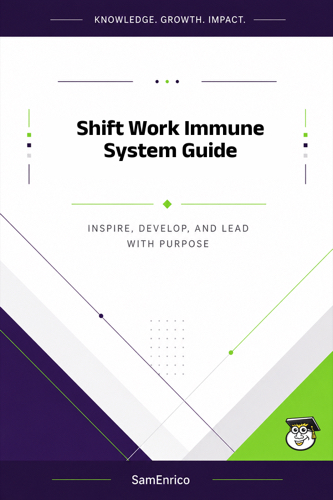
Shift Work Immune System Guide eBook
Boost immunity to counter sleep deprivation's effe
Boost immunity to counter sleep deprivation's effects on sickness risk.
Formats
Free sample
Chapter 1: The Perfect Storm--–- The alarm shrieks at 3:45 PM, but your body feels like midnight. You swing your legs out of bed, and a wave of fatigue hits you that no amount of coffee will fully cure. Another night shift lies ahead. You tell yourself you are used to it by now. You have been doing this for years.
But somewhere beneath the surface, invisible to you and your doctors, something is quietly going wrong.This is not just about feeling tired. This is about a fundamental breakdown in how your body defends itself against the outside world. Every virus you encounter, every bacterial threat you breathe in, every precancerous cell that arises in your body—your immune system is supposed to handle these silently and efficiently. But shift work is slowly dismantling that defense system, one night at a time. And the most dangerous part is that you cannot feel it happening.Welcome to the perfect storm.
In this chapter, you will learn exactly why shift work is uniquely damaging to your immune system—not because you are weak, not because you are not trying hard enough, but because you are asking your body to operate against millions of years of evolutionary programming. More importantly, you will learn a new framework for understanding your fatigue, your frequent colds, your slow recovery from injuries, and your unexplained weight gain. These are not separate problems. They are all symptoms of the same root cause: circadian immune disruption.The 24-Hour Economy and Its Hidden Toll Over twenty percent of the global workforce now regularly works outside the traditional nine-to-five schedule. That is more than six hundred million people worldwide.
Nurses, firefighters, factory workers, truck drivers, call center employees, pilots, police officers, emergency dispatchers, and countless others keep the world running while the rest of society sleeps. We celebrate these workers as essential—and they are—but we have failed to give them the tools to protect their own health.The medical literature is unforgiving. Long-term shift work is associated with a forty to fifty percent increase in cardiovascular disease, a thirty percent increase in type 2 diabetes, and significantly higher rates of depression, gastrointestinal disorders, and certain cancers. But these statistics, while alarming, miss the immediate day-to-day reality. Before the heart attack, before the diabetes diagnosis, there is the slow erosion of immune resilience.
You catch every cold that goes around the workplace. A minor cut takes twice as long to heal. You feel vaguely unwell more days than not. Your doctor runs standard blood tests and tells you everything is normal. But everything is not normal.
Your doctor is not measuring what is actually broken.The three components of the perfect storm are circadian misalignment, sleep restriction, and social jetlag. Each one is damaging on its own. Together, they create a cascade of immune dysfunction that no amount of willpower can overcome.Circadian Misalignment: Your Brain and Your Body at War The human body operates on a roughly twenty-four-hour cycle called the circadian rhythm. This is not a habit or a preference. It is a biological imperative encoded into the DNA of nearly every cell in your body.
At the center of this system is a tiny cluster of neurons in your brain called the suprachiasmatic nucleus, or SCN. The SCN is your master clock. It receives direct input from your eyes about light and darkness, and it synchronizes everything else—your sleep-wake cycle, your body temperature, your hormone release, your digestion, and crucially, your immune function.When you work a night shift, you create a fundamental conflict. Your SCN sees light or darkness and tries to set your internal time accordingly. But your behavior tells a different story.
You eat at three in the morning when your pancreas expects to be resting. You work at midnight when your immune cells expect to be patrolling quietly. You try to sleep at ten in the morning when your core body temperature is rising to prepare for daytime activity. Your SCN and your peripheral clocks—the clocks in your liver, your gut, your immune cells—fall out of sync. This state is called circadian misalignment.Here is what happens inside your immune system during circadian misalignment.
Your body produces different types of immune cells on a daily schedule. During the day, when you are active and exposed to the outside world, your immune system prioritizes surveillance and rapid response. During the night, when you are sleeping, your immune system shifts toward repair, memory formation, and anti-inflammatory activity. This is not random. It is a highly evolved strategy that maximizes survival.When you work a night shift, you are asking your immune system to perform its daytime functions at night and its nighttime functions during the day.
But it cannot fully adapt. The peripheral clocks in your immune cells are stubborn. They resist rapid phase shifts. The result is that your immune system ends up doing neither job well. Your daytime surveillance is blunted because you are working at night when your surveillance cells are supposed to be resting.
Your nighttime repair is blunted because you are sleeping during the day when your repair mechanisms are least active. You are left with an immune system that is perpetually confused—never fully on, never fully off, always slightly dysfunctional.Sleep Restriction: The Silent Accumulator The second component of the perfect storm is sleep restriction. Shift workers do not simply sleep at the wrong time. They also sleep less overall. Multiple studies have documented that night shift workers average four to six hours of sleep per twenty-four-hour period, compared to seven to nine hours for day workers.
There are many reasons for this: daytime noise, family obligations, social pressure to be awake during daylight hours, and the simple fact that the human body struggles to achieve deep sleep when the sun is up.But sleep restriction is not just about feeling tired. It is about losing specific stages of sleep that are essential for immune function. Human sleep is divided into cycles of approximately ninety minutes, each containing non-rapid eye movement sleep and rapid eye movement sleep. Within non-REM sleep, the deepest stage—slow-wave sleep, also called deep sleep—is when the body performs its most critical immune maintenance.During slow-wave sleep, your brain clears metabolic waste through a system called the glymphatic pathway. Your body releases growth hormone, which repairs tissues and supports the production of new immune cells.
Your immune system consolidates memory of pathogens you encountered during the day, strengthening your adaptive immunity. And crucially, your body shifts into an anti-inflammatory state, reducing the circulating levels of pro-inflammatory cytokines that, if left unchecked, contribute to chronic disease.Shift workers lose slow-wave sleep for two reasons. First, they simply sleep fewer total hours, so they get fewer cycles of sleep overall. Second, slow-wave sleep is most abundant in the early part of the nighttime sleep period. When you sleep during the day, your body temperature is naturally rising, making it harder to achieve and maintain the deep, restorative stages of sleep.
Even if you manage to sleep for eight hours during the day, the quality of that sleep is fundamentally different. You get less…
This is the end of the free sample. Get the eBook to keep going. Buy now
About this book
Details
- Author
- Blanchard Shiela
- Publisher
- SamEnrico
- Language
- English
- Genre
- Non-Fiction, Health & Wellness, Immunology
- Released
- 2026-06-09
- Pages (approx.)
- 155
- Available as
- eBook, Audiobook

Read better in the ZLOADR app
Your eBooks on your phone or tablet. Sign in with your SamEnrico account and start reading.
More by Blanchard Shiela
 Self Esteem for Chronic Illness HandbookBlanchard Shiela$11.99
 Remote Asset Management GuideBlanchard Shiela$11.99
 Strontium For Bone DensityBlanchard Shiela$11.99
 Method of Loci for Chess OpeningsBlanchard Shiela$11.99
 The Celestial Plague Hunters: How Ancient Southeast Asia Shaped Modern AstronomyBlanchard Shiela$11.99
 Seeds of the Sun: How a Forgotten Amazonian Tribe Outsmarted DeforestationBlanchard Shiela$11.99
 Understanding Erythrokeratodermia With AtaxiaBlanchard Shiela$17.99
 Mentoring Across Economic BackgroundsBlanchard Shiela$12.99
 CV Writer Success RoutineBlanchard Shiela$12.99
 Maintenance WeekenderBlanchard Shiela$11.99
 How to Become a Mortgage Loan CloserBlanchard Shiela$11.99
You may also like
 Zinc For Immunity GuideMason Grant$11.99
 HGH and Autoimmune DiseaseCovey Brittny$11.99
 Cannabis Use Disorder and Immune FunctionWang Gerald$11.99
 Zinc Immunity And Healing GuideBlock Merrill$11.99
 Microbiome Immune FunctionMichael Eusebio$11.99
 Bipolar Inflammation TheoryZeigler Rosamaria$11.99
 Arthritis And VaccinationsEast Stormy$11.99
 Zinc Immune Booster GuideSheets Ryann$11.99
 Vitamin C Immune Boosting GuideUtley Isaias$11.99
 Immunocompromised Vaccination PlanRodriguez Jacqueline$11.99
 HIIT Immune System BoostLeblanc Zena$11.99
 Biologics For Rheumatoid ArthritisCharlton Nova$11.99