
Non-FictionHealth & WellnessFire Service
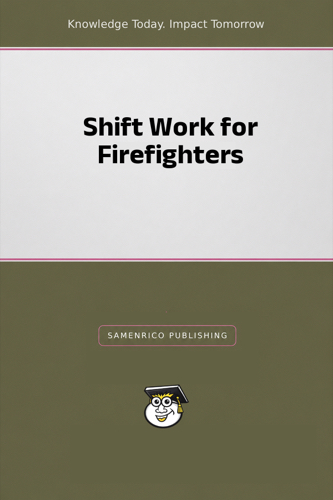
Shift Work for Firefighters eBook
Handle 24 hour shifts and interrupted sleep from e
Handle 24 hour shifts and interrupted sleep from emergency calls.
Formats
Free sample
Chapter 1: The Circadian Trap--–- The first time I nearly killed someone on the job, I wasn't on the fireground. I wasn't climbing a ladder or forcing a door or searching a smoke-filled bedroom. I was driving the engine back to the station after a routine medical call at 3:47 AM on a Tuesday. The call itself was nothing—an elderly woman with chest pain, stable vitals, transport to the hospital, handoff to the ER, back in the rig by 3:30 AM. The drive was six minutes.
Four minutes in, I crossed the center line. Not dramatically. Not enough to wake the captain in the officer's seat. Just a slow, gentle drift that pushed my tires over the painted line and into the oncoming lane. A milk delivery truck swerved.
The driver hit his air horn. I jerked the wheel back and felt my heart slam against my ribs. "You okay up there?" the captain asked, not yet alarmed. "Fine," I said. "Tired." I was twenty-seven years old, three years on the job, and convinced that exhaustion was just part of the deal.
I didn't know then that I had just experienced something with a name: sleep inertia combined with circadian low. I didn't know that my reaction time was slower than a drunk driver's. I didn't know that my brain had partially shut down while my eyes were open. All I knew was that I was tired, and tired was normal. This chapter is about why "normal" is a lie the fire service has been telling itself for decades, and why understanding your internal clock is the first and most critical step toward mastering the twenty-four-hour shift.The Invention of the Twenty-Four-Hour Shift The twenty-four-hour shift wasn't designed by sleep scientists.
It wasn't designed by anyone who understood circadian rhythms, homeostatic sleep drive, or the neurobiology of decision-making under fatigue. The twenty-four-hour shift was invented for practical reasons that had nothing to do with human biology. In the early twentieth century, fire departments needed coverage. Two twelve-hour shifts required more firefighters and more supervision. Three eight-hour shifts required even more.
The twenty-four-on, forty-eight-off schedule was a labor compromise—a way to provide continuous coverage with fewer personnel while giving firefighters blocks of days off that felt generous. The schedule was never tested for safety. No randomized controlled trial compared twenty-four-hour shifts to shorter shifts for injury rates, cardiac events, or apparatus crashes. The schedule was adopted because it was convenient, not because it worked. Today, approximately seventy percent of career firefighters in the United States work some variation of the twenty-four-hour shift.
Many departments have moved to forty-eight-hour shifts or even seventy-two-hour rotations, further compounding the problem. The fire service has built its entire operational model on a schedule that systematically destroys the organ most critical to emergency response: the brain. This chapter is not about blaming chiefs or unions or tradition. This chapter is about understanding what the twenty-four-hour shift actually does to your body, so you can stop fighting your biology and start working with it.The Master Clock: Your Suprachiasmatic Nucleus Deep inside your brain, buried in the hypothalamus just above where your optic nerves cross, sits a cluster of approximately twenty thousand neurons called the suprachiasmatic nucleus, or SCN. This tiny structure—smaller than a grain of rice—is the master clock of your entire body.
It generates circadian rhythms, from the Latin circa diem, meaning "about a day." The SCN does not keep time like a wristwatch. It does not tick at precisely twenty-four hours. Instead, it runs slightly long—about twenty-four hours and eleven minutes on average—and relies on external signals to reset itself each day. The most powerful of those signals is light. When light enters your eyes, specialized cells in your retina (called intrinsically photosensitive retinal ganglion cells, or ip RGCs) send a direct signal to your SCN.
That signal says, in effect, "It is daytime. Begin the wake program." The SCN then orchestrates a cascade of hormonal and neurological events: it raises your core body temperature, suppresses melatonin production, increases cortisol, sharpens alertness, and prepares your digestive system for food. At night, when light levels drop, the SCN does the opposite: it allows melatonin to rise, core temperature to fall, and the parasympathetic nervous system to take over for repair and restoration. This system evolved over hundreds of millions of years. It is present in virtually every multicellular organism on Earth, from fruit flies to whales.
And it cannot be overridden by willpower, discipline, or caffeine. You cannot train your SCN to ignore light. You cannot negotiate with your circadian rhythm. You can only align with it or suffer the consequences of alignment failure. For firefighters working twenty-four-hour shifts, alignment failure is not a possibility.
It is a guarantee.The Danger Zone: 3:00 AM to 5:00 AMYour circadian rhythm is not flat. It rises and falls over the twenty-four-hour day in a predictable pattern. Alertness peaks twice—once in the late morning (around 10:00 AM) and again in the early evening (around 7:00 PM). Alertness bottoms out once, in the early morning hours. The trough occurs between approximately 3:00 AM and 5:00 AM, though the exact window varies slightly between individuals based on chronotype (whether you are naturally a morning person, an evening person, or somewhere in between).
During this window, several things happen simultaneously. Your core body temperature reaches its lowest point of the day, dropping by about one to two degrees Fahrenheit. Melatonin levels peak, flooding your brain with sleep pressure. Cortisol, the alertness hormone, is at its daily minimum. Heart rate slows.
Blood pressure drops. Reaction time degrades by as much as fifty percent compared to midday performance. Working memory—the ability to hold and manipulate information temporarily—falls by approximately thirty percent. This is not a subjective feeling of tiredness. This is measurable, quantifiable, physiological impairment.
It affects every firefighter on every shift, regardless of how much sleep they got the night before, because it is driven by the SCN, not by sleep debt. You could sleep twelve hours before your shift, and your 4:00 AM reaction time would still be impaired. Now add sleep debt on top of that. Now add interrupted sleep from previous calls. Now add the adrenaline of a structure fire.
The combination is not additive. It is multiplicative. This is why the majority of fatal firefighter apparatus crashes occur between midnight and 6:00 AM. This is why medical errors in emergency settings spike during the same window. The 3:00 AM to 5:00 AM period is not just a challenge.
It is a predictable, preventable hazard—and most fire departments act as if it does not exist.Shift Work Disorder: When Your Clock and Your Schedule Collide Shift Work Disorder (SWD) is a formal diagnosis recognized by the American Academy of Sleep Medicine and listed in the International Classification of Sleep Disorders. To receive a diagnosis of SWD, a patient must meet four criteria. First, they must work a schedule that overlaps the typical sleep period. For firefighters, twenty-four-hour shifts obviously qualify. Second, they must experience clinically significant insomnia when trying to sleep off-duty.
This means difficulty falling asleep, difficulty staying asleep, or waking too early and being unable to return to sleep—not occasionally…
This is the end of the free sample. Get the eBook to keep going. Buy now
About this book
Details
- Author
- Laster Mireille
- Publisher
- SamEnrico
- Language
- English
- Genre
- Non-Fiction, Health & Wellness, Fire Service
- Released
- 2026-06-09
- Pages (approx.)
- 142
- Available as
- eBook, Audiobook

Read better in the ZLOADR app
Your eBooks on your phone or tablet. Sign in with your SamEnrico account and start reading.
More by Laster Mireille
 Self Esteem for Recovering Addicts HandbookLaster Mireille$11.99
 Multigenerational Housing FinanceLaster Mireille$11.99
 The Strategic Connection GuideLaster Mireille$11.99
 Annual Calendar Peg System GuideLaster Mireille$11.99
 Whispers of the Forgotten: The Lost Tapes of the Library of AlexandriaLaster Mireille$11.99
 The Vanishing Heiress: How a Billionaire’s Daughter Disappeared into the ShadowsLaster Mireille$11.99
 User Generated Content ToSLaster Mireille$12.99
 Understanding Esophageal Atresia Associated AnomaliesLaster Mireille$17.99
 Marco Polo CallerLaster Mireille$11.99
 How to Start a Dancing Academy (ballroom) Business (Beginners Guide)Laster Mireille$11.99
You may also like
 Hong Kong Handover 1997Dunn Johnnie$11.99
 Zumba For Postnatal Recovery CourseNeal Christian$11.99
 Zumba for BeginnersLadner Nikia$11.99
 YouTube Comment Mining GuideHumes Pandora$12.99
 Worry Box MeditationCarlin Rudy$11.99
 Workplace Stress MeditationNguyen Lynn$11.99
 Workplace Stress and Sleep RepairHawley Ivory$11.99
 Workplace Perfectionism CureDelaney Jeffry$11.99
 Workplace Injustice Anger GuideWallen Isabelle$11.99
 Work Addiction and Burnout LinkGreenwood Ester$11.99
 Women in Yoga and WellnessBeattie Galina$11.99
 Women in Stand Up ComedyChun Evangeline$11.99