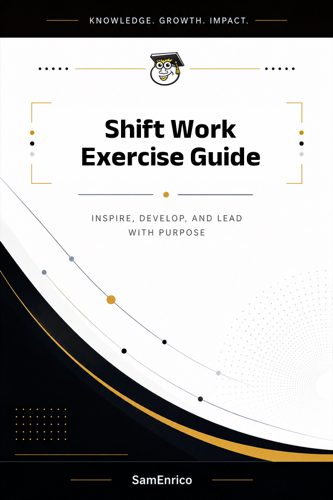
Shift Work Exercise Guide eBook
Timing physical activity to promote sleep and ener
Timing physical activity to promote sleep and energy.
Formats
Free sample
Chapter 1: The Broken Orchestra...--–- The fluorescent lights of the hospital corridor buzzed at exactly 3:47 AM. Sarah, a 34-year-old emergency room nurse, had been on her feet for eleven hours. Her eyelids felt like sandbags. Her lower back ached from compressions. And yet, when she finally collapsed into her car at 7:30 AM, her brain refused to shut off.
She drove home in a fog, crawled into bed with blackout curtains drawn, and lay there—exhausted but wired—watching the minutes tick by. At 2:00 PM, she gave up, got out of bed, and felt like a failure. Again.If you are reading this book, you know Sarah. Or you are Sarah. You are a nurse, a police officer, a firefighter, a factory worker, a truck driver, a 911 dispatcher, a warehouse associate, a power plant operator, or a military service member.
You work while the world sleeps. And you have been told, probably by well-meaning friends, fitness influencers, or even your doctor, that the solution to your fatigue is simple: "Just exercise more. Just eat better. Just get on a schedule."That advice, delivered with confident ignorance, has done you more harm than good.Standard fitness recommendations were designed for the 9-to-5 population. They assume that you wake up with the sun, eat lunch at noon, feel a natural energy dip at 3:00 PM, and fall asleep when it gets dark.
Your life bears no resemblance to that picture. And yet, you have been trying to force your body into a mold that was never built for you. No wonder you feel broken.But here is the truth that changes everything: You are not broken. Your clock is just set to a different time zone.This chapter will explain why your body seems to hate your work schedule, why the "sleep when you're tired" approach fails catastrophically for shift workers, and how exercise—when timed correctly—can become the most powerful tool you have to retake control of your energy, your sleep, and your life. We will introduce the central metaphor of this book: the Broken Orchestra, and show you exactly how to become your own conductor.The Myth of the Level Playing Field Before we dive into the biology, let us name the enemy.
It is not laziness. It is not a lack of discipline. It is circadian misalignment.Every living organism on Earth, from bacteria to humans, operates on an approximately 24-hour internal rhythm. This is not a metaphor or a wellness trend. It is a biological fact as fundamental as your heartbeat.
These rhythms control when you feel hungry, when you feel alert, when your body temperature peaks, when your muscles are strongest, when your reaction time is fastest, and when your body releases the hormones that tell you to sleep.For a person working a traditional day shift, these rhythms align beautifully. They wake up as cortisol (the alertness hormone) naturally surges. They eat lunch when digestion is most efficient. They exercise in the late afternoon when core body temperature is highest and muscles are most flexible. They fall asleep as melatonin (the sleep hormone) rises with darkness.For you, the shift worker, these rhythms are in open rebellion.Your body's master clock, located in a tiny cluster of neurons in your brain called the Suprachiasmatic Nucleus (SCN) , still thinks you should be awake during daylight and asleep at night.
It does not care that you have a night shift. It does not care about your mortgage or your patients or your sense of duty. It is a primitive, stubborn timekeeper that evolved over millions of years. And it is screaming at you to sleep when you need to be awake, and to be awake when you need to sleep.This is not a failure of will. This is biology.The Broken Orchestra: Why Your Organs Are Playing Different Songs Let us refine our understanding.
The SCN is not the only clock in your body. In fact, every major organ—your liver, your pancreas, your muscles, your gut, even your fat cells—contains its own peripheral clock. These clocks normally listen to the SCN as their conductor. When the SCN says "morning," the liver starts producing glucose. When the SCN says "evening," the gut slows down digestion.
When the SCN says "night," the muscles reduce their sensitivity to insulin. The entire body plays the same song at the same time.Shift work breaks this orchestra.Imagine a symphony where the violins are playing a waltz, the brass section is playing a march, the percussion is playing a lullaby, and the conductor has left the podium. That is your body on a rotating shift schedule. Your SCN (the conductor) is sending "daytime" signals because the sun is up, but your liver (the violins) has been activated by the meal you ate at 2:00 AM and thinks it is time to digest. Your muscles (the brass) are stiff because they expected exercise at 4:00 PM but got none.
Your gut (the percussion) is churning away at 4:00 AM because you ate a vending machine sandwich, while your brain is trying to produce melatonin because you finally got home and pulled the blackout curtains.The result is not just fatigue. The result is a cascade of physiological chaos: impaired glucose metabolism, increased inflammation, elevated cortisol at the wrong times, suppressed melatonin, reduced mitochondrial efficiency, and a chronic, low-grade sense of being unwell that you cannot quite name.This condition has a medical name. It is called Shift Work Disorder (SWD) , and it affects approximately 10 to 30 percent of all shift workers. The diagnostic criteria are specific: excessive sleepiness during waking hours (including dangerous microsleeps on the job or during the commute), and significant insomnia during scheduled sleep hours. These symptoms must persist for at least three months and cause clinically significant distress or impairment.If you have ever nodded off for a split second while driving home after a night shift, you have experienced the dangerous end of SWD.
If you have ever lain in bed at 10:00 AM, exhausted beyond words, but unable to fall asleep because your brain is racing, you have experienced the insomnia end of SWD.Neither of these is your fault. Both can be fixed.The Four Horsemen of Shift Work Fatigue Before we introduce the solution, let us name the specific biological mechanisms that make shift work so punishing. Understanding these mechanisms will help you understand why the exercise protocols in later chapters work.Horseman One: Cortisol Confusion Cortisol is not the villain that wellness influencers have made it out to be. In a healthy circadian rhythm, cortisol naturally peaks around 8:00 AM, giving you the energy and alertness to start your day. It then gradually declines throughout the day, reaching its lowest point around midnight, allowing you to sleep.In a shift worker, this pattern is shattered.
After a night shift, your cortisol is still high at 8:00 AM because your SCN thinks morning is for waking. But you need to sleep. So you lie in bed with high cortisol, feeling "wired but tired." Then, when you finally fall asleep at 1:00 PM, your cortisol crashes too late, and you wake up groggy. Then, at 3:00 AM during your shift…
This is the end of the free sample. Get the eBook to keep going. Buy now
About this book
Details
- Author
- Cotton Arminda
- Publisher
- SamEnrico
- Language
- English
- Genre
- Non-Fiction, Health & Wellness, Exercise Timing
- Released
- 2026-06-06
- Pages (approx.)
- 150
- Available as
- eBook, Audiobook

Read better in the ZLOADR app
Your eBooks on your phone or tablet. Sign in with your SamEnrico account and start reading.
More by Cotton Arminda
 Senior Financial Self EsteemCotton Arminda$11.99
 Energy Based PrioritizationCotton Arminda$11.99
 Group Decision MakingCotton Arminda$11.99
 The Step Reading CompanionCotton Arminda$11.99
 Whole Grain BenefitsCotton Arminda$11.99
 NVC for Coaching GuideCotton Arminda$11.99
 Financial Incentives for QuittingCotton Arminda$11.99
 Empress Wu's Silent Revolution: The Woman Who Ruled China in the ShadowsCotton Arminda$11.99
 The Battle of Salsu: Korea's Last Stand Against the Tang (675 AD)Cotton Arminda$11.99
 UK Russell Group vs US Ivy LeagueCotton Arminda$12.99
 Bank Verification ProcessCotton Arminda$12.99
 Service Providers Guide to General SurgeryCotton Arminda$11.99