
Non-FictionInformativeEducational
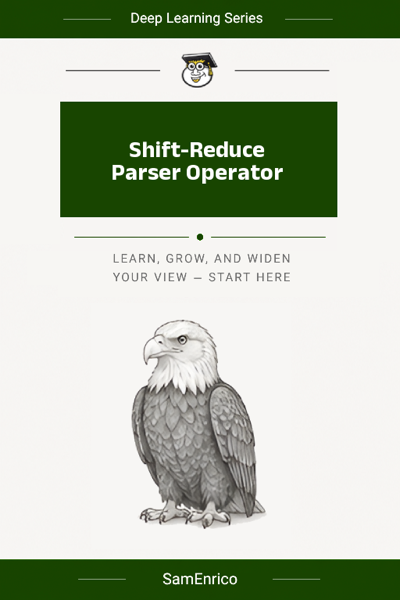
Shift-Reduce Parser Operator eBook
A Coursebook on Shift-Reduce Parser Operator
A Coursebook on Shift-Reduce Parser Operator
Formats
Free sample
Chapter 1: The Invisible Machine--– It is 2:47 AM. Your screen glows with the pale blue light of a terminal window that has stopped accepting your commands for the past three hours. Somewhere in the darkness of your office, a refrigerator hums. Outside, the city sleeps. But you are awake, staring at a single line of text that has defeated you:text Copy Download15 shift/reduce conflicts, 2 reduce/reduce conflicts.Your language—the one you have been designing for six months, the one that was going to parse configuration files faster than JSON, the one that was going to be elegant and obvious and a joy to use—refuses to compile.
The parser generator, that merciless black box you trusted to turn your beautiful grammar into working code, has vomited a cryptic error message and abandoned you.You have tried everything. You reordered the rules. You added parentheses to the grammar. You read the documentation—what little there was. You rewrote the ambiguous parts.
Nothing works. The conflicts remain, staring back at you like a riddle with no answer.And somewhere in that exhausted, caffeine-addled brain of yours, a question forms—a question that this entire book will answer, one chapter at a time:What is actually happening inside that black box?The Parser You Never See Every programming language, every configuration file, every query language, every data format you have ever used—from the Java Script powering your browser to the SQL querying your company's database to the YAML file defining your cloud infrastructure—has passed through a parser. That parser read a stream of tokens (keywords, identifiers, operators, punctuation) and transformed them into a structured representation that the compiler or interpreter could understand.Most programmers never think about the parser. It is the plumbing of language implementation: essential, invisible, and—when it works—completely forgettable.But when it breaks, it breaks everything.The parser generator you are using—Yacc, Bison, ANTLR, or a dozen others—is almost certainly implementing what computer scientists call a shift-reduce parser. This is not the only parsing algorithm in the world (we will explore alternatives in Chapter 12), but it is the workhorse.
It powers the compilers for C, C++, Java, C#, Go, Rust, and virtually every other statically typed language in common use. It parses the SQL queries that run the global economy. It processes the regular expressions that search through your log files.And yet, despite its ubiquity, the shift-reduce parser remains a mystery to most programmers. It is taught in compiler courses (often poorly), mentioned in documentation (usually cryptically), and then forgotten—until 2:47 AM, when a shift/reduce conflict brings your project to a grinding halt.This book is the antidote to that 2:47 AM despair.What You Will Learn in This Chapter Before we descend into algorithms and item sets and lookahead computations, let me tell you what you will understand by the time you finish reading these pages.First, you will learn why bottom-up parsing—the family to which shift-reduce belongs—is fundamentally more powerful than the top-down parsers you might have written by hand. You will see that the shift-reduce parser is not magic.
It is a virtual machine with a specific architecture, a specific instruction set, and a specific set of trade-offs. Once you see that architecture, the conflicts that plague you will start to make sense.Second, you will learn to think in reverse. Most programmers, when they think about parsing, imagine starting from a grammar and deriving sentences. Shift-reduce parsers work backward: they start from a sentence and reduce it to the grammar's start symbol. This reverse perspective is disorienting at first—like learning to drive in a mirror—but once it clicks, you will never look at syntax the same way again.
You will begin to see handles where before you saw only tokens.Third, you will meet three concepts that form the bedrock of everything that follows: handles, viable prefixes, and the stack. These terms sound intimidating—they come from academic literature of the 1960s and 1970s, when computer science was inventing itself—but they are simple ideas dressed in formal clothing. A handle is just a pattern that matches a grammar rule. A viable prefix is just the part of the input the parser has seen so far. The stack is just a memory.
By the time you finish this chapter, you will be able to spot a handle in a parse trace and understand why the parser's stack is its secret superpower.And finally, you will understand why the shift-reduce parser's ability to remember an unbounded amount of left context makes it the right tool for almost every real-world language—and why that same power sometimes produces those dreaded conflicts. The conflicts are not bugs; they are signposts. They tell you where your grammar asks the parser to make a decision without enough information. Learning to read those signposts is the first step toward fixing them.Let us begin.The Two Families: Top-Down and Bottom-Up Every parsing algorithm in existence belongs to one of two families: top-down or bottom-up. The distinction is simple but profound, and understanding it will change how you think about grammar design.Top-Down Parsers: Following the Grammar Forward A top-down parser starts with the grammar's start symbol and tries to derive the input sentence.
It says, "I believe this input is a program. A program begins with a statement list. A statement list is either a statement or a statement followed by a statement list. A statement is either an assignment or a loop or a conditional. Let me see if the next token could start an assignment..."This is how human beings typically think about parsing.
You look at the first word of a sentence and think, "Ah, this is probably the subject." You predict what comes next based on the grammatical rules you have internalized. You commit to an interpretation early, and you revise only when the input forces you to.Top-down parsers are intuitive. They are easy to write by hand (a technique called recursive descent that you may have used in your own projects). They produce excellent error messages because they know what they expected at each point. For many small languages, they work perfectly with minimal effort.But here is the limitation that matters for our story: top-down parsers struggle with left recursion.Consider a grammar rule like E → E + T.
This rule says that an expression E can be expanded as an expression E followed by a plus token followed by a term T. A top-down parser, when it tries to expand E, sees E on the left-hand side and then immediately sees E again on the right-hand side, at the very beginning. It tries to expand E by calling itself... which calls itself... which calls itself.
Infinite recursion. Stack overflow. Crash.To use a top-down parser, you must rewrite your grammar to eliminate left recursion. For simple arithmetic, E → E + T becomes E → T E' and E' → + T E' | ε (epsilon, meaning empty). This transformation is mechanical, but it makes the grammar larger, harder to read, and less natural.
The recursive structure of the language is inverted.More fundamentally, top-down parsers have limited memory. They can only look at a…
This is the end of the free sample. Get the eBook to keep going. Buy now
About this book
Details
- Author
- Bliss Jeannine
- Publisher
- SamEnrico
- Language
- English
- Genre
- Non-Fiction, Informative, Educational
- Released
- 2026-05-04
- Pages (approx.)
- 152
- Available as
- eBook, Audiobook

Read better in the ZLOADR app
Your eBooks on your phone or tablet. Sign in with your SamEnrico account and start reading.
More by Bliss Jeannine
 Transcendental Meditation for StudentsBliss Jeannine$11.99
 Harvard Extension School vs Community CollegeBliss Jeannine$11.99
 NVC Feelings Vocabulary GuideBliss Jeannine$11.99
 Closing An EmbassyBliss Jeannine$11.99
 Quetzalcoatl’s Serpent Flight: The Feathered Serpent’s ProphecyBliss Jeannine$11.99
 Suspicious Package IdentificationBliss Jeannine$12.99
 How to Produce Bicycle Seatpost ClampsBliss Jeannine$11.99
 How to Start a Piano Hire Business (Beginners Guide)Bliss Jeannine$11.99
You may also like
 Hong Kong Handover 1997Dunn Johnnie$11.99
 Zumba For Postnatal Recovery CourseNeal Christian$11.99
 Zumba for BeginnersLadner Nikia$11.99
 YouTube Comment Mining GuideHumes Pandora$12.99
 Worry Box MeditationCarlin Rudy$11.99
 Workplace Stress MeditationNguyen Lynn$11.99
 Workplace Stress and Sleep RepairHawley Ivory$11.99
 Workplace Perfectionism CureDelaney Jeffry$11.99
 Workplace Injustice Anger GuideWallen Isabelle$11.99
 Work Addiction and Burnout LinkGreenwood Ester$11.99
 Women in Yoga and WellnessBeattie Galina$11.99
 Women in Stand Up ComedyChun Evangeline$11.99