
Non-FictionInformativeEducational
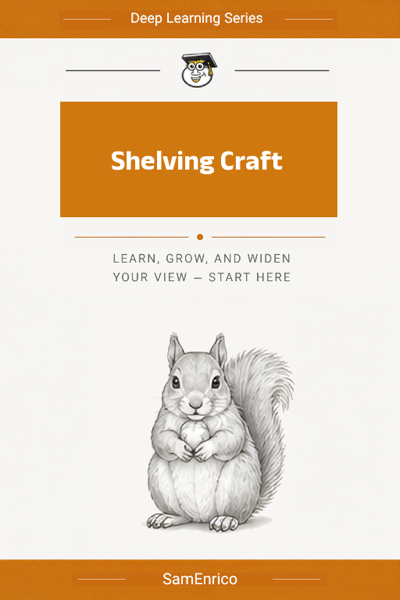
Shelving Craft eBook
A Coursebook on Shelving Craft
by Mena Gilda
A Coursebook on Shelving Craft
Formats
Free sample
Chapter 1: The Weight of Order...--–- On a humid July afternoon in 1851, a librarian named Gabriel Naudé watched as seven thousand volumes tumbled from a newly installed cast-iron shelf in the Bibliothèque Mazarine in Paris. The shelf had not collapsed. The wood had not rotted. The joinery had not failed. Instead, the books themselves had simply become too heavy for the oak planks that had held them for forty years.
But the oak had not changed. The books had. What Naudé witnessed was not a failure of carpentry but a failure of imagination – no one had anticipated that a shelf designed for three hundred books might one day hold four hundred, or that the books themselves would grow thicker, heavier, and more numerous with each passing decade.This story, apocryphal though it may be, captures something essential about the craft of shelving. We tend to think of shelves as passive objects – wooden planks that wait patiently for us to place things upon them. But the history of vertical storage tells a different story.
Shelves are active technologies that shape how we read, how we work, how we remember, and even how we think about ourselves. A medieval chained library proclaimed that knowledge was dangerous and must be locked in place. A nineteenth-century open stack declared that information should be free and self-service. A modernist modular shelf from IKEA suggests that knowledge is interchangeable, portable, and ultimately a matter of personal taste rather than authority. Every shelf design embodies a philosophy.
Every shelf tells a story about who we believe ourselves to be.This book is about learning to read those stories and then write your own. Whether you are a librarian managing ten thousand volumes, a woodworker building an heirloom bookcase, or a crafter trying to organize a room full of fabric and yarn, the principles of shelving craft remain the same. You must understand materials and their limits. You must master joinery that hides strength within simplicity. You must calculate loads and spans with the care of an engineer.
And you must organize what you store with an eye toward both efficiency and delight. But before any of that, you must understand where shelves came from and why they matter. That is the work of this first chapter.The Chained Library: Knowledge as Prison Let us begin in the medieval period, specifically in the library of Hereford Cathedral in England, where the most famous surviving chained library still operates today. Walk into that room and you will see something that shocks the modern visitor: every book is attached to its shelf by an iron chain long enough to reach a reading desk below but not long enough to reach another shelf. The chain is locked to the front corner of the book's wooden cover – not the spine, because spines did not exist yet.
Books were stored with their fore-edges facing outward, their titles written in ink on the edges of the pages. To read a book, you unchained it from the shelf, carried it to the desk, and chained it again to a rod beneath the desk. You never, ever removed a book from the room.Why this elaborate security? Because books were astronomically expensive. A single medieval manuscript required the skin of an entire herd of sheep or calves for its parchment, plus months or years of labor by a scribe and an illuminator.
A university library might own only a few hundred volumes, and each one was worth more than a professor's annual salary. The chain was not a sign of distrust in the reader; it was a recognition of value. It also reflected a specific theory of knowledge. In the medieval mind, truth was singular, authoritative, and dangerous if misused. The chained library embodied this theory: truth exists, it is valuable, it can harm you if you take it without guidance, so we will keep it close and control who touches it.The physical design of the chained library followed from this philosophy.
Shelves were fixed, not adjustable, because the collection changed slowly if at all. Shelves were deep – often eighteen inches or more – because books lay flat rather than standing upright, and they were stored in two or even three rows, one behind another. This depth created what we might call a "discovery problem": you could not see the books in the back row without removing the front row. But that was fine, because medieval readers did not browse. They consulted.
A librarian or a monk told you what existed, and you asked for it by name. The shelf was not a discovery tool; it was a secure vault.The joinery of these shelves was massive: oak beams ten inches thick, mortise-and-tenon joints pinned with oak pegs, and backs made of solid oak planks that expanded and contracted with the seasons. The craftsmen who built these shelves did not worry about wood movement because the timber was so old and so dry that it had already done most of its moving. They used no glue, because glue failed. They used no metal fasteners except the chains themselves.
The result was furniture that could last five hundred years – and did.The Birth of the Stack: Cast Iron and the Democratization of Access The chained library held sway for four centuries, but by the early 1800s, two forces were converging to destroy it. First, the printing press had made books cheaper and more numerous. A university library that had owned two hundred volumes in 1500 might own twenty thousand by 1800. Shelving space became a crisis. Second, the Enlightenment had changed how people thought about knowledge.
Truth was no longer a fixed inheritance from the past; it was something to be discovered through inquiry and debate. Libraries began to imagine that readers might benefit from browsing – from pulling a book off a shelf, paging through it, and discovering another book nearby that they had not known to ask for.The problem was weight. Wooden shelves strong enough to hold twenty thousand books would need to be absurdly thick, and the building itself would need to support enormous loads. The solution came from an unexpected place: the industrial revolution. Cast iron, which had been used for bridges and factory columns, turned out to be perfect for library shelving.
It was strong, fire-resistant, and relatively thin. In 1837, a British librarian named John Jones designed the first cast-iron book stack for the British Museum. His innovation was not just the material but the system: uprights that could be bolted together to form any height, shelves that could be adjusted in one-inch increments, and a structure so rigid that no wooden back panel was required.The cast-iron stack changed everything. For the first time, libraries could build upward rather than outward. A single stack could rise twenty feet or more, with galleries at each level and spiral staircases connecting them.
The aesthetic was deliberately industrial: black iron, exposed bolts, and narrow aisles that forced intimacy between reader and book. The philosophy embedded in these stacks was one of democratic access. Any reader who could climb a staircase could pull any book from any shelf. The chain was gone. The lock was…
This is the end of the free sample. Get the eBook to keep going. Buy now
About this book
Details
- Author
- Mena Gilda
- Publisher
- SamEnrico
- Language
- English
- Genre
- Non-Fiction, Informative, Educational
- Released
- 2026-06-03
- Pages (approx.)
- 129
- Available as
- eBook, Audiobook

Read better in the ZLOADR app
Your eBooks on your phone or tablet. Sign in with your SamEnrico account and start reading.
More by Mena Gilda
 Following Distance Safety RuleMena Gilda$11.99
 Floating On Clouds VisualizationMena Gilda$11.99
 Return to Office Anxiety GuideMena Gilda$11.99
 PCOS Gluten Free GuideMena Gilda$11.99
 The James Watson DNA Life StoryMena Gilda$11.99
 The Maqam of the Games: How a Syrian Musician United the 1900 OlympicsMena Gilda$11.99
 Understanding Osteoarthropathy of Fingers FamilialMena Gilda$17.99
 Marsh McLennan SWOTMena Gilda$12.99
 Canadian Graduate Immigration AppealMena Gilda$12.99
 A Beginners Guide to Free-style moto (Volume 1)Mena Gilda$11.99
You may also like
 Hong Kong Handover 1997Dunn Johnnie$11.99
 Zumba For Postnatal Recovery CourseNeal Christian$11.99
 Zumba for BeginnersLadner Nikia$11.99
 YouTube Comment Mining GuideHumes Pandora$12.99
 Worry Box MeditationCarlin Rudy$11.99
 Workplace Stress MeditationNguyen Lynn$11.99
 Workplace Stress and Sleep RepairHawley Ivory$11.99
 Workplace Perfectionism CureDelaney Jeffry$11.99
 Workplace Injustice Anger GuideWallen Isabelle$11.99
 Work Addiction and Burnout LinkGreenwood Ester$11.99
 Women in Yoga and WellnessBeattie Galina$11.99
 Women in Stand Up ComedyChun Evangeline$11.99