
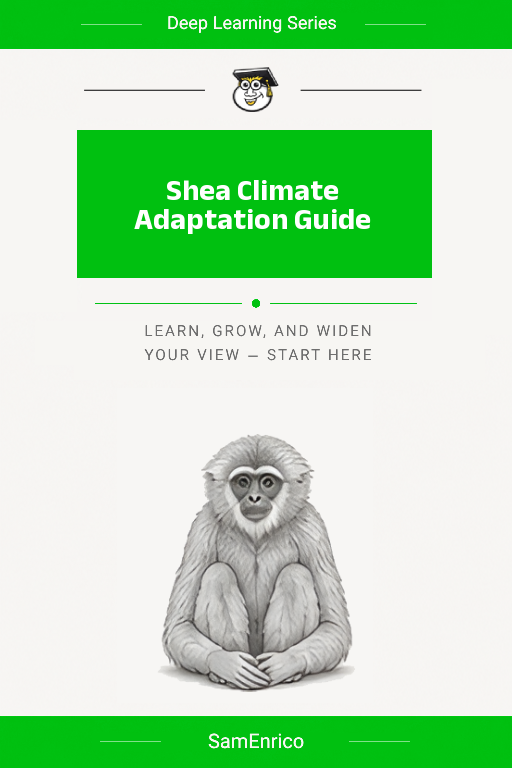
Non-FictionBusiness BriefAgricultural Trade
Shea Climate Adaptation Guide eBook
Adapt shea production for climate change to mainta
Adapt shea production for climate change to maintain export quality. Resilient practices.
Formats
Free sample
Chapter 1: The Silent Collapse--–- Mariam knew something was wrong before she cracked the first nut. She had been collecting shea fruits from the same 12 trees since she was a girl—first following her grandmother, then her mother, and now teaching her own daughter, Fatima. The trees stood on a gentle slope above their village of Tampala, in northern Ghana’s Upper West Region, where the savanna stretched like a dry ocean to the horizon. For three generations, those trees had produced reliably: every March, the plump green fruits would fall, and the women would gather them by the basketful. But this March, the ground beneath the trees was nearly bare.Mariam picked up a single fruit—smaller than usual, wrinkled at the stem.
She peeled away the sweet yellow pulp with her teeth, sucked the thin layer of sugar, and spat out the nut. The shell felt light in her palm, almost hollow. She placed it on a flat stone and struck it with the back of her knife. The nut split cleanly. Inside, the kernel was not the creamy white she remembered from childhood.
It was brown. Mottled. And when she touched it to her tongue, there was no sweetness at all—only a sharp, bitter tang that made her wince.That bitterness was the taste of climate change.And it was spreading across the entire shea belt—a 5,000-kilometer arc of savanna woodlands stretching from Senegal to South Sudan, where 16 million women depend on a single tree species for their survival. The tree is Vitellaria paradoxa, known around the world as shea. Its nut produces a butter that is used in everything from luxury cosmetics to chocolate to cooking oil.
It is worth an estimated $3.5 billion annually to African economies. It is the backbone of rural women’s income across the continent’s driest regions.And it is collapsing, silently, under the weight of heat.The Map That Changed Everything To understand what is happening to shea, you must first understand where it grows. The shea tree is not a plantation crop. It is a wild or semi-wild tree that has been integrated into traditional farming systems for centuries. It grows across the Sudano-Sahelian zone—a transitional landscape between the Sahara Desert to the north and the humid forests to the south.
This is a harsh environment: rainfall is erratic, soils are poor, and the dry season can last eight months. Shea has adapted to these conditions through deep taproots, thick bark, and a slow growth cycle that takes 15 to 20 years before the tree produces its first significant harvest.But the climate in which shea evolved no longer exists.In 2018, a team of researchers at the World Agroforestry Centre (ICRAF) in Nairobi compiled the most comprehensive climate suitability map ever made for shea. They overlaid the tree’s known distribution—21 countries, 1.2 million square kilometers—with predictive models from the Coordinated Regional Climate Downscaling Experiment (CORDIS-Africa), a collaborative effort that produces high-resolution climate projections for the continent. The results were alarming.Under a moderate emissions scenario (Representative Concentration Pathway 4.5, which assumes some global action to reduce greenhouse gases), the suitable habitat for shea contracts by 25% by 2050. Under a high emissions scenario (RCP 8.5, the path the world is currently on), suitable habitat contracts by 40% by 2080.
In practical terms, this means that the northern edge of the shea belt—a band spanning southern Senegal, Mali, Burkina Faso, Niger, and Chad—will become too hot and too dry for the tree to reproduce naturally. The southern edge, in countries like Ghana, Togo, Benin, and Nigeria, will experience more erratic rainfall and higher temperatures during the flowering and fruit-setting periods.Mariam’s village of Tampala sits near the northern edge of Ghana’s shea zone. She is already living in the future that the models predict.The Mechanism of Collapse: What Heat Does to a Nut The brown kernel that Mariam cracked open was not simply “bad.” It was the product of a specific physiological process that climate change has accelerated to the point of crisis. To understand that process, you need to understand the chemistry of the shea nut.The shea kernel is approximately 50% fat, and that fat is the reason anyone cares about the tree. Shea butter is composed of triglycerides—molecules made of glycerol attached to three fatty acid chains.
The specific fatty acids in shea butter include stearic acid (a saturated fat that is solid at room temperature), oleic acid (a monounsaturated fat that gives the butter its spreadable texture), and linoleic acid (a polyunsaturated fat that has skin-conditioning properties). The ratio of these fatty acids determines the butter’s melting point, texture, and shelf life.For export-grade shea butter—the kind that sells to European cosmetic companies and chocolate manufacturers—the stearic acid content is critical. High stearin shea butter (above 45% stearic acid) is hard, stable, and valuable as a cocoa butter equivalent (CBE). It can be used in chocolate to replace cocoa butter, which is expensive and subject to price volatility. Low stearin shea butter (below 35%) is soft, greasy, and suitable only for industrial soap or animal feed.Heat during the fruit-setting and kernel-filling period—approximately 60 to 90 days after flowering—directly reduces stearin content.
When temperatures exceed 38°C during this period, the tree’s metabolic processes shift. It prioritizes survival over reproduction, directing limited water and nutrients to its roots and leaves rather than to developing kernels. The result is a kernel that is smaller, lighter, and lower in stearin.But heat does something even more destructive after the nut has fallen.The shea nut is a living seed. Its embryo is dormant, waiting for moisture and warmth to trigger germination. In a normal climate, the dry season from November to February keeps the nuts dry and dormant on the ground or in storage.
When the rains return in April or May, the nuts germinate and—under natural conditions—send up new saplings.Climate change has broken this timing. Warmer temperatures during the dry season, combined with unseasonal humidity spikes (a phenomenon known as “atmospheric moisture intrusion”), trick the nut into thinking the rains have arrived early. The embryo begins to germinate inside the shell. As it germinates, it activates enzymes called lipases, which break down triglycerides into free fatty acids (FFAs). The process is irreversible.A shea nut with FFA above 0.5% produces butter that is rancid, acidic, and smells of vomit or old cooking oil.
European buyers reject such butter outright. A nut with FFA between 0.5% and 2% can still be sold, but only at a steep discount—typically 30 to 50% below the export price. A nut with FFA above 2% is worthless for anything except industrial soap, which pays less than 20% of the cosmetic market price.Mariam’s brown kernel had an FFA of approximately 4%. Every nut she cracked that afternoon was similarly ruined.By the Numbers: What Is Being Lost The shea belt is losing 8 million trees annually. That is not a projection.
That is a measurement from the Global Shea Alliance’s 2022 inventory, which combined satellite imagery with on-the-ground verification by national forestry departments. The inventory tracked 1.2 million hectares of shea parkland across 10 countries and found that tree density had declined by 15%…
This is the end of the free sample. Get the eBook to keep going. Buy now
About this book
Details
- Author
- Muhammad Nolan
- Publisher
- SamEnrico
- Language
- English
- Genre
- Non-Fiction, Business Brief, Agricultural Trade
- Released
- 2026-05-30
- Pages (approx.)
- 157
- Available as
- eBook, Audiobook

Read better in the ZLOADR app
Your eBooks on your phone or tablet. Sign in with your SamEnrico account and start reading.
More by Muhammad Nolan
 Remote Company Retreats For Creative TeamsMuhammad Nolan$11.99
 Amazon Review Comparison GuideMuhammad Nolan$11.99
 Burnout Prevention Work AutonomyMuhammad Nolan$11.99
 The Arthritis Surgery GuideMuhammad Nolan$11.99
 The New Skill Learning Memory GuideMuhammad Nolan$11.99
 The Golden Quill of Timbuktu: The Scholars Who Lit the WorldMuhammad Nolan$11.99
 Understanding ShigellosisMuhammad Nolan$17.99
 Korean Scholarship Document PrepMuhammad Nolan$12.99
 Security Guard LicensingMuhammad Nolan$11.99
 How to Become a Library AssistantMuhammad Nolan$11.99
You may also like
 Hong Kong Handover 1997Dunn Johnnie$11.99
 Zumba For Postnatal Recovery CourseNeal Christian$11.99
 Zumba for BeginnersLadner Nikia$11.99
 YouTube Comment Mining GuideHumes Pandora$12.99
 Worry Box MeditationCarlin Rudy$11.99
 Workplace Stress MeditationNguyen Lynn$11.99
 Workplace Stress and Sleep RepairHawley Ivory$11.99
 Workplace Perfectionism CureDelaney Jeffry$11.99
 Workplace Injustice Anger GuideWallen Isabelle$11.99
 Work Addiction and Burnout LinkGreenwood Ester$11.99
 Women in Yoga and WellnessBeattie Galina$11.99
 Women in Stand Up ComedyChun Evangeline$11.99