
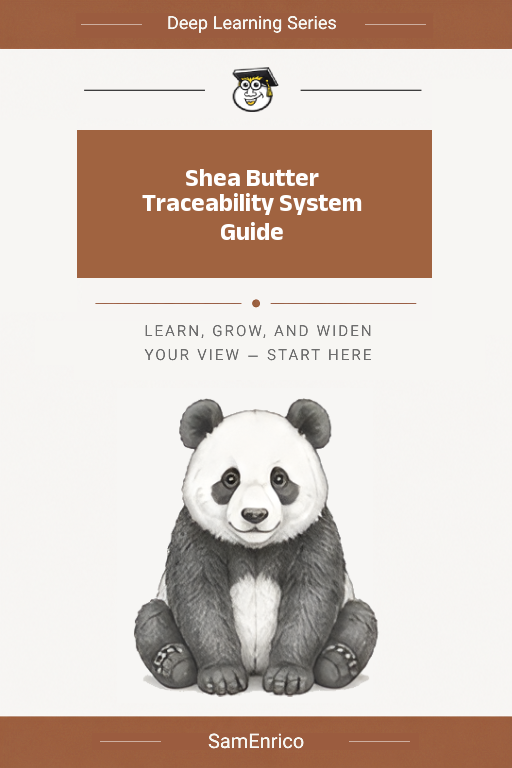
Non-FictionBusiness BriefTraceability System
Shea Butter Traceability System Guide eBook
Implement batch traceability for shea butter from
Implement batch traceability for shea butter from production zone to Europe. Blockchain tracking prevents adulteration and proves origin authenticity.
Formats
Free sample
Chapter 1: The Billion-Dollar Lie--On a humid morning in Accra, a quality control manager named Kwame Adjei opened a 200-kilogram drum of "premium organic shea butter" that had just arrived from a supplier in Tamale. The paperwork was flawless. The certificate of analysis showed perfect fatty acid profile. The Fairtrade certification was current. The batch had passed every paper audit.Kwame dipped a sampling probe into the butter, transferred a small amount to a glass slide, and placed it into a handheld spectrometer that had arrived from Germany three weeks earlier.
Ten seconds later, the device beeped. The screen displayed a single word in red: ADULTERATED.The sample was 34% palm stearin – a cheap industrial fat worth less than half the price of pure shea butter. Somewhere between the village collectors in northern Ghana and Kwame's warehouse in Accra, someone had substituted nearly seventy kilograms of expensive shea butter with filler. The original collectors – mostly women who had walked kilometers to harvest nuts, who had cracked, roasted, and ground them by hand – would never see the premium price their product should have commanded. The fraudster, whoever they were, had pocketed approximately $450 on that single drum.Kwame's company rejected the shipment.
The supplier in Tamale claimed ignorance. The paper trail went cold after three handoffs. No one was held accountable.This is not an isolated story. It happens thousands of times every year across the shea butter supply chain.The Scale of the Problem The global shea butter market is worth approximately $2.5 billion annually, with demand growing at 8-10 percent per year, driven primarily by the cosmetics industry's insatiable appetite for natural, ethically sourced ingredients. Major brands like L'Oreal, The Body Shop, and L'Occitane en Provence have built product lines around shea's unique moisturizing properties.
Chocolate manufacturers use shea butter as a cocoa butter equivalent. Pharmaceutical companies incorporate it into ointments and creams.Yet for all its commercial importance, shea butter remains one of the most vulnerable commodities in the global supply chain. Unlike palm oil, which comes from massive plantations owned by multinational corporations, or cocoa, which is tracked through cooperatives with decades of export experience, shea butter originates from wild trees scattered across remote savannas, collected by women who have no formal contracts, no bank accounts, and often no written records of their labor.The result is a supply chain built on trust – and trust, as Kwame Adjei learned, is a terrible substitute for verification.The Economic Incentive for Fraud To understand why shea butter adulteration is so widespread, one must first understand the economics. Pure, unrefined shea butter trades at approximately 2,500to2,500 to 2,500to3,500 per metric ton, depending on quality and certification status. The most common adulterants trade at significantly lower prices: palm stearin at 800to800 to 800to1,000 per ton, hydrogenated vegetable oils at 900to900 to 900to1,200 per ton, and animal fats at 600to600 to 600to900 per ton.The arbitrage opportunity is staggering.
A single 20-ton shipping container of pure shea butter represents 50,000to50,000 to 50,000to70,000 worth of product. If a fraudster replaces 30 percent of that volume with palm stearin, they pocket approximately $10,000 in additional profit per container – and the adulterated product still passes most basic quality tests because the chemical profiles of shea butter and palm stearin overlap significantly in the tests that most buyers perform.Multiply that by the estimated 500,000 metric tons of shea butter traded annually, and the potential fraud value runs into the hundreds of millions of dollars. No wonder adulteration is called the "invisible tax" on the shea industry.The Shea Belt: Geography of a Wild Crop The shea tree (Vitellaria paradoxa) grows exclusively in a band of savanna stretching approximately 5,000 kilometers from Senegal in the west to Ethiopia in the east. This region, known as the Shea Belt, is home to an estimated 1.2 billion shea trees, none of which are planted or managed in the way commercial fruit trees are managed in industrial agriculture.A typical shea tree grows wild, often integrated into farm fields where millet, sorghum, or cotton are cultivated around its base. Farmers do not plant shea trees; they preserve them when clearing land because they recognize the tree's value.
A mature shea tree can produce 15 to 20 kilograms of fresh nuts per year, which yield approximately 3 to 4 kilograms of shea butter after processing. The tree takes 15 to 20 years to reach full production – a time horizon that discourages plantation cultivation in a region where land tenure is often uncertain.The wild nature of shea creates the first traceability challenge: there is no farm gate. There is no single point of origin. A single village's collection area might span dozens of square kilometers, with trees owned by different families, under different customary tenure arrangements. No single actor controls the entire supply.The Women Who Collect Shea Approximately 16 million women across the Shea Belt are involved in shea collection and primary processing.
For most, it is seasonal work, concentrated in the months between May and August when the nuts ripen and fall from the trees. A collector might walk five to ten kilometers per day, gathering fallen nuts into woven sacks, carrying them back to her village on her head or by bicycle.The work is physically demanding. The nuts must be boiled to remove the pulp, dried in the sun, cracked open by hand (often with a stone or simple wooden tool), and then roasted. The kernels are then ground into a paste, kneaded with water to separate the butter, and boiled again to remove impurities. A full day's work might yield five to ten kilograms of finished shea butter, for which the collector is paid approximately 2to2 to 2to5 by a village trader.Most shea collectors have no formal identification.
They have no bank accounts. They have no written contracts. When they sell their butter to a trader, the transaction is recorded in a notebook – if it is recorded at all – and the collector receives cash. Her name, her production volume, and her location disappear into the informal economy, never to be seen by the European buyer who will eventually pay a premium for "ethically sourced" shea.This invisibility is not an accident. It is the structural feature that enables fraud.
When collectors are anonymous, there is no accountability. When transactions are off the books, there is no verification. When the supply chain begins with a cash payment and a handwritten ledger, the door is wide open for adulteration at every subsequent stage.The Multi-Tier Aggregation Trap From the village collector to the European factory, shea butter changes hands an average of five to seven times. The typical chain looks like this:Level 1 – Village Collector: A woman gathers nuts or produces raw butter. She sells to a local trader.Level 2 – Village Trader: This person aggregates butter from dozens of collectors, often paying cash with no receipt.
They may mix batches from different collectors to achieve consistent volume.Level 3 – Zone Aggregator: Operating at the district level, this trader collects from multiple village traders, stores butter in larger quantities, and may perform rudimentary quality tests. This is where adulteration often begins – a zone aggregator might add palm stearin to a batch to increase volume, knowing that the next buyer's quality test is…
This is the end of the free sample. Get the eBook to keep going. Buy now
About this book
Details
- Author
- Dooley Adelaida
- Publisher
- SamEnrico
- Language
- English
- Genre
- Non-Fiction, Business Brief, Traceability System
- Released
- 2026-06-01
- Pages (approx.)
- 152
- Available as
- eBook, Audiobook

Read better in the ZLOADR app
Your eBooks on your phone or tablet. Sign in with your SamEnrico account and start reading.
More by Dooley Adelaida
 Resume China Specific GuideDooley Adelaida$11.99
 Tech Founder Master GuideDooley Adelaida$11.99
 Difficult Conversations Complete GuideDooley Adelaida$11.99
 Opioid Detox Comfort Measures WorkbookDooley Adelaida$11.99
 Forgiveness for Past AddictionsDooley Adelaida$11.99
 CRE Seller Financing GuideDooley Adelaida$11.99
 Chunking for ADHD LearnersDooley Adelaida$11.99
 Cactus Garden WalkDooley Adelaida$11.99
 Childhood Shadows Adult Light ManualDooley Adelaida$11.99
 The Green Sage of Timbuktu: Al-Hasan ibn Muhammad al-Wazzan's Botanical LegacyDooley Adelaida$11.99
 The Satellite That Connected the World: The Untold Story of Middle East's Space RevolutionDooley Adelaida$11.99
 The Last Flight of the Voyager: A 21st-Century OdysseyDooley Adelaida$11.99
You may also like
 Hong Kong Handover 1997Dunn Johnnie$11.99
 Zumba For Postnatal Recovery CourseNeal Christian$11.99
 Zumba for BeginnersLadner Nikia$11.99
 YouTube Comment Mining GuideHumes Pandora$12.99
 Worry Box MeditationCarlin Rudy$11.99
 Workplace Stress MeditationNguyen Lynn$11.99
 Workplace Stress and Sleep RepairHawley Ivory$11.99
 Workplace Perfectionism CureDelaney Jeffry$11.99
 Workplace Injustice Anger GuideWallen Isabelle$11.99
 Work Addiction and Burnout LinkGreenwood Ester$11.99
 Women in Yoga and WellnessBeattie Galina$11.99
 Women in Stand Up ComedyChun Evangeline$11.99