
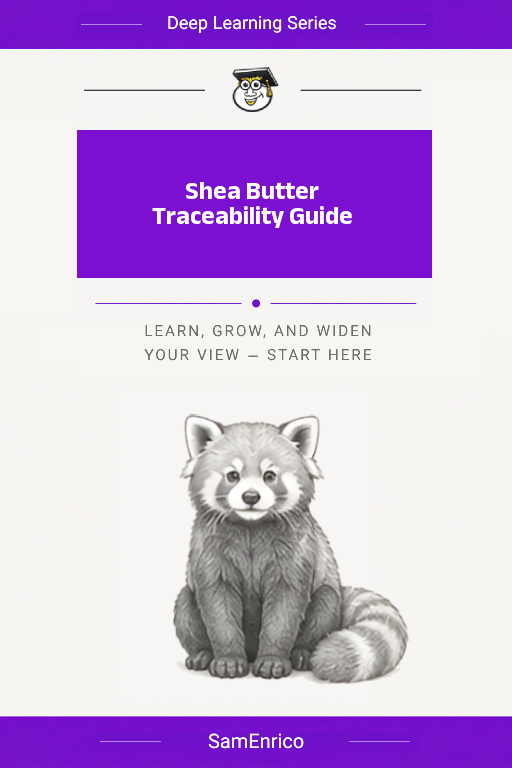
Non-FictionBusiness BriefTraceability
Shea Butter Traceability Guide eBook
Implement lot tracking for European buyer requirem
Implement lot tracking for European buyer requirements. This brief covers batch numbering and documentation for supply chain transparency.
Formats
Free sample
Chapter 1: The Forest-to-Formula Gap...--The first problem arrives not in a boardroom in Brussels or a quality control lab in London, but under the scorching sun of the African savanna, where a woman named Aminata has just finished collecting fallen shea nuts. She has walked nearly eight kilometers today, her baby strapped to her back and a woven sack slung over her shoulder. By nightfall, she will have gathered perhaps thirty kilograms of raw nuts—the fruit of trees that have stood for two hundred years, trees she did not plant and does not own, but upon which her children's school fees depend. She will sell these nuts to a local aggregator for a few thousand CFA francs, receive no receipt, sign no document, and provide only her first name before walking home in the dark. Tomorrow, those nuts will begin a journey that crosses three borders, two processing facilities, and one ocean before arriving at a European cosmetics factory.
Somewhere along that journey, the connection between Aminata's labor and the finished jar of shea butter on a shelf in Paris will vanish entirely.This is the forest-to-formula gap. It is not a failure of effort or honesty. It is a structural feature of a supply chain that evolved over centuries as an informal, trust-based system of women's commerce, long before European regulators ever demanded to know the exact GPS coordinates of where a nut was gathered. And it is the single greatest obstacle facing every African shea exporter who hopes to sell to premium European buyers in the year 2026 and beyond.The purpose of this chapter is to dismantle the myth that shea traceability is simply a matter of "keeping better records." It is not. It is a matter of understanding a profoundly complex, dispersed, and informal harvesting system that defies the plantation-based logic upon which most modern traceability regulations were built.
Without grasping this complexity, no lot numbering system, no digital platform, and no certification will succeed. With it, the path to compliance becomes not just possible, but profitable.The Geography of Wild Harvest: Why Shea is Not Cocoa To understand traceability, one must first understand what shea is—and what it is not. Shea butter is derived from the nuts of the Vitellaria paradoxa tree (and its East African subspecies Vitellaria nilotica), which grows wild across a 5,000-kilometer belt of sub-Saharan Africa from Senegal to Uganda. Unlike cocoa, coffee, or palm oil, shea is almost never cultivated on plantations. Approximately 90 to 95 percent of all shea nuts are wild-harvested from parklands—traditional agroforestry systems where trees coexist with crops and grazing land but are not owned or managed by any single farmer.This distinction is not academic.
It has profound practical consequences for traceability.On a cocoa plantation, every tree belongs to a known farmer. That farmer has a named plot of land, often with documented boundaries, and the harvest from that plot can be traced back to that single source. The supply chain is vertical: farmer to cooperative to exporter to buyer. When a European regulation demands geolocation of harvest areas, the cocoa farmer can hand over a GPS point.Shea offers no such simplicity. A single shea tree may be accessed by multiple collectors from different villages.
A single collector may harvest from hundreds of trees scattered across ten square kilometers. The land itself is often communal, with no individual ownership records. The nuts fall to the ground, are gathered by hand, and enter a supply chain that is horizontal, diffuse, and oral.This is not a bug. It is a feature of a system that has provided income to rural women for centuries without requiring land titles, formal contracts, or written records. But it becomes a bug when a European buyer demands to know exactly which trees produced the butter in their $45 jar of "ethically sourced" body cream.The Actors: A Cast of Thousands The shea supply chain is not a chain at all.
It is a web. To trace a single batch of nuts from the ground to the shipping container, one must understand the roles and limitations of each actor in that web.The Collectors: Millions of Women, One Name at a Time Across the shea belt, an estimated 16 million women engage in shea nut collection as their primary or secondary source of income. These women work individually or in small, informal groups. They are often illiterate or semi-literate, not because they lack intelligence but because rural education for girls has historically been neglected. They do not carry smartphones, and in many regions, cellular coverage is intermittent or nonexistent.
They record transactions in memory or in notebooks that degrade in the tropical sun and seasonal rains.Critically, the collector is the only person in the entire supply chain who can attest to where the nuts were harvested. Yet in the vast majority of shea exports today, that information is lost the moment the nuts leave her hands. She is paid in cash, offers her first name or village name, and receives nothing in return that connects her to the eventual shipment. The European buyer will never know her name. She will never know where her nuts ended up.
This anonymity is the root of the traceability problem.The Small Aggregators: The First Point of Failure Between the collector and the larger supply chain stands the small aggregator—often a local shopkeeper, a schoolteacher supplementing their income, or a retired farmer with a truck. These individuals travel from village to village, buying nuts from collectors in cash, storing them in sacks, and later selling them to larger cooperatives or directly to processors.The aggregator serves a vital function: they consolidate tiny lots (5 to 30 kilograms) into transportable quantities (500 to 2,000 kilograms). But they are also the first point where traceability typically breaks. An aggregator buying from fifty different women on a single morning will record, at best, the total weight purchased and the total cash paid. They rarely record which nuts came from which woman.
They almost never assign lot numbers. And their records, if they exist at all, are kept on paper that may be lost, damaged, or discarded after the transaction is complete.The Cooperatives: The Bridge Between Informal and Formal Cooperatives represent the first formally organized actor in the supply chain. A well-functioning cooperative may have hundreds or thousands of members, elected leadership, bank accounts, and relationships with international buyers. Cooperatives perform quality control (sorting nuts, removing damaged or unripe specimens), processing (boiling nuts to prevent germination), and storage (holding nuts until sufficient quantity is gathered for sale).However, cooperatives face a structural problem: they receive nuts from multiple aggregators and multiple collectors, often mixing them together in central storage. Once nuts are mixed, it becomes impossible to trace any specific nut back to its original collector.
This is the mass balance problem, which will be explored in depth in later chapters. For now, the key insight is that many cooperatives inadvertently destroy traceability at the very moment they create formal records.The Processors: Artisanal to Industrial Processing transforms raw shea nuts into shea butter. This can happen at three scales. Artisanal processing uses traditional methods: the nuts are crushed, roasted, ground into a…
This is the end of the free sample. Get the eBook to keep going. Buy now
About this book
Details
- Author
- Ervin Phillis
- Publisher
- SamEnrico
- Language
- English
- Genre
- Non-Fiction, Business Brief, Traceability
- Released
- 2026-05-30
- Pages (approx.)
- 153
- Available as
- eBook, Audiobook

Read better in the ZLOADR app
Your eBooks on your phone or tablet. Sign in with your SamEnrico account and start reading.
More by Ervin Phillis
 Bring Along ProvisionErvin Phillis$11.99
 Micronutrients For Gut Health GuideErvin Phillis$11.99
 The Sleeping Cat MethodErvin Phillis$11.99
 Metaphor Library for ScriptsErvin Phillis$11.99
 Pet Loss For ExpatriatesErvin Phillis$11.99
 The Bomb Squad Technician StressErvin Phillis$11.99
 Pelvic Pain Release ExercisesErvin Phillis$11.99
 Time Blocking For Holiday PrepErvin Phillis$11.99
 BossypantsErvin Phillis$11.99
 The Lioness of Dahomey: A Warrior Queen's Unyielding ReignErvin Phillis$11.99
 The Last Unknown River: Mapping the Amazon’s Hidden HeartErvin Phillis$11.99
 Shadow Votes: The 2000 Florida Ballot ScandalErvin Phillis$11.99
You may also like
 Hong Kong Handover 1997Dunn Johnnie$11.99
 Zumba For Postnatal Recovery CourseNeal Christian$11.99
 Zumba for BeginnersLadner Nikia$11.99
 YouTube Comment Mining GuideHumes Pandora$12.99
 Worry Box MeditationCarlin Rudy$11.99
 Workplace Stress MeditationNguyen Lynn$11.99
 Workplace Stress and Sleep RepairHawley Ivory$11.99
 Workplace Perfectionism CureDelaney Jeffry$11.99
 Workplace Injustice Anger GuideWallen Isabelle$11.99
 Work Addiction and Burnout LinkGreenwood Ester$11.99
 Women in Yoga and WellnessBeattie Galina$11.99
 Women in Stand Up ComedyChun Evangeline$11.99