
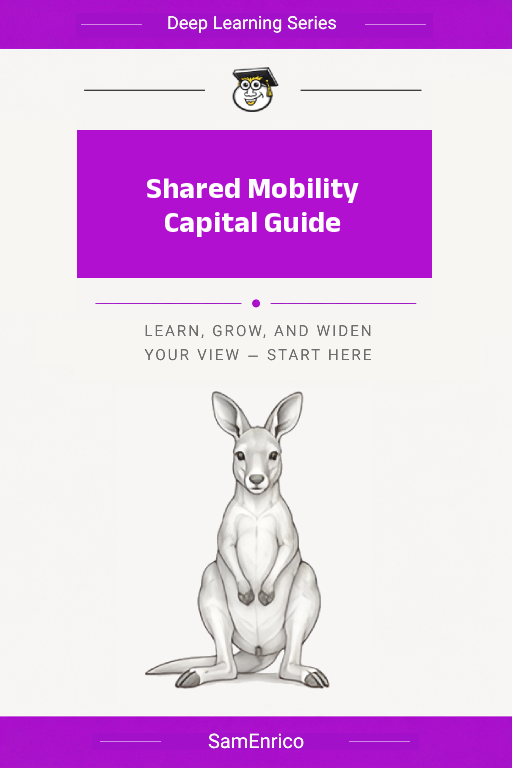
Non-FictionForecast & OutlookMobility Finance
Shared Mobility Capital Guide eBook
Project e-scooter fleet, bike-share stations, and
by Raynor Lidia
Project e-scooter fleet, bike-share stations, and ride-share platform investment strategies.
Formats
Free sample
Chapter 1: The $100 Million Graveyard--–- In 2022, Travis Vander Zanden believed he had won. His company, Bird, was worth 2.5billiononpaper.Hehadraisednearly2.5 billion on paper. He had raised nearly 2.5billiononpaper.Hehadraisednearly800 million from the most sophisticated venture capital firms on Earth—Sequoia, B Capital, Craft Ventures. His electric scooters cluttered sidewalks in 400 cities across six continents. Magazine covers called him the “Henry Ford of Micromobility.” And then, eighteen months later, he stood on a stage—not to accept an award, but to explain, in a voice that had lost its bravado, why Bird had just been delisted from the New York Stock Exchange.
By the end of 2023, Bird was bankrupt. Its assets were auctioned off for less than the cost of a single Super Bowl ad. The $2.5 billion empire had collapsed into a footnote.This chapter is not a eulogy for Bird. It is an autopsy. And the lesson is not “scooters were a bad idea.” The lesson is far more subtle and far more profitable: the financial models that built Silicon Valley’s unicorns—land grab, growth at all costs, gross bookings as a proxy for success—do not work in shared mobility.
They never did. What works is boring, data-intensive, and counterintuitive. It involves words like “depreciation curves” and “contribution margin after depreciation.” And if you learn nothing else from this book, learn this: the company that wins in shared mobility is not the one with the most scooters. It is the one with the longest-lived scooters, the most efficient rebalancing logistics, and the clearest understanding of what a vehicle actually costs per minute, per day, and per year.The Rise and Fall of the Land Grab To understand why Bird collapsed, you must first understand the venture capital playbook that built it. The playbook, refined over two decades of tech investing, goes like this: identify a large, fragmented market.
Raise massive amounts of capital. Subsidize user acquisition by pricing below cost. Capture market share before competitors can react. Achieve critical mass. Then, and only then, figure out how to make money.
This strategy worked for Amazon (lost money for six years before turning profitable). It worked for Uber (lost $10 billion before its first profitable quarter). It worked for Spotify, Netflix, and a dozen other tech giants. The underlying assumption is that once you own the customer relationship—once switching costs are high enough—you can raise prices, cut subsidies, and print money.The problem is that shared mobility violates every assumption of this playbook.First, switching costs are effectively zero. A rider who prefers Lime to Bird downloads a different app in twelve seconds.
There is no contract, no data lock-in, no ecosystem of complementary products. Second, the assets themselves are not defensible. Anyone can buy an electric scooter from a Chinese manufacturer. Ninebot, Xiaomi, and Okai will sell identical hardware to any operator with a credit card. Third, and most importantly, the unit economics are brutal in ways that software businesses never face.A software company’s product does not get stolen.
It does not need to be charged. It does not get thrown into a river by a bored teenager. It does not lose 40% of its value in twelve months because the battery has degraded past 300 charge cycles.Bird’s leadership either did not understand these differences or chose to ignore them. In 2019, at the height of the scooter bubble, Bird was spending 1.25perrideonvehicledepreciationalone—beforeaccountingforcharging,rebalancing,insurance,oroverhead.Theaveragefarewas1.25 per ride on vehicle depreciation alone—before accounting for charging, rebalancing, insurance, or overhead. The average fare was 1.25perrideonvehicledepreciationalone—beforeaccountingforcharging,rebalancing,insurance,oroverhead.Theaveragefarewas3.50.
That left $2.25 to cover everything else. It was not enough. It has never been enough. And yet, investors kept pouring money in, convinced that scale would solve the math.It did not.The Case Study That Breaks the Narrative: Donkey Republic Three thousand miles away from Bird’s Santa Monica headquarters, a small Danish company called Donkey Republic was quietly doing something remarkable. It was turning a profit.Donkey Republic did not chase 400 cities.
It did not raise $800 million. It did not put its scooters on magazine covers. Instead, it signed ten-year concession contracts with mid-sized municipalities like Turku, Finland, and Odense, Denmark. The terms were boring and beautiful: the city agreed to guarantee a minimum of €4.50 per bike per day in revenue. In exchange, Donkey Republic agreed to maintain its fleet to city specifications, share anonymized trip data, and keep bikes away from tourist-heavy pedestrian zones during peak hours.The difference in philosophy could not be starker.
Bird treated cities as obstacles to be overrun. Donkey Republic treated cities as partners to be contracted. Bird optimized for investor pitch decks (growth rate, city count, gross bookings). Donkey Republic optimized for unit economics (revenue per active vehicle, maintenance cost per trip, vehicle lifespan). Bird raised money to buy more scooters.
Donkey Republic raised money to extend the life of the scooters it already owned.The results speak for themselves. In 2023, the year Bird filed for bankruptcy, Donkey Republic reported positive EBITDA for the third consecutive year. Its fleet utilization rate (trips per vehicle per day) was 4.2, nearly double the industry average. Its average vehicle lifespan was thirty-six months—again, nearly double the industry average. And its customer acquisition cost was effectively zero because its municipal contracts came with built-in visibility: every resident who downloaded the city’s transit app saw Donkey Republic as the first-mile/last-mile option.The lesson is not that Donkey Republic is a better company than Bird, though it is.
The lesson is that shared mobility is a capital-intensive, asset-heavy, logistics-driven business. It does not behave like software. It behaves like airlines, like car rental agencies, like fleet management. And the investors who treat it as such will make money. The investors who treat it as a land grab will lose their shirts.The Two Metrics That Actually Matter If you take only two concepts from this chapter, make them these: Revenue Per Active Trip (RPAT) and Contribution Margin After Depreciation (CMAD).Let us start with RPAT.
Gross bookings—the number every startup pitches to investors—is a vanity metric. It tells you how much money flows through the platform, but it tells you nothing about profitability. A scooter that makes ten trips at 1eachgenerates1 each generates 1eachgenerates10 in gross bookings. A scooter that makes one trip at $10 generates the same gross bookings. But the first scooter incurred ten times the maintenance, ten times the battery wear, ten times the risk of theft or vandalism.
Gross bookings cannot distinguish between these two scenarios. RPAT can.Revenue Per Active Trip is calculated as total revenue from a vehicle divided by the number of trips that vehicle completes in a given period. But here is the crucial refinement: you only count trips that generate positive contribution after variable costs. If a trip costs you more in battery wear and maintenance than the rider pays, it should not count as “active” in your metric. It is a destroyer of value disguised as a transaction.In practice, a healthy shared mobility operator achieves RPAT of 1.80to1.80 to 1.80to2.50 in mature markets.
Below 1.50,theoperatorislikelysubsidizingtrips—burningcashtopumpuptripcountsforinvestors.Above1.50, the operator is likely subsidizing trips—burning cash to pump up trip counts for investors. Above 1.50,theoperatorislikelysubsidizingtrips—burningcashtopumpuptripcountsforinvestors.Above2.50 in a…
This is the end of the free sample. Get the eBook to keep going. Buy now
About this book
Details
- Author
- Raynor Lidia
- Publisher
- SamEnrico
- Language
- English
- Genre
- Non-Fiction, Forecast & Outlook, Mobility Finance
- Released
- 2026-06-01
- Pages (approx.)
- 145
- Available as
- eBook, Audiobook

Read better in the ZLOADR app
Your eBooks on your phone or tablet. Sign in with your SamEnrico account and start reading.
More by Raynor Lidia
 Anapanasati For PTSD GuideRaynor Lidia$11.99
 Palestinian American Return To West Bank CourseRaynor Lidia$11.99
 The Body Language for JournalistsRaynor Lidia$11.99
 Shopping Budget Cash OnlyRaynor Lidia$11.99
 SBA Disaster Loan Application GuideRaynor Lidia$11.99
 The Ballad of Selena: How a Murder Changed Music and Immigration LawRaynor Lidia$11.99
 API Documentation Generation GuideRaynor Lidia$12.99
 Understanding Mmt SyndromeRaynor Lidia$17.99
 Elsmoreite MiningRaynor Lidia$11.99
 How to Become a Laborer - Canvas ShopRaynor Lidia$11.99
You may also like
 Hong Kong Handover 1997Dunn Johnnie$11.99
 Zumba For Postnatal Recovery CourseNeal Christian$11.99
 Zumba for BeginnersLadner Nikia$11.99
 YouTube Comment Mining GuideHumes Pandora$12.99
 Worry Box MeditationCarlin Rudy$11.99
 Workplace Stress MeditationNguyen Lynn$11.99
 Workplace Stress and Sleep RepairHawley Ivory$11.99
 Workplace Perfectionism CureDelaney Jeffry$11.99
 Workplace Injustice Anger GuideWallen Isabelle$11.99
 Work Addiction and Burnout LinkGreenwood Ester$11.99
 Women in Yoga and WellnessBeattie Galina$11.99
 Women in Stand Up ComedyChun Evangeline$11.99