
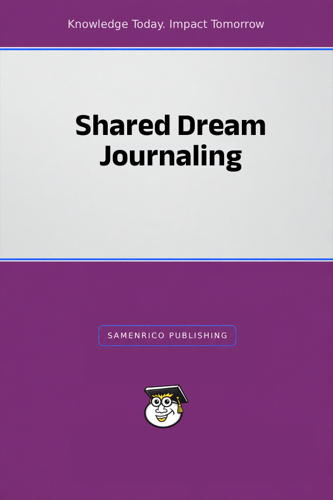
Shared Dream Journaling eBook
Compare dreams with partners to find common themes
Compare dreams with partners to find common themes.
Formats
Free sample
Chapter 1: The Unseen Conversation--Every night, while you sleep, a conversation takes place that you never hear. It does not use words. It leaves no voicemail. You will not find it in your text messages or your email inbox. And yet, this conversation has more to say about the true state of your relationship than any argument you have had over dishes, finances, or whose family you are visiting for the holidays.This conversation unfolds in images, emotions, and fragments of memory.
It speaks in the language of impossible landscapes, forgotten faces, and feelings that evaporate the moment your alarm clock drags you back into the waking world. It is the conversation between your unconscious mind and your partner's—a nightly exchange of emotional data that has been happening for as long as the two of you have shared a bed, a life, and a bond.Most couples never notice this conversation. They wake up, shake off the lingering wisps of their dreams, and stumble into the routine of coffee, commutes, and to-do lists. If they remember anything at all, it is a vague impression—something about being chased, something about a house they used to live in, something about a person they have not seen in years. They dismiss these fragments as meaningless noise, the random firing of neurons during routine brain maintenance.
Then they go about their day, never realizing that their dream contained a message about their relationship that their partner dreamed about too.This book exists because that assumption—that dreams are meaningless noise—is not just wrong. It is expensive. It costs you opportunities for connection, for conflict resolution, for intimacy that waking conversation cannot reach. And it costs you the chance to see your relationship clearly, without the filters and defenses you both wear during the day.The Map You Did Not Know You Had Imagine for a moment that you and your partner are trying to navigate a dense forest. You have no map.
You have no compass. You have only the vague sense that you are lost and the growing frustration of bumping into the same trees over and over again. That is what most relationships feel like after a few years. You have the same fights about the same things. You circle the same issues—money, sex, chores, in-laws—without ever making progress.
You know you are stuck, but you do not know why or how to get unstuck.Now imagine that someone hands you a detailed topographical map of the forest you are walking through. Suddenly, you can see the terrain. You can see where the rivers are, where the cliffs drop off, where the trails converge. You are not magically transported out of the forest. But you no longer have to walk blindly.
You have information. And information changes everything.Your shared dreams are that map.Every night, your unconscious mind processes the emotional residue of your day. It does not care about the surface details—who said what, who forgot to buy milk, who left the garage door open. It cares about the emotional undercurrents. Were you anxious?
Were you rejected? Did you feel loved? Did you feel seen? These emotional signatures leave traces in your dreams. They appear as symbols: water when you feel overwhelmed, locked doors when you feel trapped, being chased when you are avoiding something, falling when you feel out of control.Your partner's unconscious mind is doing the exact same thing, processing the exact same day, the exact same interactions, the exact same emotional undercurrents.
And because your sleep cycles have synchronized through weeks, months, or years of sleeping next to each other, you process this material at the same time. Your dreams become parallel streams running down the same mountain. Different rocks, different ripples, but the same water, the same gravity, the same destination.When you learn to read these parallel streams—when you learn to compare your dream journals and find the common themes—you gain access to a level of information about your relationship that waking conversation cannot provide. You see the emotional terrain you are both navigating. You see the issues you have been avoiding.
You see the wounds that have not healed. And you see all of this without blame, without defensiveness, without the walls that go up when you try to have a difficult conversation over dinner.Why This Is Not Telepathy (And Why That Matters)Let me address the elephant in the room immediately. When people hear about shared dreaming, they often think of telepathy. They imagine two lovers meeting in a dream, having a conversation, exchanging information across the veil of sleep. That is a compelling image.
It makes for great movies and romance novels. But it is not what this book is about, and chasing that fantasy will only frustrate you.Telepathic dreams—the literal transfer of specific information from one sleeping brain to another—are extraordinarily rare. Researchers have documented them. The Maimonides experiments in the 1960s and 1970s produced intriguing statistical anomalies that have never been fully explained. People do sometimes report dreaming of a specific event that then happens, or dreaming of a specific image that their partner was focusing on in another room.
These reports are real. But they are also unpredictable, unreplicable, and entirely outside your control.If you spend twelve weeks trying to achieve literal telepathy with your partner, you will almost certainly fail. You will feel frustrated. You will conclude that shared dreaming is nonsense. And you will close this book, having gained nothing, having lost the opportunity to discover something real.This book is not about telepathy.
It is about something far more common, far more reliable, and far more useful: psychological synchronicity. This is the phenomenon whereby two people who share an emotional bond also share dream themes, emotional patterns, and symbolic language—not because information is magically transferring between their brains, but because their brains are processing the same relational material at the same time.The distinction matters. Telepathy suggests something paranormal, something outside the bounds of normal science. Psychological synchronicity is entirely natural. It flows from attachment theory, from the biology of sleep, from the simple fact that two people who share a life share an emotional environment.
Your dreams are not mysterious messages from beyond. They are data about your emotional state. And when you and your partner share an emotional environment, your data will naturally overlap.Think of it this way. If you and your partner both look at the same mountain from different angles, you will see different things. One of you might see the rocky eastern face.
The other might see the forested western slope. But you are both looking at the same mountain. Your reports will differ in the details but align in the essentials. That is parallel dreaming. Different angles, same mountain.The Attachment Theory Beneath the Practice To understand why parallel dreaming happens, you need to understand attachment theory.
This is not academic fluff. It is the biological and psychological foundation for everything in this book.Attachment theory, developed by British psychologist John Bowlby in the 1950s and expanded by American psychologist Mary Ainsworth, argues that human beings…
This is the end of the free sample. Get the eBook to keep going. Buy now
About this book
Details
- Author
- Minter Florentino
- Publisher
- SamEnrico
- Language
- English
- Genre
- Non-Fiction, Self-Help, Couples
- Released
- 2026-06-11
- Pages (approx.)
- 140
- Available as
- eBook, Audiobook

Read better in the ZLOADR app
Your eBooks on your phone or tablet. Sign in with your SamEnrico account and start reading.
More by Minter Florentino
 The Letting Go MeditationMinter Florentino$11.99
 Secondhand Shopping Addiction CourseMinter Florentino$11.99
 Russian Art Theft NetworksMinter Florentino$11.99
 Food Addiction Recovery AffirmationsMinter Florentino$11.99
 The Deepwire Revolution: How a Forgotten Cable Changed the PacificMinter Florentino$11.99
 Echoes of the Storm: The Unseen Heroes of Hurricane KatrinaMinter Florentino$11.99
 How to Become a Centrifuge-separator TenderMinter Florentino$11.99
 Understanding Congenital Cardiovascular MalformationsMinter Florentino$17.99
 China Physical Examination VisaMinter Florentino$12.99
 After Sales Service BoPMinter Florentino$12.99
 Master Data SpecialistMinter Florentino$11.99
You may also like
 Hong Kong Handover 1997Dunn Johnnie$11.99
 Zumba For Postnatal Recovery CourseNeal Christian$11.99
 Zumba for BeginnersLadner Nikia$11.99
 YouTube Comment Mining GuideHumes Pandora$12.99
 Worry Box MeditationCarlin Rudy$11.99
 Workplace Stress MeditationNguyen Lynn$11.99
 Workplace Stress and Sleep RepairHawley Ivory$11.99
 Workplace Perfectionism CureDelaney Jeffry$11.99
 Workplace Injustice Anger GuideWallen Isabelle$11.99
 Work Addiction and Burnout LinkGreenwood Ester$11.99
 Women in Yoga and WellnessBeattie Galina$11.99
 Women in Stand Up ComedyChun Evangeline$11.99