
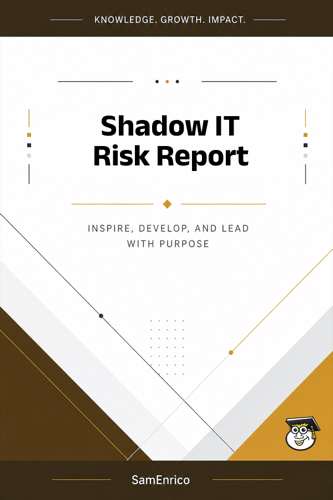
Non-FictionAnnual CheckupIT Governance
Shadow IT Risk Report eBook
Document unsanctioned cloud app usage and data lea
Document unsanctioned cloud app usage and data leakage this year.
Formats
Free sample
Chapter 1: The 40-App Lie...--–- The chief information security officer of a Fortune 500 financial services firm sat in a windowless boardroom, presenting to the audit committee. His slide deck was immaculate. It showed exactly 37 approved cloud applications—Microsoft 365, Salesforce, Workday, Box, and thirty-three others, all neatly categorized, all with active monitoring, all compliant with every regulatory framework the company touched. The CISO was proud of this deck. He had spent three weeks refining it.
The board nodded approvingly. They asked about metrics. He showed them login frequency, data loss prevention alerts, and the number of revoked OAuth tokens. Everything was green. Everything was under control.–- Three weeks later, the company suffered a data breach that would cost them $47 million in fines, legal fees, and customer compensation.
The breach did not come through a sanctioned app. It did not come through a firewall vulnerability. It did not come from a sophisticated nation-state actor. It came from a free PDF conversion tool that a junior financial analyst had signed up for using her work email. The tool had requested—and received—"read all files in your Google Drive" access.
She clicked "Allow" without reading the permissions screen. The tool's developer had left an API key exposed in a public Git Hub repository. A threat actor found the key, used it to access the analyst's Google Drive, and discovered a spreadsheet containing unredacted customer Social Security numbers that she had saved there for "convenience."–- The CISO was fired within six months. His replacement, during the first week on the job, ran a passive network capture. She discovered that the organization was using 1,847 distinct cloud services.
Not 37. Not 40. Not even 100. 1,847. Ninety-three percent of those services were completely unknown to IT.
Many had been connected for years. Some had administrative access to corporate systems. Several were free-tier consumer tools with no data protection agreements. One—a note-taking app—had been used by three C-suite executives to draft board materials containing forward-looking financial statements.–- This is not an outlier. This is the norm.–- Every organization has a shadow IT problem.
The only difference between companies is whether they know it.The Visibility Gap: What You Don't Know Is Killing You–- The central thesis of this book, and the foundation of everything that follows, is disarmingly simple: you cannot secure what you cannot see. And right now, you cannot see most of what is happening in your cloud environment. The term "Shadow IT" has been in use for nearly two decades, originally referring to employees setting up unauthorized servers under their desks or running unapproved software on corporate laptops. In 2026, Shadow IT looks very different. It is not a physical server humming in a forgotten closet.
It is a browser extension installed in thirty seconds. It is a free AI chatbot that an employee uses to draft emails. It is a file synchronization tool that automatically mirrors your sanctioned Share Point repository to an unsanctioned Google Drive account. It is a developer pasting an API key into a Slack channel for "temporary debugging" and never deleting the message.–- The visibility gap—the difference between what IT leaders believe is happening and what is actually happening—is the single largest unaddressed risk in modern cybersecurity. In survey after survey, IT leaders estimate that their organizations use between 30 and 60 cloud applications.
The actual number, across industries and company sizes, consistently exceeds 1,000. This gap exists for three reasons. First, employees adopt tools without permission because the tools solve real problems faster than IT can provide approved solutions. Second, security tools are designed to monitor sanctioned applications, not the long tail of unsanctioned services. Third, and most importantly, most organizations actively avoid looking for shadow IT because they are afraid of what they will find.–- That last point deserves emphasis.
The CISO with the immaculate slide deck was not incompetent. He was willfully blind. He knew that shadow IT existed. He had heard the statistics. But he had built his entire security program around the assumption that if he could secure the 37 sanctioned apps, the rest would take care of itself.
They did not. The fear of discovery—the fear that his board would learn the truth—prevented him from running the very network capture that would have revealed the PDF tool, revoked its access, and saved his career.–- This book exists to eliminate that fear through knowledge and action. By the time you finish these twelve chapters, you will know exactly how to find every shadow app in your environment, quantify the risk of each, and implement a sustainable governance model that does not require you to become the department of "no."The Productivity Paradox: Why Blocking Makes Everything Worse–- Most security professionals, when confronted with the existence of shadow IT, have an instinctive reaction: block it. Block the domain. Block the IP address.
Add the application to the deny-list. This response is understandable. It is also catastrophically wrong.–- The Productivity Paradox works like this. When an organization blocks a popular cloud application—say, Chat GPT or Dropbox or We Transfer—employees do not stop needing the functionality that application provided. They simply find another way to get it.
That other way is almost always riskier than the original. A blocked file-sharing service leads to employees emailing large attachments to personal accounts. A blocked AI chatbot leads to employees using their personal devices and personal accounts, outside of any corporate monitoring. A blocked productivity tool leads to employees finding an obscure alternative that has never been reviewed by any security team anywhere.–- The paradox is that blocking increases risk rather than reducing it. The employee who was using a known shadow app—imperfect but at least visible to network logs—becomes an employee using an unknown shadow app, or worse, a consumer-grade tool on personal infrastructure.
The security team loses all visibility. The data continues to move. The only thing that has changed is that the security team has lost the ability to see the movement.–- This pattern has played out repeatedly across the last decade. When organizations blocked consumer file-sharing services like Dropbox and Box, employees migrated to Google Drive and personal One Drive accounts. When those were blocked, employees began using encrypted messaging apps with file transfer capabilities.
When those were blocked, employees started emailing files to personal addresses. The security team won every battle and lost the war. Each blocking action reduced visibility and increased the friction that drives the behavior in the first place.–- Understanding the Productivity Paradox is essential to everything that follows in this book. Chapter 11 will present an alternative model called strategic redirection—using gateways and sanctioned alternatives to change behavior without punishment. But before we can redirect, we must understand.
And before we can understand, we must see.The Psychology of the Friction-Driven Insider–- The term "insider threat" typically conjures images of disgruntled employees stealing data or spies selling credentials to foreign governments. These threats are real, but they are rare. The far more common insider threat is the friction-driven insider: a well-intentioned, hardworking employee who bypasses security controls because those controls are slowing them down.–- The friction-driven insider…
This is the end of the free sample. Get the eBook to keep going. Buy now
About this book
Details
- Author
- Christiansen Cherlyn
- Publisher
- SamEnrico
- Language
- English
- Genre
- Non-Fiction, Annual Checkup, IT Governance
- Released
- 2026-06-07
- Pages (approx.)
- 154
- Available as
- eBook, Audiobook

Read better in the ZLOADR app
Your eBooks on your phone or tablet. Sign in with your SamEnrico account and start reading.
More by Christiansen Cherlyn
 Bipolar And Financial ImpulsivityChristiansen Cherlyn$11.99
 Women Imposter Syndrome GuideChristiansen Cherlyn$11.99
 Alcohol Detox Questions to AskChristiansen Cherlyn$11.99
 Understanding Food Addiction BrainChristiansen Cherlyn$11.99
 The Jade Serpent's Curse: How a Dragon Brought Down an EmperorChristiansen Cherlyn$11.99
 How to Start a Child Day-care (non-charitable) Business (Beginners Guide)Christiansen Cherlyn$11.99
 GA4 Predictive Metrics GuideChristiansen Cherlyn$12.99
 B Corp Certification for ExportersChristiansen Cherlyn$12.99
 Commission Sales AssociateChristiansen Cherlyn$11.99Commission Sales AssociateChristiansen Cherlyn$11.99
You may also like
 Hong Kong Handover 1997Dunn Johnnie$11.99
 Zumba For Postnatal Recovery CourseNeal Christian$11.99
 Zumba for BeginnersLadner Nikia$11.99
 YouTube Comment Mining GuideHumes Pandora$12.99
 Worry Box MeditationCarlin Rudy$11.99
 Workplace Stress MeditationNguyen Lynn$11.99
 Workplace Stress and Sleep RepairHawley Ivory$11.99
 Workplace Perfectionism CureDelaney Jeffry$11.99
 Workplace Injustice Anger GuideWallen Isabelle$11.99
 Work Addiction and Burnout LinkGreenwood Ester$11.99
 Women in Yoga and WellnessBeattie Galina$11.99
 Women in Stand Up ComedyChun Evangeline$11.99