
Non-FictionInformativeEducational
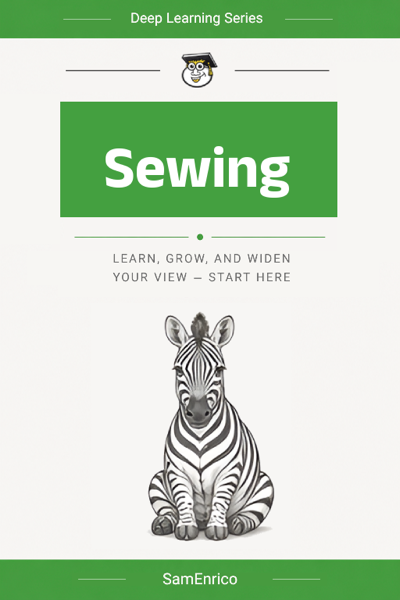
Sewing eBook
A Coursebook on Sewing
by Irby Junita
A Coursebook on Sewing
Formats
Free sample
Chapter 1: Threading Your Courage--–- The sewing machine sat in your closet for three years. Maybe it was a gift from a well-meaning relative. Maybe you bought it during a late-night surge of optimism, convinced you would finally become the kind of person who makes their own curtains, mends their own hems, and creates birthday gifts that make people say “Wait, YOU made this?” Instead, it has become a silent monument to good intentions. The manual is lost. The thread is tangled.
And somewhere deep in the mechanical heart of that machine, a tiny bobbin waits to be wound, secretly hoping you will finally open the hinged door and figure it out.This is the chapter where that changes.Before we talk about needles, before we discuss fabric grain or seam allowances or any of the other terms that make sewing sound like a secret society with a complicated handshake, we need to address the single most important factor in your success as a sewist. It is not your machine. It is not your budget for fancy scissors. It is not even your natural talent, which I promise you have more of than you think.The most important factor is your permission to begin badly.Every person who has ever sewn a straight line, every tailor who has ever drafted a perfect blazer, every grandmother who mended a thousand socks without breaking a thread — every single one of them started with a mess. Their first seams were crooked.
Their first buttonholes looked like wounded caterpillars. Their first garments were unwearable. The only difference between them and the person who still has a sewing machine in the closet is that they kept going after the first disaster.This book is not designed to make you a perfect sewist overnight. That is impossible and anyone who promises it is lying. This book is designed to make you a brave sewist.
By the time you finish these pages, you will have made things. Some of them will be beautiful. Some of them will be slightly wonky. All of them will be yours.And here is the secret that the sewing industry does not want you to know: wonky is fine. Wonky is how you learn.
Wonky is the path to wonderful.What This Chapter Will Actually Do For You Let me be brutally honest about what you will and will not accomplish in this first chapter.You will NOT sew a garment. You will NOT master the French seam. You will NOT look at a pattern envelope and instantly understand why there are seventeen different lines for “size 12” that all seem to mean different things.What you WILL do is something far more important. You will set up your sewing space so your back does not ache after twenty minutes. You will learn exactly which tools you actually need to buy right now versus which ones can wait until you are addicted to this hobby and looking for excuses to visit the fabric store.
You will understand what all those mysterious parts of your sewing machine are called and what they do. You will thread that machine for the first time without crying. You will wind a bobbin and feel a small but genuine surge of accomplishment when the little metal spool fills evenly with thread.And then — because I refuse to let you close this book without making something — you will sew your first seam. It will be on paper, not fabric. It will be straight lines and curves and zigzags that teach your foot how much pressure to apply to the pedal and your hands how to guide material without forcing it.
By the end of this chapter, you will have sewn something. Not a tote bag, not a pillowcase, not anything you would show off on social media. But something that proves you can do this.Because you can. You absolutely can.The Psychology of the Beginner Sewist Before we touch a single tool, let us name the fears that are probably sitting in the room with you right now.Fear Number One: I will break the machine. This is extraordinarily unlikely unless you sew over a pin made of solid steel or attempt to force denim through a needle designed for silk.
Sewing machines are durable. They are designed to be used by people who make mistakes. The worst thing that will happen is that you will break a needle — which costs about fifty cents and takes thirty seconds to replace — or you will jam the bobbin mechanism so thoroughly that you have to spend ten minutes with tweezers and a muttered curse. Neither of these is permanent damage. Neither of these means you are bad at sewing.
Both of these mean you are learning.Fear Number Two: I have no spatial intelligence. This is the fear that you cannot visualize how flat fabric becomes a three-dimensional garment. Here is the truth: nobody can visualize that perfectly until they have done it a few dozen times. Darts, gathers, pleats, and seams are not intuitive. They are taught.
They are practiced. Your brain literally builds new neural pathways as you learn to see fabric in three dimensions. You are not lacking an innate gift. You are lacking repetition.Fear Number Three: Everyone will laugh at my first projects. Who is everyone?
The people who love you will be genuinely impressed that you tried something new. The strangers on the internet do not matter. And the sewists who have been doing this for twenty years will look at your crooked seams and feel nothing but warm nostalgia for their own crooked beginnings. Nobody is born holding a perfect ⅝-inch seam allowance. Everyone started exactly where you are standing right now.Fear Number Four: I will spend a fortune on tools and then give up.
This is the only fear that has some legitimate weight behind it. The sewing industry wants you to believe you need a 1,200machine,a1,200 machine, a 1,200machine,a300 set of scissors, and a room full of organizational systems before you can sew a single stitch. This is nonsense. In the next section, I will give you a shopping list that costs less than a dinner out and fits in a shoebox.The Absolute Minimum Toolkit (What You Actually Need)Let me save you from the paralysis of choice. Walk into any fabric store and you will see walls of gadgets designed to separate you from your money.
Rotary cutters in four sizes! Magnetic seam guides! Fabric weights shaped like kittens! Thread organizers that cost more than your first machine!Ignore almost all of it.Here is what you actually need to start sewing. I have organized this into three tiers: what you must buy, what you probably already own, and what you can add later if (when) you fall in love with this craft.Tier One: The Non-Negotiable Essentials A sewing machine that works.
That is the entire specification. It does not need to be new. It does not need to have forty-seven built-in stitches. It needs to form a straight stitch and a zigzag stitch, and it needs to be in working condition. If you already…
This is the end of the free sample. Get the eBook to keep going. Buy now
About this book
Details
- Author
- Irby Junita
- Publisher
- SamEnrico
- Language
- English
- Genre
- Non-Fiction, Informative, Educational
- Released
- 2026-05-09
- Pages (approx.)
- 143
- Available as
- eBook, Audiobook

Read better in the ZLOADR app
Your eBooks on your phone or tablet. Sign in with your SamEnrico account and start reading.
More by Irby Junita
 Joke and Humor Conversation HandbookIrby Junita$11.99
 Brand Positioning Map WorkbookIrby Junita$11.99
 Habit Formation for TeensIrby Junita$11.99
 Walking Meditation for OverthinkingIrby Junita$11.99
 The Nobel And Radio AstronomyIrby Junita$11.99
 The Last Broadcast of the Midnight SunIrby Junita$11.99
 The Mathematician Who Defied the Jungle: Carlos Gustavo Moreno and the Birth of Modern Epidemiology in the AmazonIrby Junita$11.99
 How to Start a Buhl Cutting Business (Beginners Guide)Irby Junita$11.99
 Countertrade Payment PrimerIrby Junita$12.99
 Jamaica Customer Support GuideIrby Junita$12.99
 Understanding Granuloma AnnulareIrby Junita$17.99
You may also like
 Hong Kong Handover 1997Dunn Johnnie$11.99
 Zumba For Postnatal Recovery CourseNeal Christian$11.99
 Zumba for BeginnersLadner Nikia$11.99
 YouTube Comment Mining GuideHumes Pandora$12.99
 Worry Box MeditationCarlin Rudy$11.99
 Workplace Stress MeditationNguyen Lynn$11.99
 Workplace Stress and Sleep RepairHawley Ivory$11.99
 Workplace Perfectionism CureDelaney Jeffry$11.99
 Workplace Injustice Anger GuideWallen Isabelle$11.99
 Work Addiction and Burnout LinkGreenwood Ester$11.99
 Women in Yoga and WellnessBeattie Galina$11.99
 Women in Stand Up ComedyChun Evangeline$11.99