
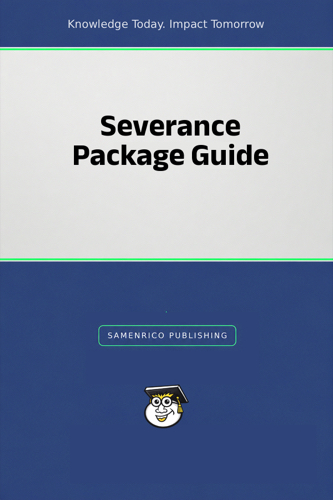
Severance Package Guide eBook
Negotiates exit terms.
by Rich Roxana
Negotiates exit terms.
Formats
Free sample
Chapter 1: The 48-Hour Rule--It happens in a room with bad lighting and a box of tissues placed precisely within arm's reach.You are called into a conference room you have never noticed before, even though you have walked past it four hundred times. The door is already closed. Inside, two people are waiting: someone from Human Resources you barely recognize and your direct manager, who cannot meet your eyes. The HR person speaks first. Your manager says nothing.
Between them on the table is a manila folder, unmarked, containing anywhere from six to twenty pages of dense legal text.Your heart rate doubles in less than three seconds. Your palms sweat. The back of your neck feels hot. You hear a rushing sound in your ears that might be blood or might be the air conditioning. You are vaguely aware that someone is talking, but the words are not landing.
Then you hear the phrase that changes everything: "We have decided to eliminate your position."What happens next is not a matter of personality or intelligence. It is biology.The Neuroscience of Bad Decisions In the moments after receiving termination news, your brain floods with cortisol and adrenaline. These are the same chemicals released when you narrowly avoid a car accident or spot a predator in the wild. Your prefrontal cortex—the part of your brain responsible for rational decision-making, long-term planning, and impulse control—partially shuts down. Your amygdala, the ancient alarm system, takes over.This is not a character flaw.
It is evolution.Your body is preparing you for survival, not negotiation. Blood flows away from your digestive system and toward your large muscle groups. Your peripheral vision narrows. Your hearing becomes selectively acute. You are, in every physiological sense, ready to fight, flee, or freeze.None of these responses are useful when someone slides a legal document across a table and asks for your signature.Yet that is exactly what happens.
In thousands of termination meetings every single day across the United States, HR professionals present severance agreements to people in the midst of this biochemical cascade. And most of those people sign. Not because the offer is fair. Not because they have reviewed the terms. But because they want the pain to stop.This chapter exists to stop you from becoming one of them.The Two Stories That Explain Everything Let me tell you about two employees who worked at the same technology company, on the same floor, doing substantially similar jobs.
Both were laid off on the same Friday in a reduction in force that eliminated forty percent of their department. Both received identical initial offers: twelve weeks of base salary, COBRA continuation for three months, and outplacement services.The first employee, let us call her Sarah, was a senior product manager. When she was called into the conference room, she felt the familiar rush of panic. She had a mortgage. She had two children.
Her husband had been laid off the previous year and was still underemployed. She needed the money, and she was terrified that if she caused any trouble, the offer would be withdrawn entirely. So she smiled, said thank you, and signed the agreement before she left the building. The entire interaction lasted twenty-two minutes.The second employee, whom we will call Marcus, was a senior product manager in the same group. He received the same news from the same HR representative in the same room.
But Marcus had been through a layoff once before, seven years earlier, at a different company. He had signed that first agreement in a panic and later learned from a lawyer friend that he had left nearly thirty thousand dollars on the table. He had promised himself he would never make that mistake again.When HR slid the agreement toward him, Marcus did not pick up the pen. He looked at the document, then looked at the HR representative, and said six words: "I will need to review this."The HR representative said, "Of course. We would like an answer by Tuesday."Marcus said, "I will be in touch."He took the agreement home.
He did not sign it that weekend. He did not sign it on Monday. On Tuesday morning, he sent a one-page email asking for three adjustments: fourteen weeks of base salary instead of twelve, a lump sum for healthcare instead of COBRA continuation, and an agreement that the company would not contest his unemployment claim. By Thursday, the company had agreed to all three. Marcus signed on Friday—seven full days after his termination meeting.The difference between Sarah and Marcus was not intelligence, education, or job performance.
It was time. Sarah signed in twenty-two minutes. Marcus waited seven days. For that patience, he received an additional $34,000 in cash and benefits.Why Speed Is Your Enemy The single most important fact about severance negotiation is this: there is almost never a legitimate reason to sign within the first forty-eight hours.Employers want you to believe otherwise. They will use phrases like "this offer expires on Friday" or "we need to close this out by end of week." These deadlines are almost always artificial.
HR departments have been processing severance agreements for decades. They know that the longer you wait, the more likely you are to ask questions, consult an attorney, or demand better terms.The artificial deadline serves one purpose: to exploit your emotional vulnerability before you have time to think clearly.Let us examine the neuroscience more closely. Cortisol peaks approximately twenty to thirty minutes after a stressful event and can remain elevated for twenty-four to forty-eight hours. During this window, your ability to assess risk, evaluate trade-offs, and project future outcomes is significantly impaired. You are more likely to focus on immediate relief—ending the conversation, leaving the building, stopping the pain—than on long-term financial consequences.This is not a moral failing.
It is a chemical reality.But here is what HR knows that you may not: the same chemical response works in your favor if you simply wait. By the forty-eight-hour mark, your cortisol levels begin to normalize. Your prefrontal cortex comes back online. You can think clearly again. You can read the agreement line by line.
You can research your rights. You can calculate what you are actually owed versus what they are offering.The difference between signing at twenty-two minutes and signing at forty-eight hours is the difference between reacting and responding. Reacting is survival. Responding is strategy.The True Cost of Silence When Sarah signed her severance agreement in twenty-two minutes, she left an estimated 40 percent of potential value on the table. That number is not a guess.
It comes from a decade of data collected by employment law firms and negotiation consultants who have analyzed thousands of severance agreements.The average employee who negotiates receives between 30 and 50 percent more than the initial offer. The average employee who does not negotiate receives exactly what was first presented.Let me put that in concrete terms. If your initial offer is $30,000, the average successful negotiator walks away with between $39,000 and $45,000. If your initial offer is $100,000, the average uplift is $30,000 to $50,000.…
This is the end of the free sample. Get the eBook to keep going. Buy now
About this book
Details
- Author
- Rich Roxana
- Publisher
- SamEnrico
- Language
- English
- Genre
- Non-Fiction, Business Brief, Termination Benefits
- Released
- 2026-06-05
- Pages (approx.)
- 148
- Available as
- eBook, Audiobook

Read better in the ZLOADR app
Your eBooks on your phone or tablet. Sign in with your SamEnrico account and start reading.
More by Rich Roxana
 Letting Go of Unrequited LoveRich Roxana$11.99
 Recording Hypnotic PantomimeRich Roxana$11.99
 Twelve Step Programs Relapse Prevention GuideRich Roxana$11.99
 Hearing Loss and MemoryRich Roxana$11.99
 Voiceover Demo Reel ProductionRich Roxana$11.99
 OKR for NonprofitsRich Roxana$11.99
 Suicide Loss and Creative ExpressionRich Roxana$11.99
 Leaping Through Time: Black Pioneers of Ballet GraceRich Roxana$11.99
 The Iron Discipline: Prussia's Blueprint for Modern GovernanceRich Roxana$11.99
 How to Start a Envelope Addressing Service Business (Beginners Guide)Rich Roxana$11.99
 How to Produce Yuca RootRich Roxana$11.99
 How to Produce Mineral SpiritsRich Roxana$11.99