
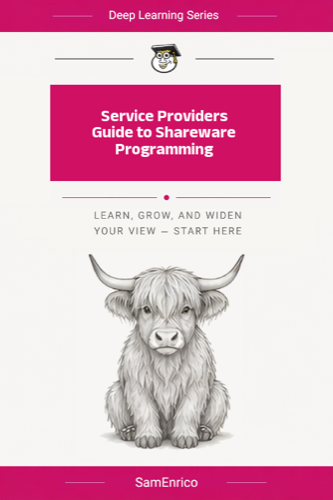
Non-FictionInformativeEducational
Service Providers Guide to Shareware Programming eBook
This publication, published by SamEnrico, covers S
This publication, published by SamEnrico, covers Service Providers Guide to Shareware Programming
Formats
Free sample
Chapter 1: The Honor Economy--–- The email arrived at 2:47 AM on a Tuesday. Subject line: "Your software changed my life. Here's $5." No signature, no return address, just a Pay Pal notification from a username that looked like keyboard smash. The sender had downloaded a free utility you built over a weekend three years ago, used it to save hundreds of hours of manual work, and decided—completely voluntarily—to pay you something. Not because you locked features behind a paywall.
Not because you threatened to delete their data. But because your software made their life better, and they wanted to say thank you.This is not a fantasy. This is the honor system in action. And in an era of subscription fatigue, surveillance capitalism, and the creeping sensation that nobody owns anything anymore, the honor system is not just returning—it is becoming a competitive advantage for service providers who understand its mechanics.Welcome to the Honor Economy.The premise of this book is simple but counterintuitive: if you are a service provider—a consultant, an agency owner, a freelance developer, an IT professional—your most powerful marketing asset is not a sales pitch, a proposal template, or a Linked In connection request. It is a piece of software that solves a real problem, works reliably, and asks for nothing in return except the possibility that you might hire the person who built it.Traditional shareware sold software.
This book sells you.Before we dive into code, distribution, payment processing, or any of the tactical material that fills the remaining eleven chapters, we must establish a shared understanding of why this model works at all. Why would anyone pay for something they can get for free? Why would a consultant give away a tool that does the very thing clients normally pay them to do? And how does a business model born in the era of 2400 baud modems and floppy disks win in the age of artificial intelligence and cloud computing?The answers lie in three intersecting trends: the collapse of trust in traditional software pricing, the rediscovery of voluntary exchange as a relationship builder, and the unique position of service providers who can afford to give away tools because they sell outcomes, not executables.The Collapse of Trust: Why the Subscription Era Broke Something Fundamental Let us begin with a confession. The software industry spent the last fifteen years training users to hate them.It started innocently enough.
Adobe moved Creative Suite to the cloud. Microsoft followed with Office 365. Suddenly, software that you used to buy once and own forever became a monthly line item on your credit card statement. The justification was reasonable enough: continuous updates, cloud storage, cross-platform synchronization. But the side effect was predictable and brutal.
Users began to feel like tenants in their own digital lives.You do not own your photo editor. You rent it. You do not own your word processor. You subscribe to it. And if you stop paying, not only do you lose access to future updates—you lose access to the files you created yesterday.
The software does not merely stop improving. It stops working entirely.This is the opposite of how physical tools work. If you buy a hammer, you own the hammer. It does not demand a monthly fee. It does not report your hammer usage patterns to a corporate server.
And when you put it in the toolbox, you do not worry that the manufacturer will remotely disable it because your credit card expired.The software industry forgot this. They optimized for recurring revenue at the expense of user trust. And now, a growing segment of users—including the very professionals who are your target audience for consulting services—are actively seeking alternatives. They want software that does not demand a subscription. They want tools that store data locally, not in someone else's cloud.
They want to pay once, or not at all, and they want the relationship with the developer to feel like a partnership rather than a hostage situation.This is where shareware makes its return.Shareware, in its original form, was the anti-subscription. You downloaded a program. You used it for as long as you wanted, with no time limits and no disabled features. If you found it useful, you sent the author a check. If you did not, you deleted it.
No strings, no automatic renewals, no dark patterns designed to make cancellation difficult.The honor system worked because it respected the user. And respect, it turns out, is a powerful marketing force.The Three Models of the Honor Economy Throughout this book, we will refer to three distinct business models. They are not interchangeable. Choosing the wrong model for your situation is the fastest way to fail. But understanding all three will help you select the path that aligns with your goals, your audience, and your tolerance for legal and financial complexity.Model A: The Pure Honor System In this model, the software is completely free.
No feature limitations. No time limits. No nag screens. No commercial-use restrictions. The user is never asked to pay for anything related to the software itself.
Instead, the developer includes a polite message somewhere unobtrusive: "If you find this software useful, please consider supporting its development with a donation." That is it.The Pure Honor System is the closest to the original shareware ethos of the 1980s and 1990s. It works best for developers who have low costs, high volume, and a community that values the software enough to voluntarily contribute. Win RAR, the file compression utility that practically every Windows user has encountered, still operates on this model decades after its release. Most users do not even realize they are supposed to pay. The ones who do pay are evangelists—loyal, vocal, and disproportionately valuable as word-of-mouth marketers.For service providers, the Pure Honor System is attractive because it requires no payment infrastructure, no license enforcement, and no legal paperwork.
The downside is that donation rates are typically below five percent. You cannot build a consulting business on donations alone. But you can use the software as a lead generation tool, collecting usage data (with explicit permission) and reaching out to power users with consulting offers.Model B: Freemium with Commercial Tiers This model makes a clear legal distinction between personal and commercial use. The software is free for individuals, hobbyists, and non-commercial projects. But if you are a business, a consultant, or any entity using the software for revenue-generating activities, you must purchase a license.Model B is not an honor system.
It is a legally enforceable licensing model. The software may not have technical locks preventing commercial use—many developers rely on the honor system even here—but the license agreement creates a legal obligation. For service providers selling to other businesses, this is often the most appropriate model because it aligns with the expectations of corporate purchasing departments.The advantage of Model B is that it captures value from the users who can most afford to pay while keeping the software accessible to the hobbyists and students who might become future customers. The disadvantage is that you need to actually enforce the license terms, which…
This is the end of the free sample. Get the eBook to keep going. Buy now
About this book
Details
- Author
- Martindale Glenn
- Publisher
- SamEnrico
- Language
- English
- Genre
- Non-Fiction, Informative, Educational
- Released
- 2026-06-02
- Pages (approx.)
- 136
- Available as
- eBook, Audiobook

Read better in the ZLOADR app
Your eBooks on your phone or tablet. Sign in with your SamEnrico account and start reading.
More by Martindale Glenn
 Sunk Cost Fallacy InfluenceMartindale Glenn$11.99
 Benzo Freedom Cognitive Repair HandbookMartindale Glenn$11.99
 Stress and Alzheimer's RiskMartindale Glenn$11.99
 Esophageal Cancer SurvivorMartindale Glenn$11.99
 Getting in and Out TubMartindale Glenn$11.99
 Russian Mafia in DenmarkMartindale Glenn$11.99
 Nobel Laureates in Climate ScienceMartindale Glenn$11.99
 Grief After Long IllnessMartindale Glenn$11.99
 The Price of Power: How Sweden’s Gold Bought the Great Northern WarMartindale Glenn$11.99
 Silent Ballots: The Phantom Voters of 1824Martindale Glenn$11.99
 How to Produce a Mangle (Machine)Martindale Glenn$11.99
 A Collector's Handbook to the Morgan Plus Four Super SportsMartindale Glenn$11.99
You may also like
 Hong Kong Handover 1997Dunn Johnnie$11.99
 Zumba For Postnatal Recovery CourseNeal Christian$11.99
 Zumba for BeginnersLadner Nikia$11.99
 YouTube Comment Mining GuideHumes Pandora$12.99
 Worry Box MeditationCarlin Rudy$11.99
 Workplace Stress MeditationNguyen Lynn$11.99
 Workplace Stress and Sleep RepairHawley Ivory$11.99
 Workplace Perfectionism CureDelaney Jeffry$11.99
 Workplace Injustice Anger GuideWallen Isabelle$11.99
 Work Addiction and Burnout LinkGreenwood Ester$11.99
 Women in Yoga and WellnessBeattie Galina$11.99
 Women in Stand Up ComedyChun Evangeline$11.99