
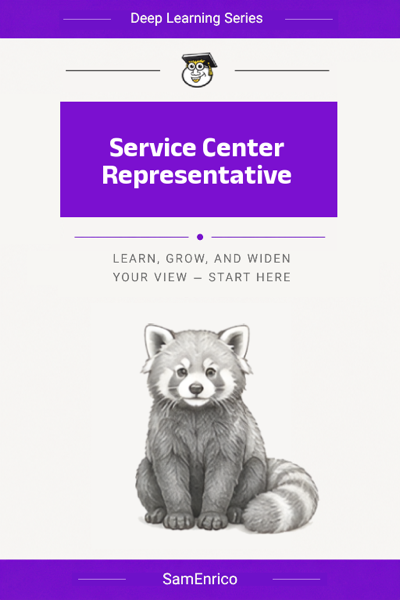
Non-FictionInformativeEducational
Service Center Representative eBook
A Coursebook on Service Center Representative
A Coursebook on Service Center Representative
Formats
Free sample
Chapter 1: The Identity Shift...--–- Every service center in the world is filled with two kinds of people. The first kind sits down at their workstation, puts on their headset, and waits to be told what to do. They follow the script that someone else wrote. They escalate anything that feels slightly uncomfortable. They watch the clock.
They count the minutes until break, then lunch, then quitting time. They are order-takers. And they are everywhere.The second kind is rarer. They sit down with a different posture—literally and figuratively. They lean toward the screen, not away from it.
They see the incoming call not as an interruption but as a puzzle. They listen for what is not being said. They take ownership of the problem, not because they have to, but because they have decided to. They are problem-solvers. And they are the ones who get promoted.This book is about becoming the second kind of person.Before we teach you a single phrase, before we walk you through a single system, before we show you how to navigate a difficult call or de-escalate an angry customer, we have to settle one question: Who are you going to be in this role?Most training manuals get this backward.
They start with the buttons to push, the software to learn, the metrics to hit. They assume that if you know what to do, you will know who to be. That is a lie. The opposite is true. Who you are determines what you do.
Your identity as a Service Professional—a Service Pro—comes first. The mechanics come second.This chapter is about that identity. It is about the fundamental choice you must make before you answer your first call or write your first email. It is about the difference between an Order-Taker and a Problem-Solver, and why that difference matters more than any script, any policy, or any metric your company will ever give you.The Great Divide: Order-Taker vs. Problem-Solver Let us be brutally honest with each other.
The service center industry has a reputation problem, and it has earned every bit of it. For decades, companies have treated service centers as cost centers—necessary evils to be minimized, outsourced, and automated. They have hired for compliance rather than creativity. They have measured speed over quality. They have written scripts so rigid that representatives sound like robots reading from a manual written by lawyers.And then they wonder why customers are angry.The Order-Taker is the product of this broken system.
The Order-Taker believes their job is to follow rules, not to solve problems. When a customer asks for something outside the script, the Order-Taker says, "That's not my job" or "I don't know" or "You'll have to call another department." The Order-Taker is technically correct—that specific situation might not be in their script—but technical correctness is not the same as good service. The Order-Taker hides behind policy. The Order-Taker escalates anything that requires a judgment call. The Order-Taker passes the buck.The Problem-Solver operates from a completely different set of assumptions.
The Problem-Solver believes their job is to help customers, regardless of where the fault originated. When a customer asks for something outside the script, the Problem-Solver says, "That's a great question; let me find out for you" or "I may need to connect you with someone, but I will stay on the line until we get an answer." The Problem-Solver sees policy as a guideline, not a prison. The Problem-Solver uses judgment. The Problem-Solver owns the resolution.Here is the uncomfortable truth that most service center managers will not tell you: your company's policies and scripts were written to protect the company, not to serve the customer. They were written by people who will never take a call.
They were written to minimize legal risk, to reduce average handle time, and to make the representative interchangeable. The Order-Taker follows these policies blindly. The Problem-Solver understands them, respects them, and then finds a way to help the customer within them—or advocates for changing them.Which one do you want to be?The Three Pillars of the Service Pro Based on occupational standards from organizations like O*NET and the International Customer Management Institute (ICMI), the role of a Service Center Representative rests on three core competencies. Every chapter in this book will build on these pillars. But here, we simply name them.Pillar One: Active Listening.
This is not the same as hearing. Hearing is passive. Listening is active. Active listening means you are not just waiting for your turn to speak. You are tracking what the customer is saying, what they are not saying, and what their emotional state is telling you.
You are listening for the problem behind the problem. The customer says, "My bill is too high." That is the symptom. The root cause might be that they do not understand their plan, that they were misquoted, that a promotion fell off, or that they are simply angry about something else entirely. Active listening gets you from symptom to root cause.Pillar Two: Critical Reasoning. This is the ability to analyze a situation, evaluate possible solutions, and make a judgment call without someone holding your hand.
Critical reasoning is what separates the Order-Taker from the Problem-Solver. When a customer presents an edge case—something the training manual did not cover—the Order-Taker freezes or escalates. The Problem-Solver thinks: What is the customer actually trying to accomplish? What are my available tools? What is a reasonable outcome?
Critical reasoning is not about knowing every answer. It is about knowing how to find the answer.Pillar Three: Administrative Support. This is the least glamorous pillar, but it is the one that will save you from chaos. Administrative support means documenting what happened, updating the customer's record, and creating a trail that the next representative can follow. It means typing notes that are actually useful—not "Customer called about bill" but "Customer disputed charge of $47.23 from 3/15.
Verified that product was returned on 3/20. Submitted credit request. Credit will appear in 3-5 business days. Customer confirmed understanding." Good administrative support is invisible when it is done well and disastrous when it is done poorly.These three pillars will appear in every chapter of this book. By the time you finish, you will not just know what they mean—you will have practiced them until they become automatic.Own the Resolution, Not the Blame One of the most common points of confusion for new representatives is the question of ownership.
How much should you take on? Where does your responsibility end and someone else's begin?Let us resolve this confusion right now, because it will come up again in later chapters—particularly when we discuss difficult customers and internal collaboration.Owning the resolution means you take responsibility for making sure the customer's problem gets solved, even if you did not cause it. If the shipping department lost a package, you did not lose it. But you can help track it, file a claim, or send a replacement. If billing made an error, you did not make it.
But you can correct it, credit the account, or explain what happened. Owning the resolution does not mean accepting blame.…
This is the end of the free sample. Get the eBook to keep going. Buy now
About this book
Details
- Author
- Westbrook Nestor
- Publisher
- SamEnrico
- Language
- English
- Genre
- Non-Fiction, Informative, Educational
- Released
- 2026-06-02
- Pages (approx.)
- 135
- Available as
- eBook, Audiobook

Read better in the ZLOADR app
Your eBooks on your phone or tablet. Sign in with your SamEnrico account and start reading.
More by Westbrook Nestor
 Vipassana for Chronic SufferingWestbrook Nestor$11.99
 Spin Class Interval Training HandbookWestbrook Nestor$11.99
 Homeowners Insurance Agency ListWestbrook Nestor$11.99
 Art Class For Older AdultsWestbrook Nestor$11.99
 Finding Your Tribe WorkbookWestbrook Nestor$11.99
 The Silent Codebreakers: The Women Who Cracked the NazisWestbrook Nestor$11.99
 Echoes in the Abyss: Australia’s Ancient Underwater Cave Art RevelationsWestbrook Nestor$11.99Echoes in the Abyss: Australia’s Ancient Underwater Cave Art RevelationsWestbrook Nestor$11.99
 CTA Penalty Avoidance GuideWestbrook Nestor$12.99
 Tableau Desktop SpecialistWestbrook Nestor$12.99
 Understanding Dermatoosteolysis Kirghizian TypeWestbrook Nestor$17.99
 Ultimate Handbook Guide to Suwon : (South Korea) Travel GuideWestbrook Nestor$11.99
You may also like
 Hong Kong Handover 1997Dunn Johnnie$11.99
 Zumba For Postnatal Recovery CourseNeal Christian$11.99
 Zumba for BeginnersLadner Nikia$11.99
 YouTube Comment Mining GuideHumes Pandora$12.99
 Worry Box MeditationCarlin Rudy$11.99
 Workplace Stress MeditationNguyen Lynn$11.99
 Workplace Stress and Sleep RepairHawley Ivory$11.99
 Workplace Perfectionism CureDelaney Jeffry$11.99
 Workplace Injustice Anger GuideWallen Isabelle$11.99
 Work Addiction and Burnout LinkGreenwood Ester$11.99
 Women in Yoga and WellnessBeattie Galina$11.99
 Women in Stand Up ComedyChun Evangeline$11.99