
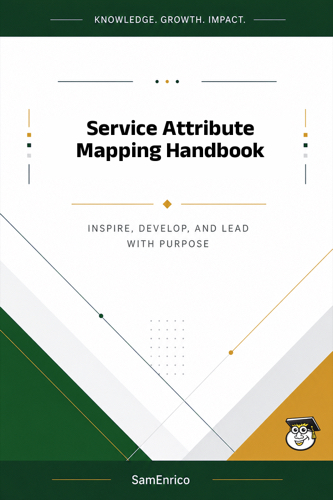
Non-FictionStrategic AtlasService Strategy
Service Attribute Mapping Handbook eBook
Build positioning maps for service industries usin
Build positioning maps for service industries using intangible attributes like responsiveness and empathy.
Formats
Free sample
Chapter 1: The Invisible Product--–- In 2019, a regional bank in the Midwest lost seventeen thousand customers in a single quarter. Their product was competitive. Their interest rates were among the best in the state. Their branches were clean, modern, and conveniently located. Their digital app had won a design award the previous year.
By every tangible measure, they were winning. But customers were leaving in droves, and the bank's leadership could not understand why. The exit surveys offered useless platitudes: "Just wanted a change." "Found better service elsewhere." "Didn't feel valued." The bank's chief marketing officer convened a task force, hired a consulting firm, and spent three months building sophisticated positioning maps based on price, branch density, and digital features. The maps showed they were in an ideal competitive position—a comfortable cluster of success with no immediate threats. And still, customers fled.The problem was not the maps.
The problem was what the maps could not see.Everything the bank had measured was tangible. Price is a number. Branch locations are dots on a map. Digital features are checklists. But customers were leaving because of things that have no numbers: how quickly a teller smiled, whether a phone agent sounded like they actually cared, the degree to which a loan officer remembered a conversation from three months ago.
These intangible attributes—responsiveness, empathy, assurance, reliability—are the actual currency of service relationships. And the bank was not mapping them. They were flying blind over the most important terrain of their business.This book exists because that bank's problem is your problem too. Whether you run a hospital, a software company, a law firm, a hotel chain, an airline, a logistics provider, or a government agency, you are competing on intangibles whether you realize it or not. And the tools you have been using to understand your competitive position were designed for a different era—one where products were physical, features were visible, and customers evaluated what they could see and touch.
That era is over. Welcome to the age of the invisible product.The Failure of Tangible Maps For decades, strategists have relied on a deceptively simple tool: the two-dimensional positioning map. Place price on one axis, quality on the other. Or convenience versus luxury. Or speed versus accuracy.
Plot your brand, plot your competitors, and look for gaps. The logic is seductive because it is visual. You can see where you stand. You can see where you are vulnerable. You can see the empty spaces waiting to be claimed.But this logic contains a fatal flaw when applied to services.
The flaw is not that positioning maps are useless—they are not. The flaw is that the attributes traditionally placed on those maps are almost always tangible, observable, and easily measured. Price is a fact. Speed is a stopwatch. Branch locations are addresses.
These are important variables, but they are not the variables that drive customer loyalty in service industries. They are table stakes. They get you into the game, but they do not help you win.Consider the last time you switched service providers. Perhaps you left a bank, an internet provider, a doctor, a hair stylist, an accountant, or a cleaning service. Ask yourself: was the primary reason for leaving something measurable, or something felt?
Most people switch not because the competitor's price was lower (though sometimes it is) but because they stopped feeling valued. A single rude interaction. A pattern of delayed responses. A sense that the provider no longer remembered who they were. These are not tangible attributes.
You cannot put them on a spreadsheet. But you can put them on a map—and that is what this book will teach you to do.The Service Difference: Three Inconvenient Truths Services are different from physical products in three fundamental ways, each of which breaks the traditional mapping approach. Understanding these differences is not academic philosophy. It is the prerequisite for building maps that actually work.The first difference is intangibility. You cannot try a service before you buy it.
You cannot inspect a haircut before the scissors touch your hair. You cannot test a consultant's advice before paying for the consultation. You cannot sample a hospital's bedside manner before checking in for surgery. This means that customers make decisions based on promises, signals, and past experiences—not on direct inspection. When you map tangible attributes, you are mapping what customers can verify after the fact.
When you map intangible attributes, you are mapping what customers must trust you to deliver.The second difference is heterogeneity. No two service encounters are identical. A hotel stay depends on which front desk agent is working, how much sleep they got, how many complaints they have already handled that day. A consulting engagement depends on which partner is assigned, what mood they are in, how well they remember the client's history. Unlike a factory producing identical widgets, a service organization produces unique, unrepeatable experiences every single time.
This means that your positioning map is not a map of your product—it is a map of your people, your processes, and your culture. And those are far harder to measure than widget dimensions.The third difference is the performer as product. In manufacturing, the product is separate from the person who made it. You do not care which factory worker assembled your toaster. In services, the employee is the product.
A rude flight attendant is not a problem with the airplane—it is a problem with the service itself. The smile, the tone of voice, the willingness to solve a problem—these are not decorations on top of the service. They are the service. When you map a service, you are mapping human behavior. And human behavior is messy, variable, and profoundly difficult to reduce to simple coordinates.These three differences are why traditional mapping fails.
They are also why this book exists. You cannot solve the intangibility problem by ignoring it. You cannot wish away heterogeneity. You cannot pretend that employees are interchangeable. You need new tools, new data sources, and new ways of thinking about competitive position.
That is what the Service Attribute Mapping Handbook provides.The Four Intangible Pillars Before we build a single map, we need a shared vocabulary. This book organizes service intangibles into a hierarchy, but at the center of that hierarchy are four pillars that appear in every service industry, from luxury hotels to budget airlines, from brain surgery to gutter cleaning. These four pillars are the foundation of every service positioning map you will build. Master these, and you can map any service. Ignore them, and your maps will miss the entire point.Responsiveness is the willingness to help customers promptly and the agility to adapt when situations change.
Notice the two components here. Speed matters, but speed without willingness feels robotic. A chat bot that answers in 0.3 seconds but cannot solve a novel problem is responsive in the first sense but not the second. True responsiveness combines quick reaction time with flexible problem-solving. It is the difference between a hotel that answers the phone on the first ring but says "that is not my department" versus one that answers…
This is the end of the free sample. Get the eBook to keep going. Buy now
About this book
Details
- Author
- Devries Janette
- Publisher
- SamEnrico
- Language
- English
- Genre
- Non-Fiction, Strategic Atlas, Service Strategy
- Released
- 2026-06-08
- Pages (approx.)
- 156
- Available as
- eBook, Audiobook

Read better in the ZLOADR app
Your eBooks on your phone or tablet. Sign in with your SamEnrico account and start reading.
More by Devries Janette
 Outsourcing for Tech StartupsDevries Janette$11.99
 Men's Family History Heart StrategyDevries Janette$11.99
 Marketing Plan Integration GuideDevries Janette$11.99
 Decluttering for Profit PlaybookDevries Janette$11.99
 The Day the Internet Almost Broke: The Great DDoS of 2016Devries Janette$11.99
 India Vendor Management GuideDevries Janette$12.99
 Ash and Ashes: The Forgotten Eruption That Reshaped the WorldDevries Janette$11.99
 Understanding Chromosome 11q Partial DeletionDevries Janette$17.99
 Spray PainterDevries Janette$11.99
 DTC Brand Retention GuideDevries Janette$12.99
 How to Become a Transportation AgentDevries Janette$11.99
You may also like
 Hong Kong Handover 1997Dunn Johnnie$11.99
 Zumba For Postnatal Recovery CourseNeal Christian$11.99
 Zumba for BeginnersLadner Nikia$11.99
 YouTube Comment Mining GuideHumes Pandora$12.99
 Worry Box MeditationCarlin Rudy$11.99
 Workplace Stress MeditationNguyen Lynn$11.99
 Workplace Stress and Sleep RepairHawley Ivory$11.99
 Workplace Perfectionism CureDelaney Jeffry$11.99
 Workplace Injustice Anger GuideWallen Isabelle$11.99
 Work Addiction and Burnout LinkGreenwood Ester$11.99
 Women in Yoga and WellnessBeattie Galina$11.99
 Women in Stand Up ComedyChun Evangeline$11.99