
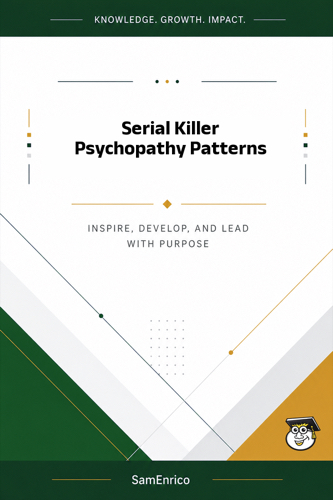
Non-FictionTrue CrimeSerial Murder
Serial Killer Psychopathy Patterns eBook
Identify common traits in organized and disorganiz
Identify common traits in organized and disorganized murderers.
Formats
Free sample
Chapter 1: The Bloody Divide...–– The first body was found face-down in a drainage ditch on a Tuesday. The second was discovered three days later, posed on a bed in a motel room twenty miles away. To the patrol officers who responded to both scenes, the cases seemed unrelated. Different jurisdictions. Different methods.
Different victims. But the man who would eventually connect them—a behavioral analyst named Robert Ressler—saw something the uniforms missed. Not in the evidence. In the absence of evidence.The first scene was a storm. Blood spatter on three walls.
The victim’s face obscured by a pillow, as if the killer could not bear to be seen. The murder weapon—a kitchen knife, later determined to belong to the victim—left in the sink, washed but still detectable. Fingerprints on the refrigerator door. A neighbor who heard screaming but assumed it was a domestic dispute. Everything about this scene screamed chaos, impulsivity, a mind unmoored from planning or self-control.The second scene was a cathedral.
The victim was naked but clean, positioned with hands folded across her chest. No ligature marks on the wrists, indicating she had not been restrained—or that the restraints had been removed before death. No semen. No weapon. The room had been wiped down with bleach.
The motel clerk remembered a man who paid in cash, smiled, asked about the weather, and left no registration card. He was described as “polite” and “normal.” No one saw his car. No one heard a sound.Two scenes. Two killers. Two entirely different psychological universes.The first was the work of a Disorganized offender—driven by psychosis, panic, and an internal chaos he could not control.
The second was the signature of an Organized predator—methodical, ritualistic, and hidden behind a mask of sanity so convincing that he had attended a church breakfast the morning after the murder.This book is about the space between those two scenes. It is about the classification system that the FBI built to understand killers like these—and about the limitations of that system when confronted with killers like Jeffrey Dahmer, who planned with the precision of an architect but killed with the frenzy of a wild animal. It is about the difference between what a killer has to do and what a killer wants to do, between the mask worn to hunt and the mask worn to hide, between the control that defines the Organized mind and the chaos that consumes the Disorganized one.But before we can understand the exceptions, we must master the rule. And the rule begins with thirty-six men in prison, two FBI agents with a tape recorder, and a question that had never been asked before: What does the crime scene tell us about the killer’s childhood?The Birth of an Idea In 1978, the Behavioral Science Unit at the FBI Academy in Quantico, Virginia, was not yet the legendary institution depicted in Hollywood thrillers. It was a small office staffed by a handful of agents who taught hostage negotiation and police psychology to local law enforcement.
Serial murder was not a recognized category of crime. There was no national database for tracking homicides across jurisdictions. When a body turned up in one county and another body turned up fifty miles away, the two investigations rarely communicated. And when they did, they had no shared language for describing what they were seeing.John E. Douglas and Robert K.
Ressler changed that. Both men had come to the BSU through unconventional paths. Douglas had been a hostage negotiator in the field, frustrated by the lack of psychological tools available to investigators. Ressler had a background in military criminology and a restless curiosity about the minds of the most violent offenders. Together, they proposed something radical: they would go into maximum-security prisons, sit face-to-face with convicted serial murderers, and ask them to explain, in their own words, how they thought, how they planned, how they selected victims, and how they felt before, during, and after the kill.The project was nearly rejected.
The FBI’s leadership was skeptical. What could a killer possibly teach an agent? Wasn’t the point of law enforcement to catch criminals, not to interview them like anthropologists studying a tribe? But Douglas and Ressler persisted, and in 1979 they conducted their first interviews at a prison in Pennsylvania. Over the next six years, they interviewed thirty-six sexual murderers—thirty-five men and one woman—including Ted Bundy, John Wayne Gacy, Ed Kemper, and Henry Lee Lucas.
The interviews were structured but open-ended, lasting anywhere from six hours to three days. Ressler would later describe the experience as “listening to monsters tell you how they became monsters, knowing that you could never unhear it.”What emerged from those interviews was not merely a collection of case studies. It was a classification system—a way of sorting offenders based on the observable characteristics of their crimes. The FBI divided these characteristics into two broad clusters, which they called Organized and Disorganized. The terms were not perfect.
They did not capture every nuance of every killer. But they did something more important: they gave investigators a shared vocabulary and a set of testable predictions.The Two Faces of Evil: A First Glance Before we dive into the specifics of each type, it is essential to understand what the Organized/Disorganized distinction is and what it is not.It is not a diagnostic tool. You cannot look at a crime scene, tick boxes on a checklist, and definitively conclude that the killer is one type or the other. Human behavior is messier than that. What the classification provides is a probability profile—a set of likely characteristics based on statistical patterns observed across dozens of confirmed cases.
When an investigator determines that a crime scene shows predominantly Organized features, they are not saying the killer must be socially adept, employed, and married. They are saying that, based on the data, those characteristics are more likely than the alternatives.It is not a moral judgment. The terms “Organized” and “Disorganized” describe behavior, not character. An Organized killer is not “better” or “smarter” than a Disorganized killer in any moral sense. He is simply better at not getting caught.
That distinction is tactical, not ethical.It is not immutable. As we will explore in Chapter 4, killers can change over time. A Disorganized offender who learns from his mistakes can become more Organized with each subsequent crime. An Organized offender under the influence of drugs, alcohol, or escalating fantasy pressure can devolve into Disorganized behavior. The typology describes a moment in time—a snapshot of the killer’s psychology as it manifested at a particular crime scene.With those caveats in place, let us examine the two clusters in their ideal forms.The Organized Predator: The Architect of Murder The Organized killer is defined by three core characteristics: planning, control, and concealment.
These are not separate traits but interlocking components of a single psychological drive. The Organized killer plans because he cannot tolerate uncertainty. He controls because he cannot tolerate submission. He conceals because he cannot tolerate exposure.Consider the crime scene of an Organized offender. The victim was…
This is the end of the free sample. Get the eBook to keep going. Buy now
About this book
Details
- Author
- Thorne Hannelore
- Publisher
- SamEnrico
- Language
- English
- Genre
- Non-Fiction, True Crime, Serial Murder
- Released
- 2026-06-06
- Pages (approx.)
- 149
- Available as
- eBook, Audiobook

Read better in the ZLOADR app
Your eBooks on your phone or tablet. Sign in with your SamEnrico account and start reading.
More by Thorne Hannelore
 Managing Open Door Policy HandbookThorne Hannelore$11.99
 Female CEOs Corporate RiseThorne Hannelore$11.99
 Delegation for ADHDThorne Hannelore$11.99
 Saving And Debt AttitudesThorne Hannelore$11.99
 Meditation Habit GuideThorne Hannelore$11.99
 Step Four Moral InventoryThorne Hannelore$11.99
 Mindset For Lifelong LearningThorne Hannelore$11.99
 The Shadow Triads: Hong Kong's Underworld War of 1925Thorne Hannelore$11.99
 The Ghost of Fort Jesus: The Witchcraft and Espionage Trial of Mombasa (1875)Thorne Hannelore$11.99
 A Collector's Handbook to the Chevrolet Ad UniversalThorne Hannelore$11.99
 Bootcamp Specialization Depth GuideThorne Hannelore$12.99
 Rubric Based Prompt GuideThorne Hannelore$12.99
You may also like
 Hong Kong Handover 1997Dunn Johnnie$11.99
 Zumba For Postnatal Recovery CourseNeal Christian$11.99
 Zumba for BeginnersLadner Nikia$11.99
 YouTube Comment Mining GuideHumes Pandora$12.99
 Worry Box MeditationCarlin Rudy$11.99
 Workplace Stress MeditationNguyen Lynn$11.99
 Workplace Stress and Sleep RepairHawley Ivory$11.99
 Workplace Perfectionism CureDelaney Jeffry$11.99
 Workplace Injustice Anger GuideWallen Isabelle$11.99
 Work Addiction and Burnout LinkGreenwood Ester$11.99
 Women in Yoga and WellnessBeattie Galina$11.99
 Women in Stand Up ComedyChun Evangeline$11.99