

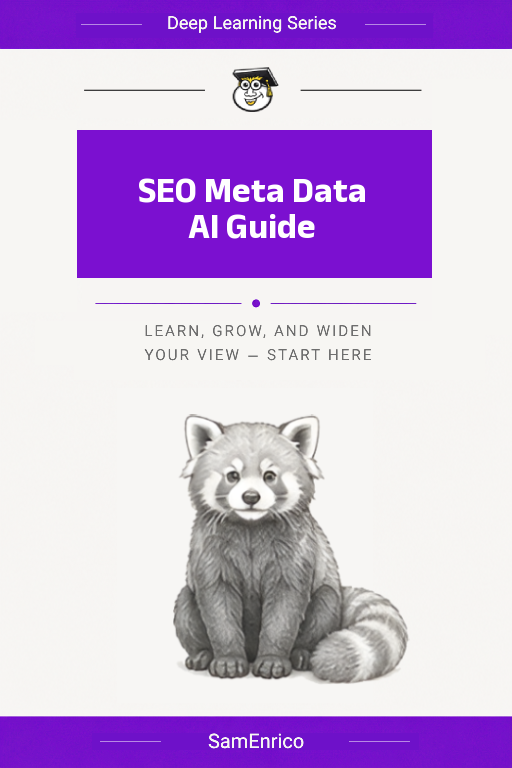
SEO Meta Data AI Guide eBook
Generate title tags meta descriptions and alt text
Generate title tags meta descriptions and alt text using generative AI for marketing content.
Formats
Free sample
Chapter 1: The Click That Never Came--When Sarah, the head of content for a mid-sized e-commerce brand, checked her analytics on a Tuesday morning in late 2024, she saw something that made her coffee go cold. Her organic traffic had dropped thirty percent overnight. There was no algorithm update announcement. No manual penalty. No technical glitch.
Her titles were perfectly optimized. Her meta descriptions were under 160 characters. Her alt text was pristine. Everything the SEO books had taught her was still in place. And yet, the traffic was gone.She did what any rational marketer would do.
She panicked. Then she opened Chat GPT and asked a simple question: “What are the best running shoes for flat feet?” The answer appeared instantly. Not a list of links. Not ten blue results to scroll through. A complete, well-formatted paragraph naming three specific shoe models, why they worked for flat feet, and where to buy them.
Sarah scrolled to the bottom of the response. Her brand wasn’t cited. Her competitor was. Not because her competitor had better SEO—but because something had fundamentally changed about how people find answers online.That morning, Sarah became one of the first marketers to discover a truth that would reshape the entire search industry. The era of ranking was ending.
The era of being cited had begun.The Invisible Earthquake For more than two decades, search engine optimization followed a relatively stable playbook. You researched keywords. You optimized title tags and meta descriptions. You built backlinks. You published content.
Google’s crawler visited your site, indexed your pages, and ranked them based on hundreds of factors. When a user typed a query, you competed for position one, two, or three. Click-through rates followed predictable curves. The rules were complex but knowable. The game was hard but fair.That world no longer exists.What Sarah experienced is not an anomaly.
It is the leading edge of a structural shift that is fundamentally changing how content gets discovered, consumed, and attributed. Generative AI—large language models like Chat GPT, Google’s Gemini, Anthropic’s Claude, and Perplexity—has introduced a new kind of information retrieval system. These systems do not simply list links. They synthesize answers. They read thousands of pages, extract facts, and generate original responses that often satisfy the user’s question without a single click.The term for this shift is Generative Engine Optimization (GEO) .
It is the practice of optimizing content not just to rank in traditional search results, but to be cited as a source within AI-generated answers. And it requires a completely different mindset from traditional SEO.Here is the difference in plain terms. Traditional SEO asks: “How do I get my link to appear first?” GEO asks: “How do I get my facts to appear inside the AI’s answer?” One is about ranking. The other is about citation. One sends users to your website.
The other sends your reputation into the world whether users click or not.This chapter is not a eulogy for search engines. Google is not dying. Bing is not disappearing. Billions of searches still happen every day on traditional result pages. But the center of gravity is moving.
According to multiple industry studies, nearly twenty-five percent of all informational queries are now answered—not just asked—on AI platforms. For younger users, that number approaches forty percent. And the trend lines point in only one direction.If you are a marketer, a content strategist, a business owner, or an SEO professional, you have two choices. You can ignore this shift and continue optimizing for a world that is shrinking. Or you can learn the new rules and position your content to win citations, not just rankings.This book exists to help you make that second choice.
But before we get to the tactics, the prompts, and the workflows, you need to understand exactly what has changed and why your old metadata habits are actively hurting you.The Anatomy of an AI Answer To understand why metadata matters more than ever in the AI era, you must first understand how large language models retrieve and generate information. This is not an abstract technical exercise. It is the foundation of every strategy in this book.When you type a question into Chat GPT or Perplexity, the model does not search the live internet in real time (unless you have specifically enabled web browsing). Instead, it relies on a vast internal representation of knowledge—patterns, facts, and relationships extracted from billions of web pages, books, and documents during its training phase. This is why a model can answer questions about events that happened before its training cutoff date without ever leaving its servers.But there is a second mode that is becoming increasingly common: retrieval-augmented generation (RAG) .
In RAG, the model performs a live search, retrieves relevant documents, and then generates an answer based specifically on those retrieved sources. This is how tools like Perplexity, Microsoft Copilot, and Google’s AI Overviews work. When you use these tools, the model is effectively reading your website in real time—or at least reading cached versions of it.Here is the critical insight. In both modes—pure generation and RAG—the model relies on metadata to make split-second decisions about relevance, trust, and authority. It does not read your beautiful design.
It does not watch your embedded video. It does not interact with your Java Script menu. It reads text. Specifically, it reads title tags, meta descriptions, heading structures, alt text, and structured data. If those elements do not clearly and accurately summarize your content, the AI will either ignore you or—worse—misinterpret you.Consider what happens inside a RAG pipeline.
The user asks: “What is the best time of year to visit Japan?” The model retrieves the top twenty or thirty documents from its index. It has milliseconds to decide which documents are relevant. How does it decide? It reads the titles and meta descriptions. If your title says “Tokyo Travel Guide 2025” and your meta description says “Budget tips for cherry blossom season,” the model will likely retrieve your page.
If your title says “Welcome to Our Travel Blog” and your meta description says “Click here for more,” the model will skip you entirely. It is that fast. It is that ruthless.This is why the old advice about character counts is not just outdated—it is actively counterproductive. Counting characters without considering semantic meaning is like measuring a novel by its page count while ignoring the plot. The AI does not care if your meta description is 156 characters or 164 characters.
It cares whether those characters accurately describe the page, match the query intent, and provide enough context for the model to trust the content.The Zero-Click Reality Let us confront an uncomfortable truth. Even if you do everything right—even if your titles are perfect, your descriptions are compelling, and your content is authoritative—many users will never visit your website. The AI will give them the answer directly. This is called the zero-click future, and it is already here.In traditional SEO, a zero-click search was generally considered a failure. You wanted the user to click.
That click was the goal. In the AI era, a zero-click search can still deliver value—but only if your brand…
This is the end of the free sample. Get the eBook to keep going. Buy now
About this book
Details
- Author
- Schmid Vaughn
- Publisher
- SamEnrico
- Language
- English
- Genre
- Non-Fiction, AI Operator, SEO
- Released
- 2026-06-02
- Pages (approx.)
- 154
- Available as
- eBook, Audiobook

Read better in the ZLOADR app
Your eBooks on your phone or tablet. Sign in with your SamEnrico account and start reading.
More by Schmid Vaughn
 Detecting Lies Through Body LanguageSchmid Vaughn$11.99
 Ethnic Diversity In Wellness MarketSchmid Vaughn$11.99
 Teen Self Esteem in LGBTQ YouthSchmid Vaughn$11.99
 Surviving Toxic WorkplacesSchmid Vaughn$11.99
 The Thai Eastern Corridor Talent ImportSchmid Vaughn$11.99
 Whispers of the Iron Phoenix: The Untold Mentorship of Sun TzuSchmid Vaughn$11.99
 Understanding Microcephaly MSchmid Vaughn$17.99
 How to Start a Building Completion Work Business (Beginners Guide)Schmid Vaughn$11.99
 Green Hydrogen Investment GuideSchmid Vaughn$12.99
 Youth WorkerSchmid Vaughn$11.99
You may also like
 Hong Kong Handover 1997Dunn Johnnie$11.99
 Zumba For Postnatal Recovery CourseNeal Christian$11.99
 Zumba for BeginnersLadner Nikia$11.99
 YouTube Comment Mining GuideHumes Pandora$12.99
 Worry Box MeditationCarlin Rudy$11.99
 Workplace Stress MeditationNguyen Lynn$11.99
 Workplace Stress and Sleep RepairHawley Ivory$11.99
 Workplace Perfectionism CureDelaney Jeffry$11.99
 Workplace Injustice Anger GuideWallen Isabelle$11.99
 Work Addiction and Burnout LinkGreenwood Ester$11.99
 Women in Yoga and WellnessBeattie Galina$11.99
 Women in Stand Up ComedyChun Evangeline$11.99